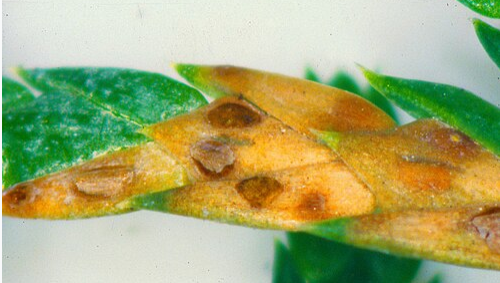
Cedar leaf blight mites is a descriptive name sometimes used for mites associated with yellowing, bronzing, or blight-like foliage on cedar trees and related ornamental conifers. It is not the accepted common name of one particular mite species. In the United States, the mite most often responsible for this type of injury is the spruce spider mite, Oligonychus ununguis.
Despite its common name, the spruce spider mite feeds on many conifers besides spruce. Hosts include true cedars, junipers, arborvitae, hemlocks, firs, false cypress, and several pines. Junipers can also be affected by specialized eriophyid mites, such as the juniper tip dwarf mite, Trisetacus juniperinus. Correct identification is important because mite feeding can resemble fungal tip blight, winter injury, drought stress, root problems, or normal shedding of older foliage.
Taxonomy and Classification
- Primary species: Oligonychus ununguis
- Common name: Spruce spider mite
- Class: Arachnida
- Order: Trombidiformes
- Family: Tetranychidae
- Genus: Oligonychus
Spider mites are arachnids and are more closely related to ticks and spiders than to insects. Mature mites and nymphs have eight legs, while newly hatched larvae have six. Eriophyid mites form a separate group of extremely small, elongated mites with only two pairs of legs throughout their active stages.
What Is Considered a Cedar?
The common name “cedar” is applied to several unrelated groups of conifers. True cedars belong to the genus Cedrus and include Atlas, deodar, and cedar of Lebanon. Eastern red cedar is actually a juniper, Juniperus virginiana, while northern white cedar is an arborvitae, Thuja occidentalis. These distinctions matter because susceptibility to mites, diseases, and environmental damage differs among plant genera and cultivars.
Spruce spider mites can feed on plants in all three groups, making them a reasonable first suspect when fine stippling, bronzing, and webbing occur. Nevertheless, visible symptoms alone do not prove that mites are responsible.
Identification
Spruce spider mites are extremely small, typically measuring around 1/50 inch long. Adults range from dark green or brown to reddish-brown and may appear almost black without magnification. Their rounded eggs are placed around bud scales, bark crevices, and the bases of needles or scale-like leaves.
Because individual mites are difficult to see on the plant, inspect suspicious foliage with the white-paper test. Hold a clean sheet of white paper beneath a branch and strike or shake the branch sharply. Spider mites appear as tiny moving specks. Smearing one across the paper may leave a greenish or brown streak. Stationary grains may instead be dirt, pollen, debris, or mite eggs.
Fine silk webbing between foliage scales, needles, and small twigs can support a spider mite diagnosis. However, webbing may be sparse during an early infestation. Predatory mites and other small beneficial arthropods may also fall onto the paper, so an Extension office or plant diagnostic laboratory can help confirm uncertain specimens.
Distribution and Habitat
Spruce spider mites occur widely across North America wherever susceptible conifers are grown. They affect landscape hedges, foundation plantings, windbreaks, nurseries, Christmas tree plantings, and ornamental specimens. Closely spaced or repeatedly sheared cedars may develop dense foliage that shelters mites from rain and makes inspection difficult.
Damage is often most noticeable on inner branches and portions of the canopy protected from direct rainfall. Dusty sites, reflected heat, drought stress, restricted root zones, and previous pesticide applications can contribute to outbreaks. Broad-spectrum insecticides may eliminate predatory mites and insects that normally suppress pest populations.
Life Cycle and Seasonal Activity
Spruce spider mites pass through egg, larval, nymphal, and adult stages. They usually overwinter as eggs attached to bark, buds, and foliage. Eggs hatch when favorable conditions return, and several generations may develop during one growing season.
Unlike twospotted spider mites, which are usually most troublesome during hot summer weather, spruce spider mites are primarily cool-season pests. Populations often increase in spring and again during fall. Activity may decline during sustained summer heat, although local conditions and weather patterns can alter the timing.
Generations overlap, so eggs, larvae, nymphs, and adults may occur together. This is one reason a single treatment may not eliminate an established population. Monitoring is more reliable than treating according to a fixed calendar.
Feeding Damage
Spider mites use piercing mouthparts to remove the contents of individual plant cells. Each feeding site becomes a tiny pale fleck. As injury accumulates, cedar foliage develops a mottled, gray-green, yellow, bronze, or rusty appearance. Heavily damaged foliage may turn brown and drop prematurely.
Once plant cells have been destroyed, damaged foliage does not return to its original green color. Successful control prevents additional injury, but the appearance of the plant improves only as healthy new growth develops and damaged foliage is replaced. Severe or repeated infestations can thin branches, reduce plant vigor, and contribute to dieback, especially when the cedar is already stressed.
Juniper tip dwarf mites produce somewhat different symptoms. They feed inside or around juniper buds, causing stunted shoots, distorted new growth, clustered foliage, or dead buds. These mites are too small for a standard paper test to detect reliably and usually require substantial magnification.
Mite Damage Versus Cedar Blight
True cedar and juniper blights are diseases caused by fungi rather than mites. Phomopsis and Kabatina tip blights can kill sections of new growth, while Cercospora blight often begins on older foliage in the lower or inner canopy. Disease symptoms may include distinct dead shoot tips, lesions where living and dead tissue meet, or fruiting structures visible under magnification.
- Spider mites: Fine pale stippling, gradual bronzing, possible silk webbing, and live mites detected by tapping branches over white paper
- Tip blight: Distinct sections of dead shoot growth, sometimes with lesions or fungal structures and no active mites
- Winter injury: Browning concentrated on exposed sides or above the snow line, often appearing in late winter or spring
- Drought stress: Generalized browning associated with dry soil, heat, or root limitations
- Root decline: Whole branches or plants may fade and die, often in compacted or poorly drained soil
- Normal shedding: Older interior foliage yellows or browns while branch tips remain healthy and green
A treatment for mites will not cure fungal blight, winter burn, or root rot. Confirming active mites before applying a pesticide avoids unnecessary expense and protects beneficial organisms.
Monitoring Cedar Mites
Inspect susceptible cedars in early spring and continue monitoring during cool periods. Test branches from several parts of the plant because mites may be concentrated in protected interior foliage. Record where mites are detected and compare their abundance during later inspections.
Examine new growth as well as previously damaged sections. Brown foliage may represent an old infestation that is no longer active. Treatment should be based on living mites, viable overwintering eggs, and continuing injury rather than discoloration alone.
Management and Control
Support Plant Health
Provide deep watering during dry periods while avoiding constantly saturated soil. Apply mulch over the root zone to conserve moisture, but keep it several inches away from trunks and stems. Avoid excessive nitrogen fertilization, which can produce soft growth attractive to certain pests. Select cedar species suited to the site’s climate, drainage, sunlight, and available root space.
Use Water and Pruning
A firm stream of water can dislodge mites from accessible foliage and reduce dusty conditions. Direct the spray into interior branches without damaging the plant. Repeat as needed while monitoring the population. Prune out dead branches because brown foliage will not recover, but avoid removing large amounts of living tissue from already stressed plants.
Protect Natural Enemies
Predatory mites, minute pirate bugs, lacewing larvae, lady beetles, and other natural enemies help control spider mites. Avoid routine use of broad-spectrum insecticides, particularly when mites have not been confirmed. Some insecticides do not control mites and can make an outbreak worse by killing their predators.
Horticultural Oils and Insecticidal Soaps
Horticultural oils and insecticidal soaps can suppress active mites when products are labeled for the plant and site. These materials work through direct contact, so thorough coverage is necessary. They provide little residual control and may require repeat applications.
Some conifers are sensitive to oil or soap sprays, especially during temperature extremes, drought stress, or periods of tender new growth. Oils may also alter the blue coloration of certain ornamental conifers. Test a small section first, follow the label exactly, and allow time to check for plant injury before treating the entire hedge or tree.
Miticides
A labeled miticide may be appropriate when damaging populations remain active despite cultural controls. Products differ in which life stages they affect, and some do not kill eggs. Large trees, dense hedges, or recurring infestations may require treatment by a licensed landscape professional. Rotate modes of action where repeated applications are permitted to reduce the risk of resistance.
Never apply a pesticide merely because cedar foliage is brown. Verify the pest, choose a product specifically labeled for mites and the treatment site, protect pollinators and natural enemies, and observe all environmental restrictions.
Conclusion
Cedar leaf blight mites are not one formally recognized species. The name most often describes spruce spider mites or, less commonly, specialized mites producing blight-like symptoms on cedar, juniper, or arborvitae. Fine stippling, bronzing, webbing, and moving mites on a white-paper test support a spider mite diagnosis. Accurate identification, proper watering, conservation of predators, physical removal, and carefully selected treatments provide more reliable control than automatically treating every brown cedar for mites.