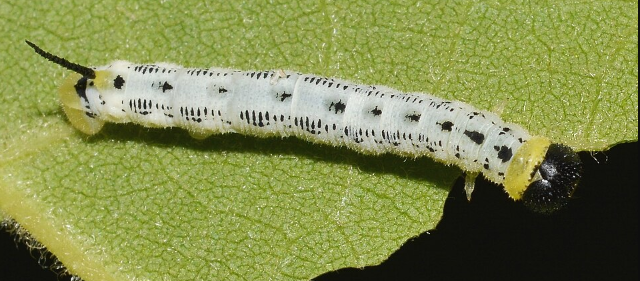
Catalpa sphinx caterpillars are large, leaf-feeding hornworms found almost exclusively on catalpa trees. They are the larval stage of the catalpa sphinx moth (Ceratomia catalpae) and are commonly called catalpa worms. Large groups can rapidly consume catalpa foliage and may temporarily leave a tree almost completely bare.
Although their size and prominent black tail horn can appear threatening, catalpa sphinx caterpillars do not sting and are not dangerous to people or pets. Established catalpa trees usually recover from occasional defoliation, making chemical control unnecessary in many situations.
Taxonomy and Classification
- Common name: Catalpa sphinx caterpillar or catalpa worm
- Scientific name: Ceratomia catalpae
- Order: Lepidoptera
- Family: Sphingidae
- Genus: Ceratomia
- Type: Hornworm and defoliating caterpillar
- Primary hosts: Northern and southern catalpa trees
Catalpa sphinx caterpillars belong to the sphinx moth or hawk moth family. Caterpillars in this family are often called hornworms because many have a horn-like projection on the rear of the abdomen. The structure is used as a visual defense and is not a stinger.
Identification
Mature catalpa sphinx caterpillars may reach approximately 2.5 to 3 inches long. They have smooth bodies, black heads, and a conspicuous black horn extending from the rear. The caterpillars occur in both dark and pale color forms.
The dark form has a broad, velvety black stripe running along the back. Its sides are white, pale yellow, or yellowish-green and may be marked with black spots or short vertical bands. The underside is generally pale green.
Pale-form caterpillars may be light green, yellowish-green, or nearly white. They can have a row of dark spots along the back instead of a solid black stripe. Some pale individuals have very few black markings apart from the head and tail horn.
Young larvae are much smaller and may appear pale yellow or whitish with black markings. They frequently feed together in groups. Older caterpillars become more widely distributed across the tree as their food requirements increase.
Adult Catalpa Sphinx Moths
Adult catalpa sphinx moths are robust, grayish-brown moths with long, narrow forewings. Dark, wavy lines and streaks help the moths blend with tree bark. The hindwings are lighter and may have darker bands or shading.
The adults are primarily active at night and may be attracted to outdoor lights. Unlike many other sphinx moths, adult catalpa sphinx moths do not feed. Their adult stage is devoted mainly to mating and laying eggs.
Distribution and Habitat
Catalpa sphinx moths are native to the eastern United States and occur wherever suitable catalpa trees grow. Their range extends from parts of New England and southern Canada westward through the central states and south to Florida and Texas. Catalpa trees planted outside their original native range can also support the caterpillars.
Typical habitats include woodlands, riverbanks, parks, residential landscapes, roadsides, farms, and nurseries containing catalpa trees. Caterpillar abundance can vary considerably from year to year and even between neighboring trees.
Host Plants
Catalpa sphinx caterpillars are specialists that feed on trees in the genus Catalpa. Their primary hosts in the United States are the northern catalpa (Catalpa speciosa) and southern catalpa (Catalpa bignonioides).
The caterpillars are specially adapted to the defensive compounds produced by catalpa leaves. They can consume the foliage and retain certain plant chemicals that may make them less appealing to some predators. Their close relationship with catalpa trees is a natural part of eastern North American ecosystems.
Life Cycle
Catalpa sphinx moths undergo complete metamorphosis with egg, larval, pupal, and adult stages. The species commonly survives winter as a pupa several inches beneath the soil surface. Adult moths emerge during spring, mate, and begin laying eggs on new catalpa foliage.
Females deposit pale or translucent eggs in masses on the undersides of catalpa leaves. A single cluster may contain dozens or hundreds of eggs. After hatching, the young caterpillars begin feeding together and pass through five increasingly larger larval stages called instars.
Fully grown caterpillars leave the tree and crawl across the ground in search of suitable soil. They burrow below the surface and form dark brown pupae. Adult moths later emerge to begin another generation.
The number of generations varies by climate. Two generations are common across much of the central and eastern United States, while a partial third generation may occur during long, warm growing seasons. Later generations are often larger and may cause the most noticeable defoliation.
Feeding Damage
Young catalpa worms chew small sections from the surfaces or edges of leaves. As the caterpillars grow, their consumption increases dramatically. Older larvae can remove entire leaves, leaving only major veins, petioles, or bare branches.
Large populations may completely defoliate a catalpa tree within a short period. Caterpillars also produce conspicuous pellets of waste called frass. Frass may collect on sidewalks, vehicles, outdoor furniture, or plants beneath an infested tree.
A healthy, established catalpa can usually produce replacement foliage after a single defoliation event. The damage may look severe without causing permanent injury. However, repeated defoliation can reduce growth and place additional stress on young, recently transplanted, drought-stressed, or otherwise unhealthy trees.
Signs of Catalpa Sphinx Caterpillars
- Large caterpillars with black tail horns
- Black-striped or pale caterpillars on catalpa leaves
- Clusters of young larvae feeding together
- Irregular holes and missing sections of foliage
- Leaves eaten down to their major veins
- Large quantities of dark frass beneath the tree
- Bare branches during summer
- Gray-brown sphinx moths near outdoor lights
- Hornworms covered with clusters of white parasitoid cocoons
Natural Enemies
Catalpa sphinx caterpillar populations are influenced by birds, predatory bugs, spiders, diseases, and parasitic insects. Spined soldier bugs can attack and consume the caterpillars despite the hornworms’ large size.
One of the most important natural enemies is the small braconid wasp Cotesia congregata. A female wasp inserts eggs into a young caterpillar. The wasp larvae develop inside the hornworm before emerging and spinning numerous small, white silk cocoons on its body.
A caterpillar covered with white cocoons should be left in place. The white structures are not caterpillar eggs. They contain developing beneficial wasps that will emerge and attack additional hornworms. Removing or crushing these parasitized caterpillars can interfere with natural biological control.
Are Catalpa Worms Dangerous?
Catalpa sphinx caterpillars do not sting, bite aggressively, or possess venomous spines. The black horn at the rear is flexible and harmless. Sensitive people may still prefer to wear gloves when handling any caterpillar because contact with insect hairs, defensive chemicals, or plant material can occasionally irritate the skin.
The caterpillars are well known among anglers as fishing bait, particularly for catfish and bass. In some areas, catalpa trees have traditionally been planted specifically to produce a seasonal supply of catalpa worms.
Monitoring Catalpa Trees
Begin checking catalpa foliage after leaves develop in spring. Examine the undersides of leaves for egg masses and groups of small caterpillars. Early detection is important when protecting a young or recently transplanted tree.
Look for fresh chewing, skeletonized leaves, and frass beneath the canopy. Because populations can increase quickly, a tree with minor damage one week may have extensive defoliation the next. Determine the tree’s overall health before deciding whether intervention is necessary.
Management and Control
Tolerate Limited Feeding
Control is generally unnecessary on a healthy, mature catalpa. The tree and caterpillar are native ecological partners, and populations frequently decline because of predators, parasitoids, disease, or unfavorable weather. Even complete defoliation may be followed by a new flush of leaves.
Hand Removal
On small trees, egg masses and caterpillars can be removed by hand. Relocate the caterpillars to another catalpa if preserving them is desired. Do not move them to unrelated tree species because they require catalpa foliage to complete development.
Support Tree Health
Water stressed trees deeply during prolonged dry weather. Apply an appropriate layer of mulch over the root zone while keeping it away from direct contact with the trunk. Avoid unnecessary pruning or excessive fertilizer while the tree is recovering from defoliation.
Biological Insecticides
If treatment is necessary, products containing Bacillus thuringiensis var. kurstaki, commonly called Bt, may control young caterpillars when applied to foliage they are actively eating. Bt is less effective after caterpillars become large, so timing and thorough leaf coverage are important.
Any pesticide must be labeled for use on ornamental trees and caterpillars. Follow every direction concerning application rates, protective equipment, environmental precautions, and reapplication. Treating a mature tree may require professional equipment to obtain safe, effective coverage.
Conclusion
Catalpa sphinx caterpillars are large black, white, yellow, or green hornworms that feed specifically on catalpa trees. Their group feeding can strip a tree of foliage and produce substantial amounts of frass, but established catalpas usually recover. Monitoring young trees, conserving parasitoid wasps, hand-removing caterpillars, and maintaining tree health are generally sufficient. When control is necessary, early treatment of small larvae provides the best results.