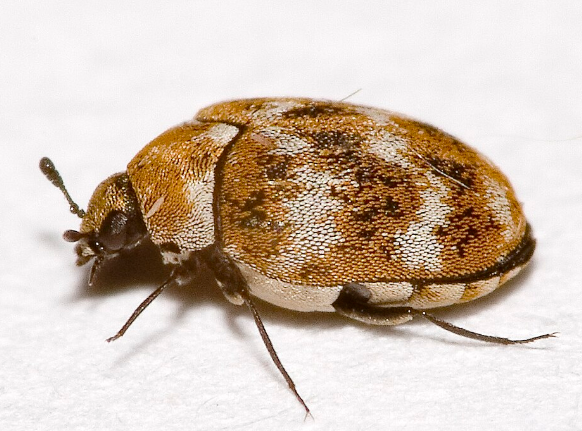
Carpet mite beetles is an informal name that usually refers to carpet beetles or their small, hairy larvae. Carpet beetles are insects, not mites. They belong to the beetle family Dermestidae and develop through egg, larval, pupal, and adult stages. Their larvae can damage wool carpets, clothing, upholstery, feathers, furs, stored foods, and other materials containing animal or plant products.
The mixed name probably developed because the larvae are extremely small, may be mistaken for moving specks, and often occur in household dust, lint, or carpet fibers. True mites have eight legs as adults and do not develop into beetles. Correctly identifying the pest is important because carpet beetles, dust mites, bird mites, clothes moths, fleas, and bed bugs require different management methods.
Taxonomy and Classification
- Class: Insecta
- Order: Coleoptera
- Family: Dermestidae
- Varied carpet beetle: Anthrenus verbasci
- Furniture carpet beetle: Anthrenus flavipes
- Common carpet beetle: Anthrenus scrophulariae
- Black carpet beetle: Attagenus unicolor
Dermestidae includes carpet beetles, hide beetles, larder beetles, warehouse beetles, and related scavengers. Different species favor different foods, but many can survive on dried animal material, dead insects, pet hair, feathers, wool, leather, and stored food products.
Identification
Adult Carpet Beetles
Most adult carpet beetles are approximately 1/10 to 3/16 inch long. They have hardened wing covers, six legs, short antennae, and rounded or elongated bodies. Adults are substantially larger and more structured than household mites, although their small size can still make identification difficult without magnification.
Adult varied carpet beetles are oval and patterned with irregular white, brown, yellow, and black scales. Furniture carpet beetles have a similarly mottled appearance but are usually rounder and may display white, yellow-orange, and black scales. The scales gradually wear away, making older beetles appear darker than newly emerged individuals.
Black carpet beetles are more elongated than Anthrenus species. Adults are shiny dark brown or black with brownish legs. Adult carpet beetles commonly appear on windowsills because they are attracted to light. Outdoors, many adults visit flowers and feed on pollen and nectar.
Carpet Beetle Larvae
The larva is the damaging stage. Carpet beetle larvae are small, segmented, brownish, and densely covered with hairs or bristles. Varied carpet beetle larvae have alternating light and dark bands and are broader toward the rear. When disturbed, mature larvae may raise tufts of specialized hairs.
Black carpet beetle larvae are elongated and carrot-shaped, tapering toward the rear. They range from light brown to nearly black and have a distinctive tuft of long hairs at the end of the abdomen. Shed larval skins resemble dry, hollow, bristly shells and are often the most noticeable evidence of an infestation.
Carpet Beetles Versus Mites
Carpet beetles and mites are different types of arthropods. An adult beetle has six legs, antennae, and hardened wing covers. Adult mites have eight legs, no wings, and no antennae. Many household mites are too small to identify without strong magnification.
- Carpet beetles: Hairy larvae, patterned or black adults, shed larval skins, and damage to natural-fiber materials
- Dust mites: Microscopic organisms associated with household dust that do not make holes in carpets or clothing
- Bird or rodent mites: Tiny mites associated with animal nests that may temporarily bite people
- Clothes moths: Pale caterpillars that produce silk, webbing, or portable cases while feeding
- Fleas: Dark, laterally flattened insects that jump and feed on blood
Carpet beetle larvae do not produce silken webbing. Brown, bristly cast skins combined with damaged natural fibers and an absence of silk strongly suggest carpet beetles rather than carpet moths.
Distribution and Habitat
Carpet beetles occur throughout the United States and are common in homes, apartments, warehouses, museums, schools, stores, and other buildings. Adult beetles can fly indoors through open windows, damaged screens, vents, and doors. They may also arrive on cut flowers or infested materials.
Larvae prefer dark, quiet locations where suitable food accumulates. Common hiding places include carpet edges, closets, floor cracks, air registers, upholstered furniture, attics, wall voids, stored clothing, and areas beneath heavy furniture. Old bird, bee, wasp, or rodent nests may support infestations because they contain hair, feathers, pollen, wax, and dead insects.
Life Cycle and Behavior
Female carpet beetles deposit eggs on or near suitable larval food. Eggs commonly hatch within several weeks under favorable indoor conditions. The larvae then feed and molt repeatedly, leaving recognizable cast skins behind.
The larval period may last several months to more than a year, depending on species, temperature, humidity, and food quality. Larvae avoid light and can travel considerable distances while searching for food or a place to pupate. This wandering behavior explains why larvae are sometimes found on walls or in rooms containing no obvious fabric damage.
After pupation, adults seek light and may gather around windows. Finding one adult near a window does not necessarily indicate a damaging infestation. Repeated adults, larvae, shed skins, or damaged materials justify a detailed inspection.
Food Sources and Damage
Carpet beetle larvae feed on dried organic materials rich in animal protein. Vulnerable items include wool carpets, rugs, sweaters, felt, silk, fur, leather, feathers, down-filled products, natural-bristle brushes, taxidermy mounts, and insect collections. They may also infest dry pet food, cereals, seeds, spices, and other stored products.
Larvae do not normally digest clean synthetic fibers. However, they may occur in synthetic carpets where pet hair, dead insects, food crumbs, skin flakes, or other organic debris has accumulated. Fabrics containing wool blends or food and perspiration stains are also vulnerable.
Damage may appear as irregular holes, surface grazing, missing carpet pile, or concentrated destruction in a concealed area. Carpet beetles tend to produce broader damaged patches, while clothes moth damage is often more scattered and accompanied by silk.
Do Carpet Beetles Bite?
Carpet beetles do not bite people or feed on blood. However, the specialized hairs on some larvae and shed skins can irritate sensitive individuals. Exposure may cause itching, red bumps, or a rash that resembles insect bites. Airborne hairs can occasionally irritate the eyes or respiratory tract.
A rash alone cannot confirm the presence of carpet beetles. Bed bugs, fleas, biting mites, contact dermatitis, and other medical conditions can produce similar symptoms. Persistent or severe skin, eye, or respiratory reactions should be evaluated by a healthcare professional while the building is inspected for physical pest evidence.
Inspection
Successful control begins with locating every larval food source. Examine carpet edges, rug undersides, closets, stored natural-fiber clothing, upholstery folds, pet bedding, air vents, baseboards, attics, and spaces beneath appliances or furniture. Look for live larvae, cast skins, fecal pellets, and damaged materials.
Check dry pet food and long-stored pantry products, especially when black carpet beetles are present. Inspect nearby bird or rodent nesting sites where this can be done safely and legally. Adults found around windows may have developed elsewhere, so spraying the window does not resolve the underlying infestation.
Management and Control
Vacuum and Remove Food Sources
Vacuum carpet edges, baseboards, floor cracks, closets, upholstered furniture, vents, and areas beneath heavy objects. Remove accumulations of lint, pet hair, dead insects, and old spider webs. Empty the vacuum immediately into a sealed bag and dispose of it outside the occupied area.
Discard severely infested low-value materials. Place contaminated food products in a sealed bag before removal. Clean shelves, cracks, and spilled material around the source rather than relying on a surface spray.
Treat and Protect Fabrics
Launder washable items in hot water when permitted by their care labels or have them professionally dry-cleaned. Clean articles before storage because perspiration and food residues make fabrics more attractive. Place pest-free woolens, furs, feathers, and other vulnerable items in airtight containers.
Controlled freezing can treat certain objects, but the entire item must remain sufficiently cold for an adequate period. Fragile, antique, or valuable materials should be evaluated by a textile conservator or pest-management specialist to prevent damage.
Exclusion and Monitoring
Repair damaged screens and seal gaps around doors, windows, and vents. Inspect cut flowers before bringing them indoors. Species-specific pheromone traps can help locate persistent infestations, but traps will not eliminate larvae feeding in concealed areas.
Pesticide Use
Insecticides are often unnecessary when infested materials and food sources are removed. Never spray clothing, bedding, toys, food, or food-contact surfaces unless the product label explicitly permits that use. General room spraying or fogging is unlikely to reach larvae hidden beneath carpets, inside furniture, or within wall voids.
A licensed pest-management professional may be needed for infestations involving inaccessible voids, valuable collections, extensive carpeting, multiple rooms, or concealed animal nests. Professional identification can also prevent carpet beetles from being confused with mites, bed bugs, or clothes moths.
Conclusion
Carpet mite beetles are more accurately called carpet beetles. Their hairy larvae—not the adults—damage natural-fiber fabrics, stored products, and dried animal materials. The most effective control combines source identification, thorough vacuuming, treatment of infested articles, protected storage, and exclusion. Confirming the pest before treatment is essential because carpet beetles are neither mites nor blood-feeding insects.