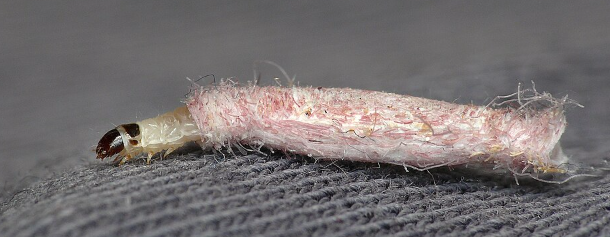
Case-bearing clothes moth larvae are fabric-damaging caterpillars produced by the case-bearing or casemaking clothes moth, Tinea pellionella. Each larva constructs a portable silken case from fibers taken from its food. It carries this case as it moves, extending its head and front legs from either end to feed.
The larvae can damage wool clothing, rugs, fur, feathers, taxidermy, natural-bristle brushes, and furnishings containing animal hair. Their portable cases and preference for dark, undisturbed locations make infestations easy to overlook. The adult moths do not damage fabrics; all feeding injury is caused by the larvae.
Taxonomy and Classification
- Kingdom: Animalia
- Phylum: Arthropoda
- Class: Insecta
- Order: Lepidoptera
- Family: Tineidae
- Genus: Tinea
- Species: Tinea pellionella
The common name is written in several ways, including case-bearing clothes moth, casemaking clothes moth, and case-making clothes moth. These names all refer to the larva’s habit of living inside a tube that it constructs and carries.
Larval Identification
The caterpillar is shiny white or cream-colored with a dark brown head capsule. Its soft body remains almost entirely concealed inside a narrow, cigar-shaped case. A mature case is usually about three-eighths inch long, although size varies with the larva’s age.
- White or cream-colored caterpillar
- Dark brown head
- Cylindrical, open-ended silken case
- Fabric fibers incorporated into the case
- Case color that frequently matches the damaged material
- Ability to feed from either end of the case
- Slow movement across fabrics, walls, or closet surfaces
The larva never voluntarily abandons its protective case. It enlarges the tube as it grows and retreats inside when disturbed. Because fibers from the infested material are woven into the silk, a larva feeding on a red sweater may have a reddish case, while one feeding on a gray rug may be difficult to see against the carpet.
An empty case does not always indicate an active infestation. It may contain an abandoned pupal skin or represent a larva that has died. Examine the case for movement or carefully inspect both open ends without damaging a valuable textile.
Adult Case-Bearing Clothes Moths
Adult moths are small, with a wingspan of approximately one-half inch. At rest, they are about one-quarter inch long. Their narrow, fringed wings are brownish or yellow-brown and commonly have several faint dark spots. Pale hairs cover the top of the head.
Clothes moths are weak fliers and generally avoid bright light. Instead of flying directly across a room toward lamps, they tend to flutter close to closets, rugs, furniture, and other infested materials. Adult sightings indicate that larvae may be developing nearby, but killing the visible moths will not eliminate concealed eggs and larvae.
Distribution and Indoor Habitat
Case-bearing clothes moths have a broad distribution and can survive inside heated buildings throughout the United States. Infestations may begin when an affected garment, rug, upholstered item, taxidermy specimen, or other animal-based material is brought indoors.
The larvae prefer dark, quiet, humid locations where fabrics remain undisturbed. Common hiding places include closet corners, folded clothing, storage boxes, carpet edges, the undersides of rugs, areas beneath furniture, upholstery crevices, heating vents, and spaces along baseboards.
Animal hair, feathers, dead insects, or abandoned bird and rodent nesting material can provide additional food. When clothing is not the source, inspect attics, chimneys, vents, wall voids, and other areas where animal materials may have accumulated.
What Do the Larvae Eat?
Case-bearing clothes moth larvae require animal-derived nutrients, particularly keratin. They most commonly attack wool and other materials containing animal hair or feathers.
- Wool clothing and blankets
- Wool carpets and area rugs
- Fur garments
- Feather-filled items
- Taxidermy mounts and animal hides
- Upholstery containing animal hair
- Natural-bristle brushes
- Wool felt, including felt used in musical instruments
- Animal-fiber craft supplies
- Fish meal and certain animal-based stored products
Pure cotton, linen, and synthetic fabrics do not normally provide an adequate diet. However, larvae may damage blended fabrics containing wool, feed where animal fibers or food residue are present, or use cotton and synthetic threads when constructing their cases.
Clothing stained with perspiration, body oils, urine, beverages, or food is especially attractive. These contaminants provide moisture and nutrients that may be limited in clean fibers. Washing or dry-cleaning garments before storage is therefore an important preventive measure.
Life Cycle
Case-bearing clothes moths undergo complete metamorphosis through egg, larval, pupal, and adult stages. A female normally attaches approximately 40 to 50 eggs to suitable fibers with an adhesive secretion. The eggs may hatch within four to ten days during warm weather.
New larvae begin feeding and quickly construct protective cases. Development is strongly influenced by temperature, humidity, and food quality. Under favorable conditions, the larval period may last several weeks. In cool conditions or on poor food, it can continue for many months and occasionally longer than a year.
A larva molts repeatedly and enlarges its case after each growth stage. When ready to pupate, it may move away from the feeding site and attach the case to a wall, ceiling, shelf, fabric surface, or protected crevice.
The pupal stage may require approximately eight to ten days during summer but can take several weeks under cooler conditions. Heated buildings allow development to continue during winter. Multiple life stages may be present at the same time.
Signs of an Infestation
Damage is usually concentrated in concealed areas rather than exposed portions of clothing. Inspect beneath collars, inside cuffs, along seams, within folds, under rug edges, and beneath furniture.
- Irregular holes in wool clothing or blankets
- Surface grazing that leaves thin or bare areas
- Cigar-shaped fiber cases attached to fabric
- Loose fibers or clipped fur
- Bare hide visible beneath damaged fur
- Small fecal pellets matching the color of the fabric
- Larval cases crawling on walls or closet shelves
- Small brown moths fluttering in dark storage areas
Fur damage may appear as loose patches because larvae cut hairs near their base. Wool rugs are often attacked underneath furniture or along edges where regular vacuuming does not reach.
Case-Bearing Clothes Moths vs. Similar Pests
Webbing Clothes Moth Larvae
Webbing clothes moth larvae, Tineola bisselliella, do not carry permanent portable cases. They create silken mats, feeding tubes, or patches of webbing directly on the material. Adult webbing clothes moths are generally more uniformly golden and lack the faint wing spots associated with case-bearing clothes moths.
Carpet Beetle Larvae
Carpet beetle larvae are brownish, hairy, and often have distinctive bristles or tail tufts. They do not live inside silken cases. Carpet beetles are more common than clothes moths in many U.S. homes.
Pantry Moth Larvae
Indianmeal moths and other pantry moths develop in cereal, grain, nuts, dried fruit, pet food, and similar products. Their adults are stronger fliers and are commonly seen around kitchens or lights. Finding moths indoors does not automatically mean clothing is infested.
Management and Control
Locate Every Infested Item
Control begins by locating the source. Remove all susceptible materials from the affected closet, room, or storage area. Inspect garments, rugs, fur, feathers, upholstered furniture, stored craft materials, taxidermy, natural-bristle items, and animal-based debris.
Examine seams, pockets, cuffs, folds, rug undersides, furniture crevices, and storage-box corners. Place confirmed or potentially infested items in sealed plastic bags until they can be cleaned or treated, preventing larvae from spreading.
Clean the Infested Area
Vacuum closet floors, shelves, baseboards, carpet edges, air registers, cracks, and areas beneath furniture. Immediately empty the vacuum into a sealed bag and place it in an outdoor trash container. Wash hard surfaces with soap and water after vacuuming.
Regular cleaning removes hair, lint, dead insects, eggs, larvae, and other material capable of supporting an infestation. Reduce indoor humidity where practical and inspect seldom-used storage areas periodically.
Treat Clothing and Fabrics
Dry cleaning kills eggs, larvae, and adults on suitable garments. Washable items can be laundered according to their care labels. Do not expose wool, silk, fur, or delicate textiles to high temperatures unless the manufacturer confirms that the treatment is safe.
Small nonwashable items that tolerate freezing can be sealed in plastic and placed in a freezer for approximately two weeks. Allow the sealed item to return to room temperature before opening the bag so condensation forms outside rather than on the textile. Valuable antiques, museum textiles, taxidermy, and delicate furnishings should be evaluated by a conservator or experienced pest-management professional.
Store Clean Items Properly
Only store clothing after it has been cleaned and confirmed pest-free. Use tightly sealed plastic containers, garment-storage systems, or bags that prevent adult moths from reaching the contents. Cardboard boxes and loosely closed bags do not provide dependable protection.
Cedar aroma alone is unreliable. A tightly constructed cedar chest can be helpful primarily because it excludes moths, not because the wood kills established larvae. Cedar oils lose strength over time and may not affect older caterpillars.
Use Pheromone Traps for Monitoring
Species-appropriate pheromone traps attract male clothes moths and can reveal continuing adult activity. Place them in closets and rooms containing susceptible materials. Traps are useful for detection and evaluating control but will not remove eggs, larvae, or mated females. They must be combined with inspection, cleaning, and treatment of infested objects.
Use Mothballs Safely
Mothballs are pesticides that release toxic gases. They may only be used according to their labels, typically inside airtight containers where vapors cannot escape into occupied rooms. Never scatter mothballs in closets, attics, gardens, or open living areas. Keep them away from children, pets, food, and food-preparation areas.
Professional Treatment
Professional assistance may be necessary when larvae have entered wall voids, extensive wool carpeting, furniture stuffing, taxidermy collections, or inaccessible structural spaces. Any insecticide must list clothes moths and the intended application site on its label. Spraying exposed clothing or entire rooms without locating the infestation is unlikely to provide lasting control.
Conclusion
Case-bearing clothes moth larvae are small fabric pests distinguished by the portable, fiber-covered cases they carry. They damage wool, fur, feathers, and other animal-derived materials while hiding in dark, undisturbed locations. Successful control depends on finding every infested item, cleaning the surrounding area, treating affected fabrics, and storing clean materials in airtight containers. Pheromone traps can support monitoring, while pesticides should be reserved for situations where physical cleaning and object treatment are insufficient.