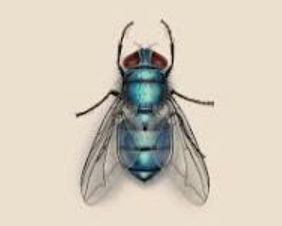
Bottle Flies, commonly known as blow flies, belong primarily to the family Calliphoridae. They are easily recognized by their metallic blue, green, or black bodies, often resembling large house flies. Bottle flies are medically and economically important because the adult flies can transfer pathogens from unsanitary breeding sites to human food, and their larvae (maggots) are significant in forensic science and can sometimes cause myiasis (infestation of living tissue) in animals.
Common genera include Calliphora (bluebottle flies) and Lucilia (greenbottle flies). Among these, the most frequently encountered species are the Green Bottle Fly (Lucilia sericata) and the Blue Bottle Fly (Calliphora vomitoria). These flies are known for their distinctive metallic colors—green or blue—which make them easy to identify and contribute to their common names. Both types are widespread and can often be found near decaying organic matter, playing a significant role in decomposition processes.
Taxonomy and Classification
Bottle Flies are members of the family Calliphoridae in the order Diptera (true flies). Common genera include *Calliphora* (bluebottle flies) and *Lucilia* (greenbottle flies). They undergo complete metamorphosis (egg, larva/maggot, pupa, adult). Their life cycle is often extremely fast, which is a key factor in their role in forensic entomology and disease transmission.
Physical Description
Adult Bottle Flies are typically 6–12 millimeters long and have robust, hairy bodies. They are characterized by their brilliant, iridescent, metallic coloring—most often blue, green, or copper—which gives them their common names. They possess large, reddish-brown compound eyes and are strong, rapid flyers, making a loud buzzing sound.
The larvae, or maggots, are creamy white, legless, and conical, tapering towards the head. They are specialized feeders on decaying organic matter and can reach 10–20 millimeters in length before pupating.
Distribution and Habitat
Bottle Flies are cosmopolitan, found globally wherever decaying organic matter is available. Their habitats are generally unsanitary and include garbage bins, manure piles, compost heaps, slaughterhouses, and decomposing animal carcasses. They are attracted to structures by the odors of these materials, and often enter homes in search of food or to lay eggs on exposed garbage or spoiled meat.
The presence of a large number of bottle flies indoors often indicates a decaying animal carcass (e.g., a dead rodent or bird) hidden within a wall void, attic, or chimney.
Behavior and Life Cycle
Bottle Flies have one of the fastest development rates of any insect, sometimes completing their life cycle in as little as 10 days in warm weather. Females lay masses of up to several hundred eggs on decaying protein sources. Maggots hatch rapidly and feed ravenously, passing through three larval instars.
Once feeding is complete, the maggots crawl away from the food source to a dry, protected site (often in the soil or under debris) to pupate in a dark, reddish-brown puparium. The adult then emerges and immediately begins seeking food and mates.
Signs of Infestation
The presence of a large number of bottle flies indoors often indicates a decaying animal carcass (e.g., a dead rodent or bird) hidden within a wall void, attic, or chimney. More commonly, the first signs are the adult flies themselves—metallic and noisy—seen resting on walls, windows, or buzzing persistently around sources of odor or potential food.
You might also spot their larvae, especially when maggots leave their breeding material in search of a drier place to pupate. These creamy white maggots may suddenly appear crawling across floors, baseboards, or emerging from cracks, signaling that a breeding source is nearby and should be located and removed.
Adult Fly Activity
The most noticeable sign of an infestation is the sudden appearance of adult bottle flies inside the home. These flies are typically metallic in color—often green, blue, or bronze—and are known for their loud, persistent buzzing.
They are commonly seen resting on walls, windows, and light fixtures, or flying repeatedly around a specific area. Bottle flies are also drawn to odors and food sources, so increased activity near trash bins, pet food, or unusual smells may indicate a nearby breeding site.
Hidden Breeding Sources
A large number of flies indoors often points to a hidden carcass, such as a dead rodent, bird, or other animal trapped within wall voids, attics, crawl spaces, or chimneys. As the material decomposes, it provides an ideal environment for flies to lay eggs and for larvae to develop.
Maggot Activity
Another strong indicator of infestation is the presence of maggots, which are the larval stage of bottle flies. These small, creamy white larvae are often seen when they leave their food source in search of a dry place to pupate.
Homeowners may notice maggots crawling along floors, baseboards, or emerging from cracks and crevices. This behavior typically signals that a breeding source is nearby and that the infestation is actively developing.
What It Means
The combination of adult fly activity and visible maggots strongly suggests an established infestation. Promptly locating and removing the source—whether it is a carcass, garbage buildup, or other organic material—is essential to stopping the life cycle and eliminating the problem.
Feeding and Health Concerns
Adult flies feed on sugary substances, nectar, and the liquid products of decay. However, because they alternate between highly contaminated sites (feces, carrion) and human food sources, they are effective **mechanical vectors** for disease agents such as bacteria that cause dysentery, food poisoning, and cholera. The adults carry these pathogens on their feet, mouthparts, and bodies.
In veterinary science, the maggots of some species cause **myiasis**—infestation of wounds or natural body cavities in livestock and sometimes pets. In forensic science, the stage of development of the maggots on a corpse is a crucial indicator for estimating the **postmortem interval** (time since death).
Management and Prevention
Management is based on **sanitation and exclusion**. The primary control measure is the prompt and proper disposal of all dead animals and garbage. Garbage bins should be kept tightly sealed and cleaned frequently. Doors and windows should be properly screened to exclude adults from indoor environments.
If an indoor infestation occurs, the source (e.g., a hidden carcass) must be found and removed. Adult fly control involves space sprays (aerosols) and residual insecticides applied to common resting surfaces, but this is always secondary to eliminating the breeding site.
Conservation and Research
Bottle Flies are generally not conserved. Research is largely focused on their importance in forensic entomology to improve methods for crime scene investigation, and on public health, studying their role in the transmission of antibiotic-resistant bacteria from decaying matter to food.
Related Articles
Explore more guides on flies, sanitation pests, and common indoor infestations:
- Flies – Identification, Breeding Sources, and Control
- House Flies – Prevention and Removal Guide
- Blow Flies – Identification and Infestation Signs
- Drain Flies – Causes and Treatment Methods
- Fruit Flies – Kitchen Infestation Solutions
- Maggots – What They Mean and How to Get Rid of Them
- Rodents – Signs of Hidden Infestations
- Cockroaches – Sanitation Risks and Control
- Ants – Indoor and Outdoor Infestation Guide
- Spider Mites – Plant Pest Identification
Need help locating the source of an infestation? Visit our pest control company directory to connect with local professionals.