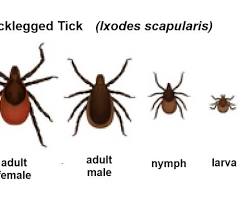
The Black Legged Tick (Ixodes scapularis), commonly known as the Deer Tick, is one of the most medically significant ticks in North America. This small parasitic arachnid is best known for its role in transmitting Lyme disease, although it can also spread several other pathogens that affect humans, pets, livestock, and wildlife. Because of their tiny size and stealthy feeding behavior, black legged ticks are often difficult to detect until after they have attached to a host.
Unlike insects, ticks belong to the arachnid group along with spiders, mites, and scorpions. They possess eight legs during their nymph and adult stages and survive entirely by feeding on blood from vertebrate hosts. Black legged ticks commonly feed on deer, rodents, birds, pets, and humans. Their feeding process may last several days while the tick slowly enlarges with blood.
Ticks thrive in humid wooded habitats with dense vegetation and abundant wildlife. They are especially common along forest edges, hiking trails, leaf litter, overgrown lawns, and brushy residential landscapes. Because the immature stages often feed on white-footed mice and other small mammals that carry disease-causing bacteria, deer ticks play a major role in the transmission cycle of Lyme disease.
Quick Facts
- Scientific Name: Ixodes scapularis
- Common Name: Black Legged Tick or Deer Tick
- Class: Arachnida
- Size: Approximately sesame-seed sized as adults
- Habitat: Woodlands, tall grass, leaf litter
- Diet: Blood from mammals, birds, and reptiles
- Status: Medically important parasite
Identification
Black legged ticks are extremely small parasites with flattened oval bodies.
Important identifying characteristics include:
- Dark brown to black legs
- Flattened body shape
- Eight legs in nymph and adult stages
- Reddish-brown abdomen in females
- Very small overall size
Adult females are usually larger than males and become significantly swollen after feeding.
Approximate sizes include:
- Larvae: nearly microscopic
- Nymphs: poppy-seed sized
- Adults: sesame-seed sized
Nymphs are particularly dangerous because their tiny size allows them to feed unnoticed.
Black legged ticks are commonly confused with:
Distribution and Habitat
Black legged ticks occur throughout eastern and central North America.
They are especially common in:
- Northeastern United States
- Midwestern forests
- Atlantic coastal regions
- Wooded suburban areas
Preferred habitats include:
- Forests
- Leaf litter
- Tall grass
- Brushy edges
- Moist shaded vegetation
- Overgrown yards
Ticks survive best in humid environments that protect them from drying out.
Hosts commonly associated with deer ticks include:
- White-tailed deer
- Mice
- Squirrels
- Birds
- Dogs
- Humans
Life Cycle
The black legged tick undergoes a multi-stage life cycle that may take two years or longer to complete.
Life stages include:
- Egg
- Larva
- Nymph
- Adult
Each stage requires a blood meal before molting into the next stage.
The cycle generally follows this pattern:
- Larvae feed on small mammals or birds.
- Nymphs feed on larger hosts including humans.
- Adults feed primarily on deer and large mammals.
After mating and feeding, adult females lay thousands of eggs before dying.
Nymphs are responsible for many Lyme disease infections because they are active during warm months and are difficult to detect.
Behavior
Black legged ticks do not jump or fly.
Instead, they use a behavior called “questing.”
During questing, ticks:
- Climb onto vegetation
- Extend their front legs
- Wait for passing hosts
When an animal or person brushes nearby, the tick grabs onto fur or clothing.
Ticks often attach in:
- Hairlines
- Armpits
- Groin areas
- Behind knees
- Around waistbands
Feeding may continue for several days if the tick remains undetected.
Medical Importance
Black legged ticks are important disease vectors.
They may transmit:
- Lyme Disease
- Anaplasmosis
- Babesiosis
- Powassan virus
- Ehrlichiosis
Lyme disease is caused by the bacterium Borrelia burgdorferi.
Symptoms may include:
- Fatigue
- Fever
- Headache
- Joint pain
- Bullseye rash
Prompt tick removal greatly reduces disease transmission risk.
Prevention
Preventing tick bites is the most effective protection against tick-borne diseases.
- Avoid tall grass and brushy vegetation.
- Wear long sleeves and pants outdoors.
- Use EPA-approved tick repellents.
- Perform full-body tick checks after outdoor activities.
- Shower after hiking or yard work.
- Keep lawns trimmed and vegetation controlled.
- Create wood-chip or gravel barriers around wooded edges.
- Treat pets with veterinarian-approved tick prevention products.
Clothing can also be treated with permethrin for additional protection.
Control
Tick control often requires a combination of environmental management and personal protection.
Control strategies may include:
- Habitat modification
- Vegetation reduction
- Professional perimeter treatments
- Wildlife management
- Tick tubes targeting rodents
Professional pest management services may be recommended in areas with high tick populations.
Interesting Facts
- Ticks are arachnids rather than insects.
- Nymphs are responsible for many Lyme disease cases.
- Ticks can survive many months without feeding.
- Deer help support adult tick populations.
- Ticks detect hosts through heat and carbon dioxide.
- Black legged ticks do not jump or fly.