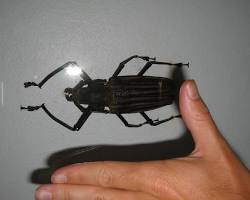
The Black Longhorned Beetle refers to several species within the longhorn beetle family Cerambycidae, a diverse group of wood-boring beetles recognized for their elongated antennae and narrow cylindrical bodies. These beetles are commonly associated with forests, dead wood, lumber, and stressed trees where their larvae develop beneath bark or deep within wood tissue. Although many species help decompose dead trees and recycle nutrients, some longhorn beetles are considered important structural or forestry pests because their larvae can damage living trees, cut timber, and wooden materials.
Longhorn beetles receive their name from their exceptionally long antennae, which in many species exceed the length of the body itself. Adults are often active during warm months and may be found resting on logs, tree trunks, flowers, or outdoor structures. Some species are attracted to lights at night and may accidentally wander indoors.
The larval stage is responsible for most damage associated with longhorn beetles. These wood-boring larvae tunnel beneath bark and through wood as they feed, creating galleries that weaken trees or damage lumber. Depending on the species, infestations may occur in dying trees, freshly cut logs, firewood, or occasionally structural wood.
Quick Facts
- Family: Cerambycidae
- Common Habitat: Forests, woodlands, lumber, dead trees
- Size: Approximately 1/2 inch to 1 inch long
- Color: Usually black or dark metallic
- Diet: Wood tissue and plant material
- Status: Beneficial decomposer and occasional wood pest
Identification
Black longhorned beetles are easily recognized by their elongated bodies and extremely long antennae.
Key identifying features include:
- Glossy black or dark-colored body
- Very long segmented antennae
- Cylindrical or narrow body shape
- Strong chewing mouthparts
- Hard wing covers protecting the abdomen
Adults typically measure:
- Between 1/2 inch and 1 inch long
Some species may appear entirely black while others display:
- Gray markings
- White spots
- Metallic highlights
- Banding patterns
The larvae are cream-colored wood-boring grubs with:
- Soft elongated bodies
- Brown head capsules
- Strong mandibles for chewing wood
Black longhorned beetles are commonly confused with:
Distribution and Habitat
Longhorn beetles occur throughout North America and many other regions worldwide.
They are especially common in:
- Forests
- Wooded residential areas
- Lumber yards
- Parks
- Orchards
- Dead tree habitats
Preferred habitats include:
- Dead trees
- Dying trees
- Logs
- Tree stumps
- Stored firewood
- Fresh-cut lumber
Some species target hardwood trees while others infest conifers.
Adults are often found on:
- Tree bark
- Flowers
- Fresh logs
- Outdoor lighting
Life Cycle
Black longhorned beetles undergo complete metamorphosis.
Their life stages include:
- Egg
- Larva
- Pupa
- Adult
Females deposit eggs in:
- Bark crevices
- Freshly cut wood
- Damaged trees
- Decaying timber
After hatching, larvae tunnel into the wood and begin feeding.
The larval stage may last:
- Several months
- One year
- Multiple years depending on species
As larvae feed, they create winding tunnels called galleries inside the wood.
After pupation within the wood, adults emerge through round exit holes.
Most adults are active during warm spring and summer months.
Behavior
Adult black longhorned beetles are generally harmless and spend much of their time searching for mates and suitable egg-laying sites.
Adults may feed on:
- Tree sap
- Leaves
- Flowers
- Pollen
Many species are nocturnal and strongly attracted to lights.
The larvae perform the most significant activity by:
- Tunneling through wood
- Feeding beneath bark
- Weakening tree tissue
- Accelerating decomposition
While some species infest healthy trees, many prefer weakened, dying, or dead wood.
Pest Status
Some black longhorned beetles are considered important forestry and structural pests.
Potential problems include:
- Damage to trees
- Wood weakening
- Lumber infestation
- Firewood infestations
- Structural wood damage in rare cases
Signs of infestation may include:
- Round exit holes
- Sawdust-like frass
- Loose bark
- Wood galleries
- Declining tree health
However, many longhorn beetles are ecologically beneficial because they help decompose dead wood and recycle nutrients within forest ecosystems.
Prevention
Preventive measures focus on reducing suitable breeding sites.
- Remove dead or dying trees promptly.
- Store firewood away from buildings.
- Inspect lumber before bringing indoors.
- Keep trees healthy through proper care.
- Avoid storing infested wood near homes.
- Monitor weakened trees for exit holes and sawdust.
Proper wood storage and tree maintenance help reduce infestation risks.
Control
Control methods depend on the severity and location of the infestation.
Common management strategies include:
- Removing infested wood
- Destroying heavily damaged trees
- Applying protective tree treatments
- Kiln-drying lumber
- Professional arborist evaluation
Indoor infestations from firewood are often temporary because adults cannot usually reproduce successfully inside homes.
Interesting Facts
- Some longhorn beetle antennae exceed body length.
- Larvae may spend years developing inside wood.
- Many species help recycle dead forest material.
- Adults are often attracted to porch lights.
- Longhorn beetles are among the largest wood-boring beetles.
- Different species specialize on different tree types.