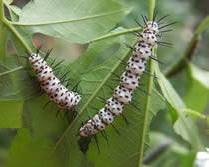
Zebra Longwing Butterfly larvae are distinctive white caterpillars covered with black spots and long black spines. They are the immature stage of the zebra longwing butterfly (Heliconius charithonia), an elegant black-and-yellow butterfly found primarily in Florida, southern Texas, Mexico, Central America, the Caribbean, and parts of South America. The species occasionally wanders farther north during warm weather.
These caterpillars feed almost exclusively on passionflower vines. Their feeding can leave passionflower plants with ragged leaves or bare stems, but the larvae are generally considered desirable garden visitors rather than serious pests. The zebra longwing is an important native butterfly and was designated Florida’s official state butterfly in 1996.
Taxonomy and Classification
- Common name: Zebra longwing butterfly larva
- Scientific name: Heliconius charithonia
- Order: Lepidoptera
- Family: Nymphalidae
- Subfamily: Heliconiinae
- Type: Butterfly caterpillar
- Primary host plants: Passionflower vines
Zebra longwings belong to the brush-footed butterfly family, Nymphalidae. The name “longwing” refers to the narrow, elongated wings of the adult. The larval and adult stages look completely different, but both possess warning colors that help discourage predators.
Identification of Zebra Longwing Larvae
Mature zebra longwing caterpillars have white or cream-colored bodies marked with numerous small black spots. Rows of long, branched black spines extend from the body, giving the larvae a dramatic and potentially threatening appearance. These spines are not known to deliver a painful sting like those of certain venomous caterpillars, although unnecessary handling should still be avoided.
Young larvae may appear pale yellow or cream-colored before developing their more recognizable white-and-black pattern. Depending on age and growing conditions, a mature caterpillar may reach approximately 1 to 1.5 inches long. Larvae have chewing mouthparts and several pairs of abdominal prolegs that allow them to grip passionflower leaves and stems.
Zebra longwing larvae are sometimes confused with Gulf fritillary caterpillars because both feed on passionflower vines. Gulf fritillary larvae are generally bright orange with black branched spines. Zebra longwing larvae, by comparison, are primarily white with black markings and spines.
Egg Identification
Female zebra longwings lay small yellow eggs singly or in small groups. Eggs are commonly placed on the tender new growth, terminal leaves, buds, and curling tendrils of passionflower vines. They are elongated and covered with fine vertical ridges.
Gardeners who grow passionflowers may notice adult females repeatedly examining the plant before depositing eggs. A female uses chemical and physical cues to determine whether a vine is an appropriate host for her offspring. After hatching, the caterpillars begin feeding close to the location where the eggs were deposited.
Distribution and Habitat
Zebra longwings are tropical and subtropical butterflies. In the United States, they are most strongly associated with peninsular Florida, where adults and larvae may be present throughout the year in warmer areas. Established populations also occur in extreme southern Texas. Wandering adults may occasionally be recorded in other states, particularly during warm periods.
Typical habitats include subtropical forests, hardwood hammocks, woodland margins, shrubby thickets, parks, shaded gardens, and suburban landscapes. Zebra longwings prefer environments where passionflower vines grow near nectar- and pollen-producing flowers. Adults often fly slowly through partially shaded vegetation rather than rapidly crossing open ground.
Host Plants and Feeding
Zebra longwing caterpillars feed on plants in the passionflower family. Important native hosts include corkystem passionflower (Passiflora suberosa), yellow passionflower (Passiflora lutea), and purple passionflower or maypop (Passiflora incarnata). Other compatible passionflower species may also support the larvae.
Newly hatched caterpillars begin by scraping or chewing small areas of tender foliage. Older larvae consume entire sections of leaves and may feed along the edges until only portions of the veins remain. Several larvae feeding together can temporarily defoliate a small vine.
Passionflower plants contain defensive chemicals intended to discourage herbivores. Zebra longwing larvae are specially adapted to feed on these plants. Chemicals obtained from their host plants contribute to the caterpillars’ and adult butterflies’ unpleasant taste, helping protect them from birds and other predators. Their contrasting colors act as a warning that they may be unpalatable.
Life Cycle
Zebra longwings undergo complete metamorphosis with four stages: egg, larva, pupa, and adult. After an egg hatches, the caterpillar passes through several growth stages called instars. It sheds its outer skin between each stage because the existing skin cannot expand indefinitely.
Once fully grown, the caterpillar leaves its feeding location and searches for a protected place to pupate. It attaches itself to a support with silk and forms a chrysalis. The zebra longwing chrysalis is brown, angular, and shaped somewhat like a curled, dried leaf. It has projections near the head and smaller bumps or bristles across its surface, providing effective camouflage among dead vegetation.
The adult that emerges has elongated black wings crossed by narrow yellow stripes. Small red markings may be visible near the base of the wings when viewed from below. Several generations can develop during the year in warm climates, and adults may remain active during every month in central and southern Florida.
Signs of Larval Activity
- White caterpillars covered with black spots and branched spines
- Small yellow eggs on new passionflower growth or tendrils
- Irregular holes or missing sections along leaf edges
- Leaves eaten down to their larger veins
- Dark caterpillar droppings beneath damaged foliage
- Groups of larvae feeding on the same passionflower vine
- Brown, dried-leaf-like chrysalises attached near the host plant
Do Zebra Longwing Larvae Harm Plants?
Zebra longwing larvae can remove a noticeable amount of foliage, especially when several caterpillars occupy a young or compact passionflower vine. Established vines usually recover by producing new leaves. Defoliation is part of the natural relationship between the butterfly and its host plant and rarely threatens a healthy, mature vine.
Damage may be more significant on recently planted vines, container-grown specimens, or plants already stressed by drought, root problems, or disease. In these cases, gardeners can protect part of the plant while leaving enough foliage available to support the developing butterflies.
Management and Conservation
Control is usually unnecessary because zebra longwings are beneficial native butterflies. If too many larvae are concentrated on a small vine, they can be gently relocated to another suitable passionflower plant. Caterpillars should not be moved to an unrelated plant because they have specialized dietary requirements.
Avoid applying broad-spectrum insecticides to passionflower vines. Products that kill pest caterpillars may also kill zebra longwing larvae, Gulf fritillary larvae, and other desirable butterflies. Even biological caterpillar treatments containing Bacillus thuringiensis can be fatal to butterfly larvae and should not be used on plants intended as butterfly hosts.
Gardeners can reduce pressure on individual vines by growing several compatible passionflower plants. Larger plantings provide enough foliage for caterpillars while allowing the vines to recover. Native passionflowers are particularly valuable because they support local butterflies and generally perform well under suitable regional conditions.
Importance of Adult Zebra Longwings
Adult zebra longwings visit flowers for both nectar and pollen. Pollen supplies amino acids and other nutrients that contribute to their unusually long adult lives. While many butterflies survive as adults for only a few weeks, zebra longwings may live for several months under favorable conditions.
Adults often return to communal nighttime roosts, gathering in small groups on sheltered branches or vines. They may use the same roost repeatedly. Their long life span, slow flight, social roosting behavior, and pollen feeding make zebra longwings one of North America’s most unusual butterflies.
Conclusion
Zebra longwing butterfly larvae are white, black-spotted caterpillars with long branched spines. They feed on passionflower vines and may temporarily remove substantial foliage, but their presence usually signals a healthy butterfly habitat rather than a serious pest problem. Gardeners can support these caterpillars by planting multiple native passionflowers, tolerating moderate leaf damage, and avoiding insecticides. With proper host plants and flowering resources, the larvae eventually become Florida’s striking black-and-yellow state butterfly.