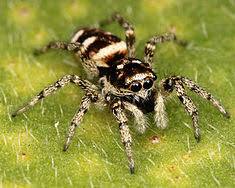
Zebra jumping spiders are small, active hunting spiders recognized by their contrasting black-and-white markings. Unlike web-building spiders, they stalk and capture insects using excellent vision, quick movements, and accurately controlled jumps. They are commonly seen hunting on sunny walls, fences, windowsills, decks, tree trunks, and other vertical surfaces.
The zebra jumping spider (Salticus scenicus), also called the zebra jumper or zebra spider, is beneficial because it consumes flies, mosquitoes, moths, and other small arthropods. It does not damage buildings, clothing, stored food, garden plants, or household belongings. Although it occasionally wanders indoors, it is not considered a dangerous or destructive pest.
Taxonomy and Classification
- Common name: Zebra jumping spider, zebra jumper, or zebra spider
- Scientific name: Salticus scenicus
- Class: Arachnida
- Order: Araneae
- Family: Salticidae
- Type: Active hunting spider
Zebra jumping spiders belong to Salticidae, the largest family of spiders. Jumping spiders are known for their compact bodies, short legs, complex courtship displays, and highly developed vision. The genus name Salticus comes from a Latin word associated with jumping or dancing.
Identification
Adult zebra jumping spiders are small and usually measure approximately 1/6 to 1/4 inch long, excluding the legs. Females are generally larger and more robust than males. The body is dark brown or black with several bold white bands or patches across the abdomen. These markings create the zebra-like pattern responsible for the spider’s common name.
The body is compact and somewhat flattened, allowing the spider to move across walls and into narrow spaces. The legs may be marked with alternating pale and dark bands. Adult males have enlarged pedipalps near their mouths and relatively long front legs, which they use during courtship displays.
Like most spiders, zebra jumpers have eight eyes. The two large forward-facing eyes are especially noticeable and give the spider an alert appearance. Smaller eyes positioned around the head provide a wide field of vision and help the spider detect movement approaching from several directions.
Distribution and Habitat
Zebra jumping spiders are widespread across much of North America and also occur in Europe and parts of Asia. In the United States, they are frequently associated with homes, commercial buildings, barns, sheds, gardens, parks, and other developed environments.
These spiders favor open, sunlit surfaces where their visual hunting method is most effective. Common locations include exterior siding, brick walls, wooden fences, rocks, railings, window frames, and tree bark. They may also hunt around outdoor lights, where flies, moths, midges, and other insects gather.
Indoors, zebra jumpers are most often noticed near windows and doors. Their presence inside usually indicates that a spider entered accidentally or followed insect prey into the building. They do not establish extensive webs in corners or create large indoor colonies.
Hunting Behavior
Zebra jumping spiders do not spin webs to capture prey. Instead, they walk slowly across a surface, pause to observe movement, and approach a potential meal. Their large principal eyes provide detailed vision that allows them to judge distance, recognize prey, and select a suitable angle of attack.
When the spider is close enough, it attaches a silk safety line to the surface and leaps toward its target. The silk line helps prevent a dangerous fall if the jump fails. After capturing prey, the spider uses its fangs to inject venom and digestive fluids before consuming the liquefied tissues.
Zebra jumpers may turn and appear to watch a nearby person or camera. This behavior does not indicate aggression. The spider is visually investigating movement in its surroundings and deciding whether to remain, approach, or retreat.
Diet
Zebra jumping spiders eat a variety of small arthropods. Their prey may include flies, mosquitoes, gnats, midges, small moths, aphids, leafhoppers, and other spiders. They are capable of attacking prey close to their own size and may carefully stalk a target for several minutes before jumping.
By capturing insects around homes and gardens, zebra jumpers provide natural biological control. They do not distinguish between pest insects and other small arthropods, but their overall effect is generally beneficial. Their presence does not indicate unsanitary conditions or a structural infestation.
Life Cycle and Reproduction
Zebra jumping spiders begin life as eggs enclosed within a protective silk sac. A female selects a sheltered crack, crevice, or other protected location before constructing the sac. She may remain nearby to guard the eggs and newly hatched spiderlings.
Young spiders resemble miniature adults but do not initially have fully developed markings or reproductive structures. They grow through a series of molts, shedding their external skeleton each time. The spiders become larger and more distinctly patterned with each developmental stage.
Before mating, a male approaches a female and performs a visual courtship display. He may raise and wave his front legs, move his pedipalps, or shift his body from side to side. These signals help the female recognize him as a potential mate rather than prey. An unreceptive female may move away or respond defensively.
Silk Use and Shelters
Although zebra jumpers do not build prey-catching webs, silk remains essential to their survival. They use it to create safety lines while jumping, construct egg sacs, and build small resting retreats. A retreat may appear as a compact silk tube hidden beneath loose bark, inside a crack, under a ledge, or around a window frame.
The spider may use its retreat for resting, molting, sheltering during unfavorable weather, or guarding eggs. These small silk structures should not be confused with the broad, sticky webs produced by cobweb or orb-weaving spiders.
Signs of Zebra Jumping Spiders
- Small black spiders with bold white bands
- Jerky walking movements followed by sudden jumps
- Spiders turning to face nearby movement
- Activity on sunny walls, fences, decks, or windowsills
- Hunting around exterior lights and window screens
- Small silk retreats hidden in cracks or protected corners
- Individual spiders indoors near windows or doors
Are Zebra Jumping Spiders Dangerous?
Zebra jumping spiders are not considered medically significant. They are alert and curious but normally retreat or jump away when disturbed. Bites are uncommon and generally occur only if a spider is trapped against the skin, squeezed, or handled roughly.
A bite may cause temporary discomfort, redness, or localized swelling, although individual reactions can vary. Wash a suspected bite with soap and water and avoid scratching it. Seek medical advice if severe pain, spreading swelling, breathing difficulty, signs of infection, or other unusual symptoms develop. Spider bites are difficult to confirm without capturing and identifying the spider.
Benefits Around Homes and Gardens
Zebra jumping spiders help suppress small insect populations without damaging plants or requiring chemical treatments. Their diet may include insects that feed on garden plants or become nuisances indoors. A zebra jumper living on an exterior wall can therefore be left in place unless its location creates a specific concern.
Because these spiders are active during the day, people notice them more frequently than many nocturnal species. Visibility does not mean that they are unusually abundant or aggressive. Their movements simply make them easier to observe.
Prevention and Indoor Management
Pesticide treatment is rarely necessary for zebra jumping spiders. An unwanted indoor spider can be captured with a cup and a stiff piece of paper, then released outdoors. A vacuum may also be used when physical removal is preferred, although release preserves a helpful predator.
- Repair damaged window and door screens.
- Seal gaps around frames, siding, pipes, and utility lines.
- Install or replace worn door sweeps.
- Reduce insects gathering around exterior entrances.
- Move bright outdoor lights away from frequently used doors.
- Remove unnecessary clutter from windowsills and storage areas.
- Vacuum visible silk retreats if they occur in unwanted locations.
Repeated indoor sightings may indicate that small insects are entering or breeding inside the structure. Correcting moisture problems, improving sanitation, and excluding flying insects will usually make the building less attractive to hunting spiders.
Conclusion
The zebra jumping spider is a small black-and-white predator commonly found on sunny walls, fences, decks, and windows. Its excellent vision and controlled jumping ability allow it to capture insects without a prey-catching web. Zebra jumpers do not damage property and rarely bite people. In most situations, they should be regarded as harmless and beneficial residents that contribute to natural insect control.