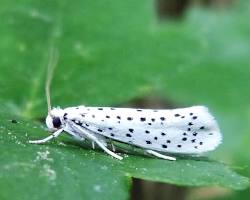
Yponomeuta moths are small, white or silvery moths in the genus Yponomeuta. They are commonly called ermine moths because many species have white forewings decorated with neat rows of black dots. The adults are harmless, but their caterpillars can cover apple trees, euonymus shrubs, willows, and other woody plants with extensive sheets of silk.
Most Yponomeuta caterpillars feed communally, skeletonizing leaves and expanding their protective webs as they move through a plant. A severe infestation may partially or completely defoliate a small tree or shrub. However, individual species have specific host preferences, and not every Yponomeuta moth is a serious pest.
Taxonomy and Classification
- Order: Lepidoptera
- Family: Yponomeutidae
- Genus: Yponomeuta
- Common names: Yponomeuta moths and ermine moths
- Damaging stage: Caterpillar
- Feeding type: Leaf miner, skeletonizer, and defoliator
The genus includes numerous closely related species found primarily across Europe, Asia, and parts of North America. Some have been introduced outside their original ranges through the movement of nursery plants, fruit trees, or other plant material.
Common Yponomeuta Species
Several members of the genus are associated with cultivated trees and ornamental landscapes:
- Apple ermine moth (Yponomeuta malinellus): Primarily attacks apple and crabapple trees.
- Spindle ermine moth (Yponomeuta cagnagella): Most commonly associated with European spindle tree and ornamental euonymus.
- Orchard ermine moth (Yponomeuta padella): Feeds on hawthorn, blackthorn, plum, and certain related trees.
- Willow ermine moth (Yponomeuta rorrella): Develops primarily on willow trees.
- Bird-cherry ermine moth (Yponomeuta evonymella): Feeds mainly on bird cherry and related plants.
Species identification based only on the adult wing pattern can be difficult. Entomologists may need to consider the host plant, caterpillar characteristics, geographic location, pheromones, or microscopic anatomical features.
Adult Moth Identification
Adult Yponomeuta moths are small and slender, generally having a wingspan of approximately 3/4 to 1 inch. Their narrow forewings are usually white, cream, or silvery white and marked with multiple rows of small black dots. The hindwings are gray and bordered by a fringe of long scales.
When resting, the moth folds its wings tightly around its body, creating an elongated, tube-like shape. The head and thorax are usually covered with white scales, while the antennae are thin and threadlike.
Yponomeuta moths may be confused with other spotted micro-moths. The adult’s appearance alone is not always sufficient for a reliable species identification. The plant on which the caterpillars were feeding is often one of the most useful clues.
Caterpillar Identification
Yponomeuta caterpillars vary from cream and pale yellow to grayish-green. Many species have dark heads and parallel rows of black spots along the body. Mature larvae commonly reach about 1/2 to 3/4 inch long.
The caterpillars usually live in groups beneath conspicuous sheets of silk. Webs may contain dozens of larvae, damaged foliage, shed skins, and dark pellets of caterpillar waste. When disturbed, caterpillars may wriggle rapidly or lower themselves from branches on silk threads.
Distribution and Habitat
Yponomeuta moths occur throughout much of Europe and Asia. Several species are present in North America, including introduced populations associated with fruit trees and ornamental plants. Their exact distributions vary considerably by species.
These moths may be encountered in orchards, nurseries, residential yards, parks, hedgerows, woodland edges, and natural areas containing suitable host plants. Adults are primarily active at night and may occasionally be attracted to outdoor lights.
Life Cycle
Most Yponomeuta moths complete one generation per year. Adults typically emerge during summer. After mating, females deposit groups of eggs on young twigs, branches, or bark near suitable buds. The eggs are covered with a protective secretion that hardens and changes color until it resembles the surrounding bark.
Young caterpillars may hatch before winter but remain together beneath the protective egg covering. This sheltered structure is sometimes called a hibernaculum. The larvae emerge during spring as the host plant begins producing leaves.
Early-stage larvae may feed inside buds or mine between the surfaces of young leaves. As they grow, the caterpillars begin feeding externally and constructing communal webs. Colonies expand the silk over additional foliage as their food supply is consumed.
Fully grown larvae produce white, spindle-shaped cocoons. The cocoons are frequently arranged side by side in clusters inside the web. Adult moths emerge after pupation and restart the annual cycle.
Plant Damage
Young caterpillars produce mines or transparent patches in developing leaves. Older larvae consume most of the leaf tissue, sometimes leaving only the midribs and larger veins. Dense colonies may strip entire sections of foliage.
Signs of Yponomeuta moth activity include:
- Small mines in newly opened leaves
- Leaves with pale or transparent patches
- Fine silk joining neighboring leaves
- Large sheets of webbing over branches
- Groups of black-spotted caterpillars
- Skeletonized or completely consumed foliage
- Clusters of white cocoons inside the webs
- Partial or complete plant defoliation
Healthy, mature trees can often recover from one period of spring feeding by producing replacement foliage. Repeated defoliation can reduce plant growth, fruit production, and stored energy. Young trees and plants already stressed by drought, root damage, disease, or poor growing conditions may suffer more serious effects.
How Yponomeuta Moths Differ From Similar Pests
Yponomeuta caterpillars may be mistaken for fall webworms or eastern tent caterpillars. Fall webworms usually become conspicuous during summer or fall and attack a broad range of deciduous trees. Their webs surround foliage near the ends of branches.
Eastern tent caterpillars build dense tents in branch forks and leave them to feed on surrounding leaves. Yponomeuta caterpillars generally extend sheets of silk directly across the foliage they are consuming. Their small, white, black-spotted adult moths also differ considerably from adult tent caterpillar and fall webworm moths.
Monitoring
Inspect susceptible trees and shrubs when buds begin opening in spring. Look for mined foliage, tiny caterpillars, and fine silk joining leaves. Early colonies are easier to remove than mature webs that cover multiple branches.
Commercial orchards may use species-specific pheromone traps to detect adult males and determine when moths are active. Traps are primarily monitoring tools and do not usually capture enough moths to control an infestation.
Management and Control
Small populations on large, healthy trees may not require treatment. Control is more appropriate when larvae threaten young trees, valuable ornamentals, nursery stock, or commercial fruit production.
- Prune early webs: Remove infested branch tips while colonies are small, provided pruning will not seriously alter the plant’s shape.
- Remove caterpillars manually: Pull accessible webs from shrubs with a stick or gloved hand and place them in soapy water.
- Inspect for egg masses: Examine young twigs during the dormant season and prune visible egg masses when practical.
- Use water: A strong stream of water can disrupt light webbing and dislodge small larvae from sturdy plants.
- Maintain plant health: Water during extended dry weather and protect roots and bark from unnecessary damage.
- Preserve natural enemies: Birds, spiders, predatory insects, tachinid flies, and parasitic wasps help reduce populations.
Bacillus thuringiensis var. kurstaki, commonly called Btk, can control young caterpillars when they eat treated foliage. It is most effective before extensive webs develop. Spinosad and other insecticides labeled for leaf-feeding caterpillars may also provide control when applied early and thoroughly.
Never attempt to burn webbing from a tree. Fire can damage bark and branches, ignite nearby vegetation, and create a greater hazard than the caterpillars. Always follow pesticide labels and observe harvest restrictions when treating apple or other fruit-producing plants.
Are Yponomeuta Moths Dangerous?
Adult Yponomeuta moths do not bite, sting, or damage household materials. They may occasionally enter buildings after being attracted to lights, but they cannot reproduce without suitable host plants. Their caterpillars are not generally known for the irritating hairs associated with certain tussock moths.
Conclusion
Yponomeuta moths are distinctive ermine moths whose caterpillars produce communal webs on apple, euonymus, willow, and related woody plants. While one infestation may cause only temporary cosmetic damage, severe or repeated defoliation can weaken valuable plants. Early monitoring, physical web removal, plant care, natural enemies, and properly timed treatments offer the most effective management.