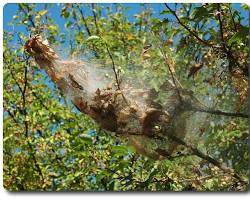
The Fall Webworm (Hyphantria cunea) is a native North American moth whose caterpillar stage is famous for creating large silken webs over the ends of tree branches during late summer and early fall. These conspicuous webs often alarm homeowners and gardeners because they can cover entire branches and contain dozens or even hundreds of caterpillars feeding together inside the protective silk enclosure.
Unlike the closely related Eastern Tent Caterpillar, which builds spring tents in branch crotches, Fall Webworms create loose communal webs at the terminal ends of branches later in the growing season. The caterpillars continually expand the web outward as they consume additional foliage.
Although the nests are visually unattractive, Fall Webworm damage is usually considered largely cosmetic because feeding occurs late in the season after most trees have already completed the majority of their annual photosynthesis and food production.
Fall Webworms are highly adaptable insects capable of feeding on more than 100 species of deciduous trees and shrubs. Their ability to colonize many different host plants has allowed them to spread widely across North America and become invasive in parts of Europe and Asia.
Taxonomy and Classification
- Kingdom: Animalia
- Phylum: Arthropoda
- Class: Insecta
- Order: Lepidoptera
- Family: Erebidae
- Genus: Hyphantria
- Species: Hyphantria cunea
- Common Name: Fall Webworm
The Fall Webworm belongs to the family Erebidae, a large moth family that includes tiger moths, tussock moths, and lichen moths.
It undergoes complete metamorphosis through four life stages:
- Egg
- Larva (caterpillar)
- Pupa
- Adult moth
Fall Webworms are highly polyphagous, meaning they feed on a wide variety of host plants.
Common host trees include:
- Pecan
- Walnut
- Hickory
- Elm
- Apple
- Mulberry
- Persimmon
- Sweetgum
- Birch
- Maple
Physical Description
The adult Fall Webworm moth is generally snow white with a wingspan of about 1 to 1.5 inches.
Characteristics of the adult moth include:
- Bright white wings
- Fuzzy white body
- Occasional dark wing spots in some populations
- Nocturnal behavior
- Attraction to lights
The larval stage is the damaging and most recognizable phase.
Fall Webworm caterpillars grow to approximately 1 inch long and are densely covered in long hairs.
Larval coloration varies depending on geographic region and genetic race.
Common features include:
- Pale yellow, greenish, or tan body
- Black or reddish head capsule
- Long white or gray hairs
- Rows of orange or black tubercles (bumps)
- Dark striping along the body
The most distinctive feature of the species is the large silken web nest containing groups of feeding caterpillars and accumulations of dark frass (droppings).
Distribution and Habitat
Fall Webworms are native to North America and are widely distributed throughout the United States, southern Canada, and parts of Mexico.
They have also become invasive pests in:
- Europe
- China
- Japan
- Korea
- Other regions of Asia
Preferred habitats include:
- Deciduous forests
- Urban shade trees
- Roadside ornamentals
- Fruit orchards
- Nut tree plantings
- Residential landscapes
- Parks and wooded areas
Fall Webworms are especially noticeable on isolated ornamental trees where their webs become highly visible.
Life Cycle
Fall Webworms typically produce one to two generations annually depending on climate.
Southern populations may produce multiple overlapping generations.
Overwintering
The insect overwinters in the pupal stage inside thin cocoons hidden beneath:
- Leaf litter
- Loose bark
- Soil debris
- Protected crevices
Adult Emergence
Adult moths emerge during mid to late summer and are active primarily at night.
Females lay clusters of several hundred eggs on the undersides of leaves. The egg masses are often covered with white hairs from the female’s abdomen.
Larval Development
After hatching, the caterpillars immediately begin spinning communal silk webs around nearby foliage.
The colony remains together throughout development and continually expands the web as more leaves are consumed.
Larvae feed for approximately 4 to 8 weeks before pupating.
Behavior and Feeding
Fall Webworm caterpillars are highly social insects that feed communally within the protection of their silken nest.
The web serves several functions:
- Protection from predators
- Microclimate regulation
- Shelter during molts
- Colony cohesion
Unlike Eastern Tent Caterpillars, which leave their tent to feed, Fall Webworms feed entirely inside the expanding web structure.
The caterpillars possess chewing mouthparts and consume leaf tissue, often skeletonizing leaves before eventually consuming entire sections of foliage.
As colonies grow, webs may enlarge dramatically and envelop entire branch tips.
Damage and Economic Importance
The primary damage caused by Fall Webworms is defoliation combined with the visual nuisance of large silk webs.
Cosmetic Damage
Most infestations are considered primarily aesthetic problems because feeding occurs late in the growing season.
By late summer, mature trees have already completed much of their annual energy production.
As a result, healthy established trees usually tolerate defoliation without lasting harm.
Stress on Small Trees
Repeated severe infestations or attacks on:
- Young trees
- Newly planted ornamentals
- Fruit trees
- Drought-stressed trees
may weaken the host and reduce vigor over time.
Orchard Concerns
In orchards, heavy infestations may reduce photosynthetic activity and interfere with fruit production or appearance.
Ecological Role
Despite their pest status, Fall Webworms are important components of many ecosystems.
The caterpillars serve as food for:
- Birds
- Predatory insects
- Parasitic wasps
- Spiders
- Small mammals
Natural enemies frequently regulate Fall Webworm populations and often cause outbreaks to collapse naturally.
Their webs also provide temporary habitat for certain beneficial arthropods.
Signs of Infestation
- Large silken webs at branch tips
- Caterpillars feeding within webs
- Defoliated branch ends
- Accumulations of frass inside nests
- Web-covered foliage in late summer
Webs become increasingly noticeable as colonies expand.
Management and Control (IPM)
Control of Fall Webworms is often unnecessary for mature healthy trees, but management is commonly performed for aesthetic reasons.
Manual Removal
Pruning and destroying webs is the simplest and most effective method for small infestations.
Removing the entire web eliminates the enclosed colony.
Do not burn nests while attached to branches, as this can severely injure the tree.
Biological Insecticides
Bacillus thuringiensis (Bt) and spinosad are highly effective when applied to young caterpillars.
Applications must penetrate the webbing to contact feeding larvae.
These products are preferred because they are more selective and environmentally safer than many broad-spectrum insecticides.
Chemical Control
Broad-spectrum insecticides are rarely necessary but may occasionally be used on high-value ornamentals or orchard trees.
Young larvae are much easier to control than older caterpillars.
Monitoring
Inspect susceptible trees during midsummer for small developing webs before colonies become large and difficult to manage.
Research and Scientific Importance
Researchers study Fall Webworms to better understand:
- Social insect behavior
- Caterpillar communication
- Outbreak population dynamics
- Biological control systems
- Invasive species ecology
The species is also used in studies involving communal insect behavior and host plant adaptation.
Conclusion
The Fall Webworm (Hyphantria cunea) is a highly recognizable caterpillar species known for building large silken webs over the ends of tree branches during late summer and fall. Although the nests can appear alarming, damage is usually cosmetic because feeding occurs late in the growing season. These caterpillars feed on many deciduous trees and are commonly found in forests, landscapes, orchards, and residential areas. Effective management typically involves pruning out small nests or using biological controls such as Bt when necessary. Despite their nuisance appearance, Fall Webworms are also valuable ecological organisms that support numerous predators and parasitoids in natural ecosystems.