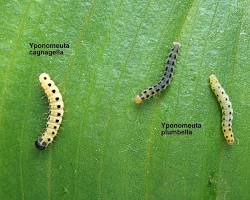
Yponomeuta Caterpillars
Yponomeuta Caterpillars are the larval stage of various ermine moth species belonging to the genus Yponomeuta. These highly social caterpillars are best known for their remarkable ability to cover entire trees, shrubs, and hedgerows in dense sheets of silk while feeding collectively on foliage. Their large communal webs and extensive defoliation often create dramatic landscapes where host plants appear wrapped in white fabric.
Although these caterpillars rarely kill mature trees outright, heavy infestations can completely strip foliage from ornamental and fruit-bearing plants. The combination of extensive silk webbing and severe leaf loss often alarms homeowners, gardeners, and landscape managers. During outbreak years, entire rows of shrubs or trees may appear ghostly white as thousands of caterpillars feed beneath protective silk coverings.
Yponomeuta caterpillars are considered significant ornamental and agricultural pests in many regions due to their ability to rapidly build populations and overwhelm susceptible host plants.
Taxonomy and Classification
- Kingdom: Animalia
- Phylum: Arthropoda
- Class: Insecta
- Order: Lepidoptera
- Family: Yponomeutidae
- Genus: Yponomeuta
Several species occur throughout Europe, Asia, and North America, with individual species specializing on specific host plants such as apple, cherry, willow, spindle tree, hawthorn, and other ornamental shrubs.
Identification
Yponomeuta caterpillars have several distinctive characteristics.
- Length: Up to 20 mm when mature.
- Color: Pale yellow, cream, or grayish-green.
- Head: Dark brown to black.
- Markings: Multiple rows of small black spots running along the body.
- Body Shape: Slender and cylindrical.
The most recognizable sign of infestation is not the caterpillar itself but the extensive silk webbing that covers branches, leaves, and sometimes entire plants.
Within these webs, hundreds or even thousands of caterpillars may be feeding simultaneously.
Distribution and Habitat
Yponomeuta caterpillars occur throughout temperate regions of Europe, Asia, and North America.
They are commonly found in:
- Orchards
- Urban landscapes
- Hedgerows
- Parks
- Gardens
- Woodland edges
- Nurseries
Different species prefer specific host plants, allowing multiple Yponomeuta species to occupy the same general region without competing directly for food.
Host Plants
Host preferences vary among species.
Common hosts include:
- Apple trees
- Cherry trees
- Hawthorn
- Willow
- Euonymus
- Plum trees
- Crabapple
- Various ornamental shrubs
Infestations are often concentrated on a single plant species because many ermine moths are highly host-specific.
Life Cycle
Yponomeuta caterpillars undergo complete metamorphosis.
- Egg Stage: Females lay eggs on twigs and branches during late summer.
- Overwintering Stage: Young larvae remain protected beneath egg coverings through winter.
- Larval Stage: Feeding begins in spring and intensifies rapidly as caterpillars grow.
- Pupal Stage: Pupation occurs inside silk webs.
- Adult Stage: Small white ermine moths emerge during summer.
Most species produce one generation per year.
Behavior
One of the most unusual characteristics of Yponomeuta caterpillars is their highly social behavior.
Unlike many caterpillars that feed individually, these insects:
- Live in large colonies.
- Construct communal silk shelters.
- Feed collectively.
- Expand webs as food resources are consumed.
- Move together between feeding areas.
The silk structures provide protection from predators, weather, and some control treatments.
Damage and Economic Importance
Yponomeuta caterpillars are primarily defoliators.
Leaf Skeletonization
Young larvae initially feed on internal leaf tissues, creating mines or translucent feeding areas.
As they mature, feeding becomes more aggressive.
- Removal of leaf tissue.
- Skeletonized leaves.
- Loss of photosynthetic capacity.
Complete Defoliation
Large infestations can remove nearly all foliage from a host plant.
Symptoms include:
- Bare branches.
- Leafless canopies.
- Reduced plant vigor.
- Delayed growth.
Silk Webbing
The dense silk coverings are often the most visible sign of infestation.
- Cover leaves and branches.
- Create unsightly appearances.
- Reduce ornamental value.
- Trap debris and frass.
Reduced Fruit Production
Fruit trees suffering repeated defoliation may experience:
- Reduced fruit yield.
- Smaller fruit size.
- Lower overall vigor.
Signs of Infestation
Common indicators include:
- Large white silk webs.
- Clusters of caterpillars.
- Skeletonized leaves.
- Defoliated branches.
- Black frass accumulation.
- Visible pupae within webs.
Heavy infestations may make entire trees appear wrapped in silk.
Behavior and Conflict
The pest status of Yponomeuta caterpillars is closely tied to their communal feeding strategy.
- Mass Feeding: Large colonies consume foliage rapidly.
- Protective Webbing: Shields caterpillars from predators.
- Rapid Expansion: Webs increase in size as feeding progresses.
- Aesthetic Damage: Silk structures are highly noticeable.
Outbreaks can transform entire landscapes within a matter of weeks.
Management and Prevention
Early detection is critical for successful control.
Mechanical Control
- Prune infested branches.
- Remove silk nests.
- Destroy heavily infested plant material.
Physical removal is highly effective when infestations are localized.
Water Disruption
- High-pressure water sprays.
- Break open silk webs.
- Expose caterpillars to predators.
This method works best during early infestation stages.
Biological Control
- Parasitic wasps.
- Predatory insects.
- Birds.
- Microbial controls.
Natural enemies often help suppress populations after outbreak years.
Microbial Insecticides
Bacillus thuringiensis (Bt) products can provide effective control when applied while larvae are actively feeding.
Treatments are most successful before webbing becomes excessively dense.
Monitoring
- Inspect twigs for egg masses.
- Monitor spring foliage.
- Check for early web formation.
- Identify host plants at risk.
Preventative monitoring often eliminates the need for larger interventions later in the season.
Natural Enemies
Numerous beneficial organisms attack Yponomeuta caterpillars.
- Ichneumonid wasps
- Braconid wasps
- Predatory beetles
- Birds
- Spiders
- Entomopathogenic fungi
These natural enemies often contribute significantly to population declines following outbreaks.
Conservation and Research
Research focuses on population dynamics, biological control, host plant relationships, and outbreak prediction. Scientists continue studying how environmental conditions influence large-scale infestations and how natural enemies can be conserved to reduce future outbreaks.
Although mature trees often recover from defoliation, Yponomeuta caterpillars remain important ornamental and agricultural pests due to their spectacular web-building behavior and ability to rapidly strip foliage from host plants. Early monitoring, mechanical removal, biological control, and integrated pest management remain the most effective approaches for managing infestations.