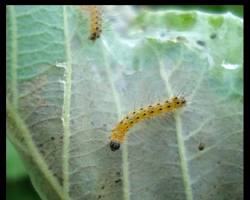
Webworms are caterpillar pests known for producing silken webs over foliage while feeding on leaves. The most familiar species is the Fall Webworm (Hyphantria cunea), a widespread defoliator found across the United States and many other regions. Other webworm species may attack turfgrass, vegetables, ornamentals, and field crops. Although webworms vary by species, they share a common habit of using silk to protect feeding colonies from predators and environmental stress.
Fall webworms are especially noticeable in late summer and fall when large, loose webs appear at the tips of tree branches. These webs expand as larvae consume enclosed foliage and move outward to capture new leaves. While healthy trees usually survive occasional infestations, heavy populations can cause serious defoliation, reduce plant vigor, and create major aesthetic problems in landscapes.
Because webworms feed within protective silk shelters, early detection and physical removal are often the most effective management strategies.
Taxonomy and Classification
- Kingdom: Animalia
- Phylum: Arthropoda
- Class: Insecta
- Order: Lepidoptera
- Family: Erebidae
- Species: Hyphantria cunea
Fall webworms belong to the same broad order as moths and butterflies. Garden webworms and sod webworms may belong to related moth families but share similar web-forming or shelter-building behavior.
Identification
Larvae
Webworm larvae are hairy caterpillars that vary in coloration.
- Length: Up to 35 mm.
- Color: Pale yellow, tan, brown, or greenish.
- Head: Red-headed or black-headed forms occur.
- Body: Covered with long, fine hairs.
Adult Moths
Fall webworm adults are small to medium-sized moths.
- Usually white.
- Sometimes marked with small dark spots.
- Active at night.
- Often attracted to outdoor lights.
Key Identification Features
- Large silken webs at branch tips.
- Caterpillars feeding inside the web.
- Skeletonized leaves within webbed areas.
- Accumulated frass and dead foliage trapped in silk.
The location of the web is a key clue. Fall webworm webs usually begin at the ends of branches, while tent caterpillar webs are more often found in branch crotches.
Distribution and Habitat
Webworms are widely distributed and occur in urban, suburban, agricultural, and forested environments.
Common habitats include:
- Shade trees.
- Fruit trees.
- Woodlands.
- Ornamental landscapes.
- Parks.
- Gardens.
- Field crops.
- Turfgrass areas.
Fall webworms occur throughout the United States and are especially noticeable in late summer.
Host Plants
Fall webworms feed on hundreds of tree and shrub species.
Common hosts include:
- Mulberry.
- Walnut.
- Hickory.
- Cherry.
- Apple.
- Persimmon.
- Sweetgum.
- Elm.
- Maple.
- Oak.
Their broad host range makes them common in both natural and managed landscapes.
Life Cycle
Webworms undergo complete metamorphosis.
- Egg Stage: Females lay clusters of eggs on leaves.
- Larval Stage: Caterpillars hatch and begin feeding within silk webs.
- Pupal Stage: Mature larvae leave the web and pupate in soil, leaf litter, or protected sites.
- Adult Stage: Moths emerge, mate, and lay eggs for the next generation.
One or more generations may occur annually depending on climate.
Feeding Habits
Webworm larvae feed on leaves while remaining inside their protective web.
- Consume tender leaf tissue.
- Skeletonize foliage.
- Expand webbing as food is depleted.
- Feed communally in colonies.
The web protects larvae from many predators and makes infestations highly visible.
Damage and Economic Importance
Defoliation
The main damage is leaf loss.
- Skeletonized leaves.
- Brown, dead foliage inside webs.
- Reduced photosynthesis.
- Branch-level defoliation.
Large colonies can defoliate entire branches.
Aesthetic Damage
Webworms are often more of an aesthetic pest than a lethal tree pest.
- Large unsightly webs.
- Frass-filled silk shelters.
- Browned branch tips.
- Reduced curb appeal.
In ornamental landscapes, the visual impact may be the main reason for control.
Tree Stress
Healthy mature trees usually tolerate late-season feeding, but repeated infestations can cause stress.
- Reduced energy storage.
- Weakened growth.
- Greater vulnerability to drought.
- Increased susceptibility to secondary pests.
Young or recently transplanted trees are more vulnerable than established trees.
Behavior and Conflict
Protective Webbing
Webworm larvae remain inside their web while feeding.
- Protection from predators.
- Protection from weather.
- Reduced pesticide exposure.
- Communal feeding benefits.
The web must often be broken open before treatments or predators can reach larvae effectively.
Colony Expansion
As the caterpillars consume enclosed leaves, they enlarge the web.
- Webs expand inward from branch tips.
- More foliage becomes enclosed.
- Damage becomes increasingly visible.
Signs of Infestation
- Large webs at branch tips.
- Hairy caterpillars inside webs.
- Skeletonized leaves.
- Brown foliage trapped in silk.
- Frass pellets inside webbing.
- White moths near lights.
Early infestations are easiest to manage before webs become large.
Management and Prevention
Integrated Pest Management (IPM) is usually effective.
Mechanical Removal
- Prune out small webs.
- Bag and dispose of infested branch tips.
- Remove colonies before they expand.
Mechanical removal is often the best option for small trees and accessible branches.
Web Disruption
- Open webs with a pole.
- Use a strong water spray.
- Expose larvae to predators.
Opening the web allows birds, wasps, and other natural enemies to reach larvae.
Biological Control
- Birds.
- Paper wasps.
- Parasitic flies.
- Parasitic wasps.
Natural enemies often reduce populations without chemical treatment.
Bt Treatments
Bacillus thuringiensis var. kurstaki is effective against young caterpillars.
- Apply to foliage near active webs.
- Target young larvae.
- Ensure caterpillars ingest treated leaves.
Bt works best when applied early before webs become large and dense.
Avoid Fire
Burning webs is not recommended.
- Damages bark.
- Injures tree tissue.
- Creates fire hazards.
- Often causes more harm than webworms.
Research and Future Studies
Researchers continue studying webworm population cycles, host plant preferences, and natural enemy interactions. Current research focuses on biological control, improved monitoring, and sustainable landscape management strategies that reduce unnecessary pesticide use.
Because fall webworms are highly visible but rarely fatal to healthy trees, education remains an important part of management.
Conclusion
Webworms are common silk-building caterpillars that create large protective webs over foliage while feeding. Although they can cause noticeable defoliation and serious aesthetic concerns, healthy trees often recover from isolated infestations. Early detection, pruning, web disruption, biological control, and properly timed Bt treatments provide effective and environmentally responsible control options.