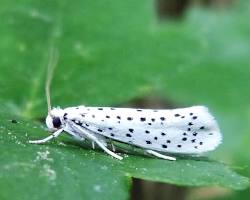
Yponomeuta Moths, commonly known as Ermine Moths, are small moths belonging to the genus Yponomeuta within the family Yponomeutidae. These insects are best known for their larval stage, during which caterpillars create large silken webs that can envelop entire branches or even whole shrubs. While these webs can appear alarming, the actual damage to host plants is often temporary, and many plants recover after defoliation.
Ermine moths are widely distributed across Europe, Asia, and North America, where they feed on a variety of host plants, including fruit trees and ornamental shrubs. Their dramatic webbing and group feeding behavior make them one of the most visually noticeable defoliating pests in gardens and landscapes.
Taxonomy and Classification
Yponomeuta moths belong to the order Lepidoptera and the family Yponomeutidae. The genus Yponomeuta includes numerous species, each typically associated with specific host plants.
Common species include the apple ermine moth (Yponomeuta malinellus) and the bird cherry ermine moth (Yponomeuta evonymella), both known for their web-forming larvae.
Identification
Adult ermine moths are small, with wingspans of approximately 16–25 mm. They are typically white with black spots on their wings, giving them a distinctive “ermine-like” pattern.
Larvae are small caterpillars, usually pale yellow to gray with black spots along the body. They are often found in large groups داخل silken webs.
The most recognizable sign of these insects is the extensive webbing that covers leaves and branches, sometimes giving plants a ghostly appearance.
Life Cycle
The life cycle of Yponomeuta moths includes egg, larva, pupa, and adult stages.
Females lay eggs on host plants, often on twigs or bark. The eggs overwinter and hatch in early spring, when larvae begin feeding on newly emerging leaves.
Larvae feed gregariously, producing silk that forms protective webs around their feeding sites. As they grow, the webbing expands, sometimes covering large portions of the plant.
Pupation occurs داخل the web, where cocoons are formed. Adult moths emerge in summer, mate, and lay eggs, completing the cycle.
Typically, there is one generation per year.
Feeding Behavior and Damage
Ermine moth larvae are foliage feeders that consume leaves within their protective webs. Their feeding can result in:
- Defoliation of branches or entire plants
- Skeletonized leaves
- Reduced photosynthesis
- Temporary ضعف (weakening) of the plant
While the visual impact can be severe, healthy plants often recover after the larvae complete their feeding cycle. Repeated infestations, however, can stress plants over time.
The webs also protect larvae from predators and environmental conditions, making control more challenging.
Signs of Infestation
- Large silken webs covering branches or shrubs
- Clusters of caterpillars داخل webs
- Defoliated or damaged leaves
- Cocoons داخل webbing
These signs are highly visible and often appear in spring and early summer.
Management and Control (IPM)
- Monitoring: Inspect plants early in the season for signs of larvae.
- Mechanical Control: Remove and destroy webs and caterpillars.
- Biological Control: Encourage natural predators such as birds and parasitic wasps.
- Cultural Practices: Maintain plant health to support recovery.
- Chemical Control: Apply treatments such as Bacillus thuringiensis (Bt) when larvae are young.
Early intervention is key, as larvae are more susceptible to control measures before webs become extensive.
Ecological Importance
Yponomeuta moths are part of natural ecosystems and serve as food for various predators. Their outbreaks are often temporary and followed by population declines due to natural controls.
In many cases, their presence does not result in long-term harm to host plants.
Conclusion
Yponomeuta Moths (Ermine Moths) are visually striking insects known for their web-forming larvae and defoliation of host plants. While their presence can be alarming, the damage is often temporary, and plants typically recover. Through monitoring and integrated pest management strategies, infestations can be managed effectively while preserving ecological balance.