Overview
Virginian Tiger Moths (Spilosoma virginica) are widespread moths found throughout North America and are best known for their larval stage, the Yellow Woolly Bear Caterpillar. These insects belong to the tiger moth group and are commonly encountered in gardens, agricultural fields, meadows, roadsides, and woodland edges.
Although generally considered minor pests, Virginian Tiger Moth caterpillars are highly adaptable feeders capable of consuming a wide variety of plants. During outbreak years, their feeding can result in noticeable defoliation of vegetables, ornamentals, and field crops. However, most infestations remain localized and rarely cause serious long-term plant damage.
The species is valued by many naturalists because of its ecological role as a food source for birds, predatory insects, and parasitoids. Its striking white adult form and fuzzy caterpillar stage make it one of the most recognizable moths in North America.
Taxonomy and Classification
- Kingdom: Animalia
- Phylum: Arthropoda
- Class: Insecta
- Order: Lepidoptera
- Family: Erebidae
- Subfamily: Arctiinae
- Genus: Spilosoma
- Species: Spilosoma virginica
The Virginian Tiger Moth belongs to a group commonly known as tiger moths, many of which have hairy caterpillars and brightly colored adults.
Identification
Adult Moth
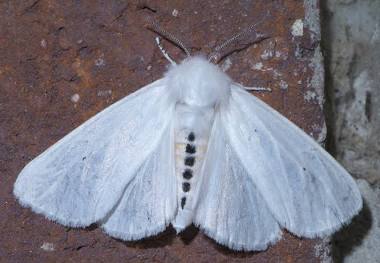
Adult Virginian Tiger Moths are attractive white moths with a wingspan ranging from 35 to 50 millimeters.
- Color: Pure white to creamy white.
- Wings: Smooth with occasional small black spots.
- Body: White with orange and black markings on the abdomen.
- Antennae: Feather-like in males and thinner in females.
- Activity: Nocturnal and attracted to lights.
Caterpillar (Yellow Woolly Bear)
The caterpillar stage is far more commonly encountered than the adult moth.
- Length: Up to 50 millimeters.
- Color: Variable, ranging from pale yellow and cream to orange, rust, or reddish-brown.
- Body: Densely covered with long hairs.
- Movement: Fast-moving compared to many caterpillars.
- Appearance: Uniform coloration without the bands found on the Isabella Woolly Bear.
Their fuzzy appearance often causes them to be mistaken for other woolly bear caterpillar species.
Distribution and Habitat
Virginian Tiger Moths occur throughout most of the United States, southern Canada, and parts of Mexico.
Common habitats include:
- Gardens
- Crop fields
- Roadsides
- Meadows
- Pastures
- Forest edges
- Urban landscapes
- Parks
The species thrives in disturbed environments where host plants are abundant.
Host Plants
The Yellow Woolly Bear is one of the most polyphagous caterpillars in North America.
Common host plants include:
- Beans
- Peas
- Corn
- Lettuce
- Cabbage
- Spinach
- Dandelion
- Plantain
- Sunflower
- Rose
- Goldenrod
- Maple seedlings
- Numerous weeds and wildflowers
This broad diet allows populations to survive in a wide range of habitats.
Life Cycle
Egg Stage
Females lay clusters of eggs on host plants during spring and summer.
Larval Stage
After hatching, caterpillars begin feeding immediately on leaves and tender plant tissues.
The larval stage lasts several weeks and includes multiple molts.
Pupal Stage
Mature caterpillars spin hairy cocoons using silk and their own body hairs.
Pupation occurs within these protective structures.
Adult Stage
Adults emerge, mate, and begin the cycle again.
Depending on climate, one to two generations may occur annually.
Damage and Economic Importance
Leaf Feeding
The primary damage results from caterpillar feeding on foliage.
Leaves develop:
- Irregular holes
- Missing margins
- Skeletonized sections
- Defoliated stems
Vegetable Crop Damage
In vegetable gardens and small farms, caterpillars may feed on:
- Beans
- Lettuce
- Greens
- Brassicas
- Corn seedlings
Young plants are particularly vulnerable.
Ornamental Plant Injury
Flower beds may experience aesthetic damage when large numbers of caterpillars feed on leaves and blooms.
Crop Contamination
The presence of caterpillars, hairs, and cocoons can reduce the marketability of leafy vegetables and ornamental plants.
Human Irritation
Although the hairs are not venomous, some individuals may experience mild skin irritation after handling caterpillars.
Signs of Infestation
- Large fuzzy caterpillars on foliage.
- Chewed leaves.
- Hairy cocoons attached to structures or vegetation.
- Rapidly moving woolly bear caterpillars crossing sidewalks and roads.
- White moths attracted to outdoor lights.
Natural Enemies
Numerous predators and parasites help suppress populations.
- Birds
- Ground beetles
- Assassin bugs
- Spiders
- Tachinid flies
- Braconid wasps
- Parasitic ichneumon wasps
Natural biological control often prevents serious outbreaks.
Management and Control (IPM)
Hand Removal
Small infestations can be managed by manually collecting caterpillars and disposing of them in soapy water.
Monitor Early
Regular inspections help detect young larvae before populations become established.
Use Row Covers
Floating row covers prevent female moths from laying eggs on vegetable crops.
Bacillus thuringiensis (Bt)
Bt products are most effective against young caterpillars before they become heavily hairy.
Weed Management
Removing preferred weed hosts around gardens can reduce local populations.
Protect Beneficial Insects
Avoid broad-spectrum insecticides that may harm predators and parasitoids.
Prevention
- Inspect plants regularly.
- Maintain healthy vegetation.
- Control weeds around gardens.
- Encourage beneficial insects.
- Use physical barriers when appropriate.
- Remove cocoons before adult emergence.
Ecological Importance
Despite their occasional pest status, Virginian Tiger Moths contribute significantly to ecosystem health.
The caterpillars provide food for numerous wildlife species, while adults serve as prey for bats and nocturnal predators. Their presence also supports populations of beneficial parasitic insects.
Conclusion
Virginian Tiger Moths are common North American insects whose famous Yellow Woolly Bear caterpillars occasionally become minor pests of vegetables, ornamentals, and field crops. While capable of causing localized defoliation, they rarely inflict severe long-term damage. Most populations are naturally controlled by predators and parasitoids, making integrated pest management and regular monitoring the most effective management strategies.