Overview
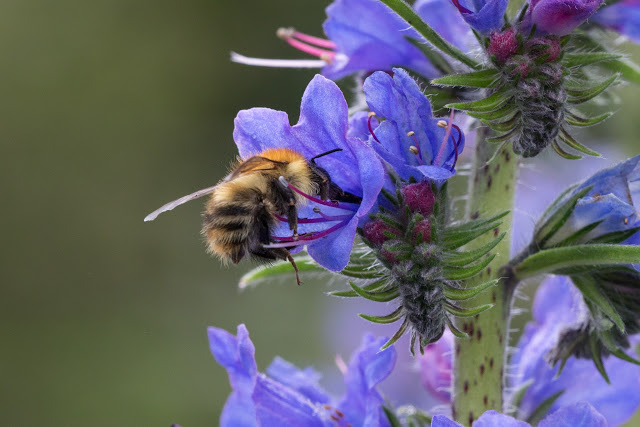
Viper’s Bugloss Mason Bees (Hoplitis anthocopoides) are solitary bees in the family Megachilidae that are closely associated with Echium vulgare, commonly known as Viper’s Bugloss. These bees are highly effective pollinators and play an important ecological role in supporting both wild plants and agricultural systems. Unlike honey bees, they do not form colonies and each female independently constructs and provisions her own nest.
Although generally considered beneficial insects, Viper’s Bugloss Mason Bees may occasionally become nuisance pests when they build nests on masonry walls, brick structures, stonework, patios, retaining walls, and other human-made surfaces. Their distinctive mud-and-sand nests can create cosmetic concerns and attract attention in residential landscapes.
Despite these nuisance issues, these bees are non-aggressive and provide valuable pollination services wherever they occur.
Taxonomy and Classification
- Kingdom: Animalia
- Phylum: Arthropoda
- Class: Insecta
- Order: Hymenoptera
- Family: Megachilidae
- Genus: Hoplitis
- Species: Hoplitis anthocopoides
Mason bees belong to a group of solitary bees known for constructing nests using mud, resin, plant fibers, or other natural materials. Unlike social bees, there are no workers, queens, or colonies.
Identification
Adult Bees
Viper’s Bugloss Mason Bees are small to medium-sized bees that typically measure between 8 and 10 millimeters in length.
- Color: Dark brown to black.
- Body: Compact and robust.
- Hair: Covered with fine pale hairs.
- Head: Broad and somewhat square-shaped.
- Flight: Fast and agile.
Females possess dense pollen-carrying hairs known as a scopa on the underside of the abdomen. When collecting pollen, the underside may appear bright yellow, orange, or gold.
Nests
The most recognizable sign of these bees is their nest structure.
- Small mud-and-sand chambers.
- Attached to stone, brick, or masonry.
- Rounded or lumpy appearance.
- Extremely hard after drying.
- Often clustered together.
Old nests may remain visible for years if not removed.
Distribution and Habitat
Viper’s Bugloss Mason Bees occur in areas where Viper’s Bugloss grows abundantly.
Common habitats include:
- Roadsides
- Meadows
- Pollinator gardens
- Prairies
- Urban landscapes
- Residential neighborhoods
- Stone walls and masonry structures
In North America, populations are concentrated in areas where their preferred host plant has become established.
Host Plant Relationship
These bees are closely associated with Viper’s Bugloss (Echium vulgare), a flowering plant that produces abundant nectar and pollen.
While they may occasionally visit other flowers, they strongly prefer Viper’s Bugloss and often rely on it for successful reproduction.
This specialized relationship explains why infestations are often found near large patches of the plant.
Life Cycle
Spring Emergence
Adults emerge during warm weather when Viper’s Bugloss begins flowering.
Mating
Males patrol flowering areas searching for females. After mating, females begin searching for suitable nesting sites.
Nest Construction
Females gather:
- Mud
- Sand particles
- Saliva
- Plant materials
These materials are combined into a mortar-like substance used to build nest chambers.
Provisioning
Each chamber is stocked with pollen and nectar before a single egg is deposited.
The chamber is then sealed and the female repeats the process.
Larval Development
Larvae consume stored food, develop within the chamber, and eventually pupate.
Overwintering
Immature bees typically remain protected within the nest until the following season.
Most populations produce one generation per year.
Damage and Nuisance Concerns
Structural Staining
The mud-and-sand nests may leave visible stains on:
- Brick walls
- Stone veneers
- Decorative masonry
- Concrete surfaces
Cosmetic Damage
Nests can detract from the appearance of homes, patios, retaining walls, and landscape structures.
Mortar Surface Wear
Repeated nest removal may occasionally cause minor surface pitting on softer masonry materials.
Nesting Density
Large numbers of nests can accumulate on favored structures, creating a noticeable nuisance.
Human Interaction
Despite their presence around homes, these bees rarely sting and pose little risk to people.
They are significantly less aggressive than honey bees, bumble bees, yellowjackets, or paper wasps.
Benefits
Viper’s Bugloss Mason Bees provide several ecological benefits.
- Excellent pollinators.
- Support native plant reproduction.
- Improve biodiversity.
- Enhance pollinator populations.
- Contribute to healthy ecosystems.
For this reason, management efforts should focus on relocation and exclusion rather than elimination whenever possible.
Signs of Activity
- Small mud nests attached to masonry.
- Frequent bee activity near Viper’s Bugloss plants.
- Pollen-covered females visiting flowers.
- Round exit holes in old nests.
- Clusters of hardened mud structures on walls.
Management and Control (IPM)
Provide Alternative Nesting Sites
Installing bee hotels can encourage females to nest away from buildings.
Commercial mason bee houses are often highly attractive alternatives.
Remove Host Plants Near Structures
Reducing large stands of Viper’s Bugloss near homes may decrease nesting pressure.
This should be balanced against pollinator conservation goals.
Seal Cracks and Crevices
Repairing masonry defects reduces potential nesting locations.
- Repair mortar joints.
- Seal wall cavities.
- Maintain exterior surfaces.
Remove Old Nests
After bees have emerged, nests can be carefully removed using plastic scrapers and warm water.
Avoid removing active nests whenever possible.
Use Physical Barriers
Smooth painted surfaces, protective coatings, and screens may discourage nesting activity.
Avoid Insecticides
Because these bees are beneficial pollinators, insecticides are generally unnecessary and discouraged.
Prevention
- Maintain exterior masonry.
- Install bee hotels away from buildings.
- Monitor structures during nesting season.
- Remove abandoned nests promptly.
- Manage nearby Viper’s Bugloss populations if necessary.
- Educate property owners about their beneficial role.
Conclusion
Viper’s Bugloss Mason Bees are valuable solitary pollinators that occasionally become nuisance pests due to their habit of constructing hardened mud nests on masonry surfaces. Although these nests may create cosmetic concerns, the bees themselves are non-aggressive and provide significant ecological benefits. Integrated management should focus on prevention, exclusion, habitat modification, and providing alternative nesting sites rather than attempting eradication.