Overview
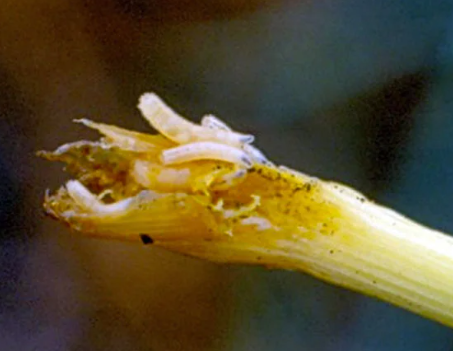
Root Maggots are the immature larval stage of several species of small flies in the genus Delia (Family Anthomyiidae). Important pest species include the Cabbage Maggot (Delia radicum), Onion Maggot (Delia antiqua), and Seedcorn Maggot (Delia platura). These pests are among the most destructive underground insects affecting vegetable production worldwide.
Root maggots attack a variety of economically important crops by feeding on roots, bulbs, stems, and underground plant tissues. Their feeding disrupts water and nutrient uptake, resulting in stunted growth, wilting, reduced yields, and, in severe infestations, complete crop failure. Because most of the damage occurs below ground, infestations often remain unnoticed until plants begin to decline.
Taxonomy and Classification
Root maggots are fly larvae belonging to the order Diptera (True Flies). They undergo complete metamorphosis, developing through egg, larval, pupal, and adult stages.
- Kingdom: Animalia
- Phylum: Arthropoda
- Class: Insecta
- Order: Diptera
- Family: Anthomyiidae
- Genus: Delia
Important agricultural species include:
- Cabbage Maggot (Delia radicum)
- Onion Maggot (Delia antiqua)
- Seedcorn Maggot (Delia platura)
- Bean Seed Maggot (Delia florilega)
Adult flies resemble small houseflies, but it is the larval stage that causes economic damage.
Physical Description
Root maggot larvae are small, legless maggots adapted for life in the soil.
- Larva (Key ID): Creamy-white, legless maggot measuring up to 8 millimeters long. The body is tapered at the head end and blunt at the rear.
- Head: No distinct head capsule is visible externally.
- Adult Fly (Key ID): Small gray or brown fly resembling a miniature housefly, typically 5 to 7 millimeters long.
- Pupa: Dark brown, oval puparium found in soil near host plants.
- Conflict: Agricultural crop destruction and yield loss.
Adult females lay eggs directly in soil cracks or at the base of host plants.
Distribution and Habitat
Root maggots occur throughout temperate agricultural regions worldwide, including North America, Europe, Asia, and parts of South America.
They are especially problematic in cool, moist climates where susceptible crops are grown.
Common habitats include:
- Vegetable gardens
- Commercial farms
- Organic production systems
- Raised beds
- Fields containing cruciferous or allium crops
Major host plants include:
- Cabbage
- Broccoli
- Cauliflower
- Brussels sprouts
- Radishes
- Turnips
- Onions
- Garlic
- Leeks
- Shallots
- Corn
- Beans
Life Cycle
Root maggots undergo complete metamorphosis with multiple generations occurring annually, depending on species and climate.
Egg Stage
Female flies deposit white, elongated eggs near the base of host plants or directly in surrounding soil.
Eggs typically hatch within several days under favorable conditions.
Larval Stage
Newly hatched maggots immediately move into roots, bulbs, or stems to begin feeding.
The larval stage usually lasts two to four weeks and is responsible for nearly all crop damage.
Pupal Stage
After completing development, larvae pupate in the soil within dark, hardened puparia.
Adult Stage
Adult flies emerge from the soil, mate, and begin searching for suitable host plants for egg laying.
Depending on environmental conditions, two to four generations may occur each year.
Behavior and Conflict
The primary conflict caused by root maggots is direct destruction of underground plant tissues.
- Root Feeding: Larvae tunnel through roots, stems, and bulbs, disrupting water and nutrient transport.
- Host Selection: Adult flies use plant odors and chemical cues to locate suitable egg-laying sites.
- Secondary Disease: Feeding wounds allow bacteria and fungi to invade damaged tissue.
- Rapid Decline: Young seedlings may collapse and die quickly after infestation.
Damage often appears suddenly because feeding occurs entirely below the soil surface.
Damage and Symptoms
Symptoms vary depending on the crop and severity of infestation.
Above-Ground Symptoms
- Wilting despite adequate soil moisture
- Yellowing foliage
- Stunted growth
- Poor vigor
- Reduced yield
- Plant death
Below-Ground Symptoms
- Tunnels in roots and stems
- Soft rot of bulbs or roots
- Brown or black feeding scars
- Hollowed plant tissues
- Decay caused by secondary pathogens
In onions and garlic, infested bulbs often become soft and rot during storage. In crucifer crops, seedlings may wilt and collapse entirely.
Economic Importance
Root maggots are among the most important soil insect pests affecting vegetable production worldwide.
Economic losses result from:
- Reduced crop yields
- Plant mortality
- Reduced market quality
- Storage losses
- Increased management costs
Severe infestations may require complete replanting of affected fields.
Management and Control (IPM)
Successful management relies heavily on prevention, exclusion, and cultural practices.
Exclusion (Key Management Strategy)
- Install fine-mesh floating row covers immediately after planting.
- Secure cover edges tightly to prevent adult flies from reaching plants.
- Remove covers only when pollination is required.
Cultural Control
- Crop Rotation: Avoid planting susceptible crops in the same location in consecutive years.
- Sanitation: Remove crop residues promptly after harvest.
- Delayed Planting: Plant after peak fly emergence when practical.
- Proper Spacing: Improve airflow and reduce favorable conditions.
Physical Controls
- Use cardboard or felt collars around plant stems to prevent egg laying.
- Inspect seedlings regularly for early signs of infestation.
Biological Control
Several natural enemies help suppress root maggot populations.
- Ground beetles
- Rove beetles
- Parasitic wasps
- Predatory mites
- Entomopathogenic nematodes
Beneficial nematodes applied to soil can reduce larval populations in some situations.
Chemical Control
In commercial production systems, insecticides may be applied as seed treatments, soil drenches, or in-furrow applications when economic thresholds are exceeded.
Chemical applications are most effective when timed to coincide with egg hatch.
Prevention
- Rotate crops annually.
- Remove weeds that may serve as alternate hosts.
- Use healthy transplants.
- Monitor adult fly activity using yellow sticky traps.
- Maintain good field sanitation.
- Destroy infested plants promptly.
Research and Future Directions
Current research focuses on developing resistant crop varieties, improving monitoring systems using odor-based traps, enhancing biological control programs, and integrating beneficial nematodes into sustainable pest management programs.
Conclusion
Root Maggots are serious agricultural pests capable of causing significant losses in vegetable crops. Because their larvae feed below ground, infestations can be difficult to detect until extensive damage has already occurred. Integrated pest management strategies emphasizing exclusion, crop rotation, sanitation, and biological control provide the most effective long-term management solutions.