Overview
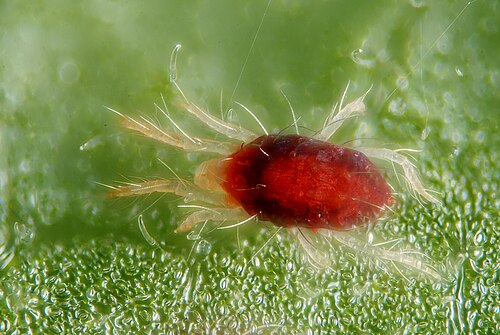
Red Mites most commonly refer to the European Red Mite (Panonychus ulmi), one of the most economically important mite pests affecting fruit trees worldwide. Other small reddish mites, such as clover mites, may also be referred to as red mites, but P. ulmi is considered the primary agricultural species. Unlike insects, red mites are arachnids, making them close relatives of spiders and ticks.
Red mites feed by piercing individual plant cells and extracting their contents. This feeding causes characteristic stippling, bronzing, and discoloration of leaves, reducing the plant’s ability to photosynthesize efficiently. Severe infestations can lead to premature leaf drop, reduced fruit quality, lower yields, and increased plant stress.
Because of their rapid reproductive capacity and ability to develop resistance to pesticides, red mites are considered major pests in orchards and agricultural systems worldwide.
Taxonomy and Classification
Red Mites belong to the family Tetranychidae, commonly known as spider mites.
- Kingdom: Animalia
- Phylum: Arthropoda
- Class: Arachnida
- Order: Trombidiformes
- Family: Tetranychidae
- Genus: Panonychus
- Species: Panonychus ulmi
Red mites undergo simple metamorphosis consisting of egg, larva, protonymph, deutonymph, and adult stages.
Physical Description
Adult Red Mites are extremely small, measuring less than 0.5 mm in length.
- Adult (Key ID): Oval, reddish-orange body with conspicuous white tubercles at the base of long body hairs (setae).
- Legs: Adults possess eight legs, characteristic of arachnids.
- Egg (Key ID): Tiny, bright red, spherical eggs often laid in clusters on bark, twigs, buds, and fruit spurs.
- Larva: Newly hatched larvae have only six legs before developing into eight-legged nymphs.
- Damage Sign (Key ID): Fine yellow, white, or bronze stippling on foliage.
- Conflict: Significant agricultural pest causing reduced photosynthesis and crop losses.
Distribution and Habitat
European Red Mites are distributed throughout temperate fruit-growing regions worldwide.
They are especially common in orchards producing:
- Apples
- Pears
- Peaches
- Plums
- Cherries
- Quince
- Grapes
Red mites primarily inhabit the undersides of leaves where they feed and reproduce. During winter, eggs overwinter on bark, around buds, and in protected crevices on host plants.
Life Cycle
Red Mites undergo multiple generations each year, particularly under favorable environmental conditions.
Egg Stage
Females lay bright red overwintering eggs on twigs, bark, and fruit spurs during late summer and autumn.
Eggs survive winter and hatch during spring as buds begin to break.
Larval Stage
Larvae emerge with six legs and immediately begin feeding on leaf tissue.
Nymphal Stages
Following the larval stage, mites develop through protonymph and deutonymph stages.
Each stage is separated by a molt.
Adult Stage
Adults continue feeding and reproduction throughout the growing season.
Under warm conditions, an entire generation may be completed in as little as two to three weeks, allowing populations to increase rapidly.
Behavior and Feeding Habits
Red Mites feed by inserting needle-like mouthparts into plant cells and removing cellular contents.
This feeding destroys chlorophyll-containing tissues and disrupts normal photosynthesis.
- Leaf Feeding: Most feeding occurs on the undersides of leaves.
- Rapid Population Growth: Populations expand quickly during hot, dry weather.
- Aggregation: Large numbers often concentrate on heavily infested leaves.
- Dispersal: Mites may spread between plants through wind, equipment, or direct plant contact.
Damage and Symptoms
Damage caused by Red Mites primarily affects plant vigor and productivity.
Early Symptoms
- Fine white or yellow stippling on leaves
- Slight discoloration
- Reduced leaf sheen
Moderate Infestations
- Bronzing of foliage
- Reduced photosynthetic activity
- Leaf curling
- Overall plant stress
Severe Infestations
- Premature leaf drop
- Reduced fruit size
- Poor fruit coloration
- Reduced sugar accumulation
- Lower yields
- Increased susceptibility to environmental stress
Repeated heavy infestations may weaken trees over multiple growing seasons.
Economic Importance
Red Mites are among the most economically important orchard pests worldwide.
Crop losses result from:
- Reduced photosynthesis
- Lower fruit quality
- Smaller fruit size
- Reduced marketability
- Increased management costs
Commercial orchards often implement extensive monitoring programs to prevent populations from exceeding economic thresholds.
Management and Control (Integrated Mite Management)
Successful management relies on Integrated Mite Management (IMM), combining biological, cultural, and chemical methods.
Monitoring
- Regularly inspect leaves for mites and eggs.
- Examine leaf undersides using a hand lens.
- Monitor populations throughout the growing season.
Biological Control (Key Strategy)
Natural enemies provide highly effective suppression.
- Typhlodromus pyri
- Amblyseius species
- Lady beetles
- Minute pirate bugs
- Lacewings
Conserving predatory mites is one of the most effective long-term management approaches.
Cultural Control
- Avoid excessive nitrogen fertilization.
- Reduce dust accumulation in orchards.
- Maintain overall tree health.
- Avoid unnecessary broad-spectrum insecticides.
Chemical Control
- Dormant Oil Sprays: Applied during late winter to smother overwintering eggs.
- Acaricides (Miticides): Specialized products may be used when economic thresholds are exceeded.
- Resistance Management: Rotate chemical classes to slow resistance development.
Research and Future Management
Current research focuses on improving biological control programs, developing selective miticides, understanding resistance mechanisms, and preserving natural predator populations.
Scientists are also studying sustainable orchard management systems that minimize pesticide use while maintaining effective mite suppression.
Conclusion
Red Mites are significant agricultural pests capable of causing extensive damage to fruit trees and other crops. Their small size, rapid reproduction, and ability to develop insecticide resistance make them challenging pests to manage. Through regular monitoring, conservation of predatory mites, and implementation of Integrated Mite Management strategies, growers can successfully maintain populations below damaging levels and protect crop productivity.