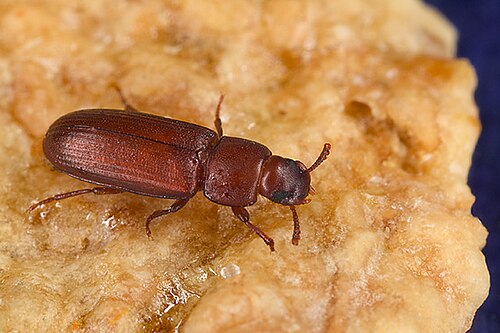
Red Flour Beetles (Tribolium castaneum) are among the most common and widespread stored product pests found in homes, food-processing facilities, warehouses, and grain storage systems worldwide. These small reddish-brown beetles primarily infest processed grain products such as flour, cereals, pasta, cake mixes, spices, and pet food. Unlike primary grain pests that attack whole kernels, red flour beetles are considered secondary pests because they typically infest cracked grains, milled products, and previously damaged food materials.
Red flour beetles are significant pests because they contaminate food products with their bodies, shed skins, fecal material, and defensive secretions. Heavy infestations can cause stored products to develop a strong, unpleasant odor and become unsuitable for human or animal consumption. Their ability to reproduce rapidly and survive for extended periods makes them particularly challenging pests in both residential and commercial settings.
Taxonomy and Classification
Red flour beetles belong to the family Tenebrionidae, commonly known as darkling beetles.
- Kingdom: Animalia
- Phylum: Arthropoda
- Class: Insecta
- Order: Coleoptera
- Family: Tenebrionidae
- Genus: Tribolium
- Species: Tribolium castaneum
Red flour beetles undergo complete metamorphosis, progressing through egg, larval, pupal, and adult stages.
Physical Description
Adult red flour beetles are approximately 3 to 4 millimeters long and possess a flattened, elongated body shape that allows them to hide in narrow cracks and crevices.
- Adult (Key ID): Shiny reddish-brown, flattened body with well-developed wings and antennae ending in a distinctive three-segmented club.
- Larva (Key ID): Slender, yellowish-brown, worm-like larvae resembling tiny mealworms; mature larvae possess two short projections on the end of the abdomen.
- Pupa: Cream-colored and immobile, gradually darkening before adult emergence.
- Damage ID: Presence of beetles, larvae, shed skins, and foul-smelling flour or grain products.
- Conflict: Stored Product, Structural.
Red flour beetles are frequently confused with the closely related Confused Flour Beetle (Tribolium confusum). The easiest distinguishing characteristic is the antennae. Red flour beetles have a three-segmented antennal club, while confused flour beetles possess a gradual four-segmented club.
Distribution and Habitat
Red flour beetles have a cosmopolitan distribution and are found in virtually every region of the world where grain products are stored or processed.
Common habitats include:
- Kitchen pantries
- Food storage rooms
- Grain elevators
- Flour mills
- Food manufacturing facilities
- Pet food storage areas
- Warehouses
- Retail food stores
They thrive in warm, humid environments and are especially abundant where fine food particles accumulate in cracks, machinery, shelving, and beneath equipment.
Life Cycle
Red flour beetles develop rapidly under favorable environmental conditions.
Egg Stage
Females lay tiny white eggs directly into food products or among food dust and debris. A single female may produce 300 to 500 eggs during her lifetime.
Larval Stage
Larvae hatch within several days and immediately begin feeding. They pass through multiple molts while consuming flour, grain particles, and other organic materials.
Pupal Stage
Mature larvae transform into pupae within the food material or hidden crevices.
Adult Stage
Adults emerge from pupae and begin feeding and reproducing shortly afterward. Under ideal conditions, development from egg to adult may occur in as little as 30 to 40 days.
Adults are exceptionally long-lived and may survive for more than one year.
Behavior and Conflict
The economic importance of red flour beetles stems from their remarkable adaptability and reproductive capacity.
- Pungent Secretions: Adults and larvae produce defensive quinones that create a strong, unpleasant odor in heavily infested products.
- Long Lifespan: Adults may survive for over a year, continually reproducing.
- Rapid Population Growth: Populations can increase quickly under warm conditions.
- Hidden Infestations: Beetles readily hide in cracks, crevices, and equipment, making elimination difficult.
Heavy infestations can spread rapidly throughout a pantry or commercial facility if not addressed promptly.
Food Sources
Red flour beetles feed on a broad range of stored food products, including:
- Flour
- Cereal products
- Cake mixes
- Pasta
- Cornmeal
- Rice products
- Spices
- Dried fruits
- Nuts
- Beans
- Chocolate
- Pet food
- Bird seed
Unlike primary grain pests, they generally cannot successfully infest intact whole grains unless kernels are damaged.
Damage and Economic Importance
Red flour beetles cause significant economic losses throughout the food supply chain.
Common forms of damage include:
- Food contamination with insects and shed skins.
- Development of foul odors and flavors.
- Reduced product quality.
- Weight loss in stored products.
- Consumer complaints and product recalls.
- Increased sanitation and pest management costs.
The quinone secretions produced by these beetles can turn flour grayish or pinkish and impart a musty odor that makes products unsuitable for consumption.
Management and Prevention
Management of red flour beetles relies heavily on sanitation, exclusion, and integrated pest management (IPM).
Sanitation (Key Strategy)
- Thoroughly remove spilled flour and food residues.
- Vacuum cracks, shelf corners, and crevices regularly.
- Clean beneath appliances and storage shelves.
- Dispose of heavily infested products immediately.
Even small accumulations of food dust can support large populations.
Exclusion and Storage
- Store susceptible foods in airtight containers.
- Use glass, metal, or heavy-duty plastic containers.
- Inspect newly purchased food products before storage.
- Rotate stored foods regularly.
Monitoring
- Inspect pantries and storage areas routinely.
- Use pheromone traps to detect adult beetles.
- Monitor food-processing equipment for hidden infestations.
Commercial Control
Commercial facilities may utilize:
- Heat treatments
- Structural fumigation
- Residual insecticides
- Pheromone-based monitoring systems
- Strict sanitation programs
Fumigation is commonly used in flour mills and large storage facilities when infestations become severe.
Research and Scientific Importance
The red flour beetle is one of the world’s most important model organisms in biological research. Scientists frequently use Tribolium castaneum to study genetics, developmental biology, evolution, and insect physiology.
Current pest management research focuses on:
- Improved pheromone lures
- Genetic control technologies
- Biological control agents
- Reduced-risk insecticides
- Resistance management strategies
Conclusion
Red Flour Beetles are among the most important stored product pests worldwide. Their ability to contaminate food, reproduce rapidly, and survive in hidden locations makes them challenging pests in homes and commercial facilities alike. Effective management depends on thorough sanitation, proper food storage, early detection, and integrated pest management practices.