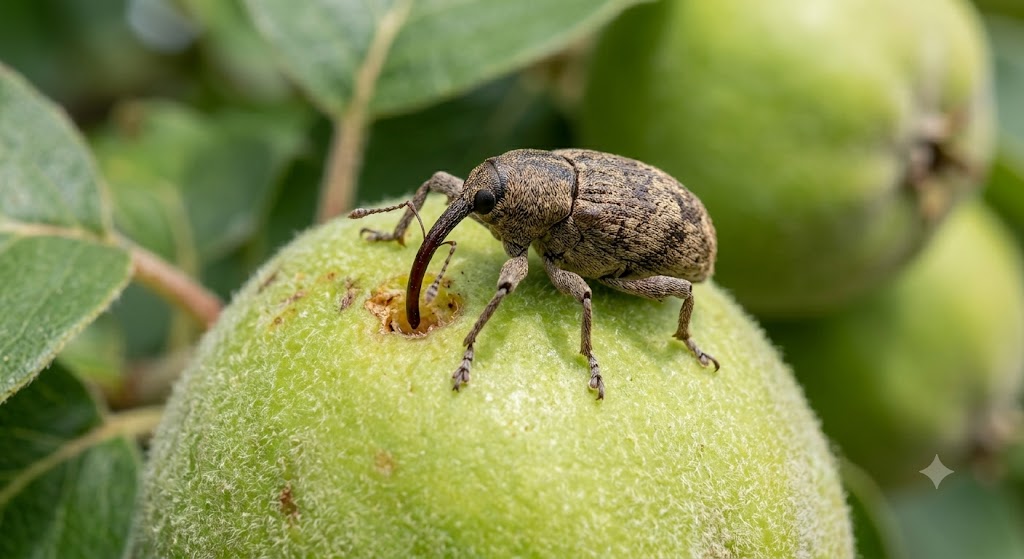
Quince Curculio (Conotrachelus crataegi) is a native North American weevil that attacks developing fruit, especially quince, hawthorn, apple, and pear. Although small, this snout beetle can cause serious fruit loss when adults puncture young fruit to feed and lay eggs. The resulting injury creates distinctive crescent-shaped scars, while the larvae tunnel inside the fruit and contaminate the flesh. Infested fruit often becomes lumpy, distorted, inedible, and may drop from the tree before maturity.
For home orchard growers and small fruit producers, Quince Curculio is an important pest because much of its damage occurs early in fruit development. Once the larva is protected inside the fruit, control becomes difficult. Successful management depends on recognizing adult emergence, monitoring fruit shortly after bloom, removing infested drops, and timing treatments before eggs hatch or larvae become established.
Taxonomy and Classification
Quince Curculio belongs to the large weevil family Curculionidae. Weevils are beetles recognized by their elongated snouts, or rostrums, which many species use for feeding, boring, or egg placement.
- Order: Coleoptera
- Family: Curculionidae
- Genus: Conotrachelus
- Species: Conotrachelus crataegi
- Common Name: Quince Curculio
Like other beetles, Quince Curculio undergoes complete metamorphosis with egg, larval, pupal, and adult stages. The larval stage is the most destructive because the grub develops inside the fruit, where it is sheltered from many external control measures.
Physical Description
Adult Quince Curculios are small, mottled beetles measuring about 1/4 inch long. Their grayish-brown coloration helps them blend into bark, buds, and soil debris beneath host trees.
- Adult Size: About 1/4 inch long
- Color: Grayish-brown, mottled, or bark-like
- Body Shape: Compact, hard-bodied, and slightly rough-textured
- Snout: Long, slender rostrum used for puncturing fruit
- Larva: White, C-shaped, legless grub inside fruit flesh
The most reliable signs are usually found on the fruit rather than the adult beetle. Females create small crescent-shaped or banana-shaped scars while laying eggs. As larvae feed internally, the fruit may become misshapen, bumpy, sunken, or prematurely discolored.
Key damage symptoms include:
- Crescent-shaped egg-laying scars
- Pinpoint feeding punctures
- Lumpy or deformed fruit
- Internal tunnels in the flesh
- Brown, corky areas around wounds
- Premature fruit drop
- White legless grubs inside damaged fruit
Distribution and Habitat
Quince Curculio is found across parts of eastern North America, especially in areas where quince, hawthorn, apple, pear, and related host plants are grown or occur naturally. It is often associated with orchards, home gardens, hedgerows, woodland edges, and unmanaged wild host trees.
Common host plants include:
- Quince
- Hawthorn
- Apple
- Pear
- Crabapple
- Other related pome fruit hosts
The insect overwinters in sheltered sites near host trees, often in soil, leaf litter, grass, or debris. Adults become active when temperatures warm and host trees begin flowering and setting young fruit.
Life Cycle
The seasonal timing of Quince Curculio is closely tied to bloom and early fruit development. Adults typically emerge around the period shortly after petal fall, when small fruitlets become available for feeding and egg laying.
Females use their snouts to puncture the fruit and deposit eggs beneath the surface. After hatching, larvae feed inside the developing fruit for several weeks. Their tunneling causes internal breakdown and outward deformation as the fruit continues growing.
Infested fruit often drops before maturity. Larvae then exit the fruit and enter the soil, where they complete development and pupate. Depending on climate and local conditions, adults may remain in protected sites until the following season.
Behavior and Crop Damage
The main conflict with Quince Curculio comes from hidden larval feeding. A fruit may look only lightly scarred from the outside, yet contain internal tunneling, frass, tissue breakdown, and larvae. This damage makes fruit unsuitable for fresh market sale and undesirable for home use.
Damage is especially serious on quince because fruit quality is strongly affected by deformation and internal contamination. Apples, pears, and hawthorn fruits may also be damaged, particularly near unmanaged host plants that maintain local populations.
Because larvae are protected inside the fruit, sprays applied too late are less effective. Management must focus on adult activity, egg laying, and sanitation of fallen fruit before larvae complete development.
Management and Prevention
Quince Curculio management relies on integrated pest management (IPM), especially sanitation, monitoring, and properly timed control measures. Home orchard growers should focus on breaking the life cycle and reducing the number of larvae that reach the soil.
| Management Strategy | Description | Purpose |
|---|---|---|
| Remove Fallen Fruit | Collect and destroy dropped or infested fruit as soon as it appears. | Prevents larvae from completing development in the soil. |
| Monitor After Petal Fall | Inspect young fruit for crescent scars and feeding punctures. | Detects adult activity early. |
| Timed Orchard Sprays | Apply registered fruit-tree insecticides according to label directions shortly after petal fall when adults are active. | Targets adults before heavy egg laying occurs. |
| Remove Wild Hosts | Manage nearby neglected quince, hawthorn, or crabapple hosts when practical. | Reduces local reinfestation pressure. |
| Soil and Debris Cleanup | Keep orchard floors clear of fruit debris and dense litter beneath host trees. | Reduces overwintering and pupation shelter. |
Infested fruit should not be composted unless the composting process reliably reaches temperatures high enough to kill larvae. Freezing, solarizing in sealed bags, deep burial where permitted, or disposal with household waste may be more effective options for small-scale growers.
In commercial orchards, treatment timing is critical. Registered insecticides are usually most effective when applied soon after petal fall and before larvae are protected inside the fruit. Growers should follow local extension recommendations and pesticide labels for crop-specific guidance.
Monitoring
Monitoring should begin as petals fall and young fruit begins to form. Growers can inspect fruit directly for crescent scars, feeding punctures, and early distortion. In some situations, beating trays or jarring boards may help detect adult weevils hiding in the canopy.
Regular inspection is important because infestations can intensify quickly during the egg-laying window. Early detection allows control measures to be used before serious internal damage develops.
Conservation and Research
Quince Curculio is managed as a significant fruit pest, especially where quince and related pome fruits are grown. Research interests include improved monitoring tools, attractant development, biological control, and better timing models based on temperature and host plant development.
Beneficial insects, including some parasitic wasps, may attack curculio larvae or eggs, but natural enemies alone rarely provide complete control in high-value fruit crops. IPM programs aim to balance effective fruit protection with conservation of beneficial orchard organisms.
Conclusion
Quince Curculio is a small native weevil capable of causing serious fruit damage in quince, hawthorn, apple, pear, and related hosts. Its crescent-shaped egg scars, internal larval tunnels, lumpy fruit deformation, and premature fruit drop make it a frustrating pest for both home and commercial growers. Since larvae are protected inside fruit, control must focus on early monitoring, sanitation, and precisely timed treatments shortly after petal fall. Removing infested fruit and interrupting the life cycle are essential steps for reducing future populations.