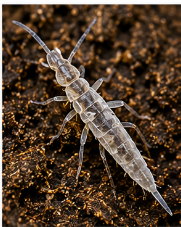
Proturans are tiny, soil-dwelling hexapods belonging to the order Protura, a primitive group of wingless arthropods that spend their entire lives hidden beneath the soil surface. Measuring less than 2 millimeters long, these microscopic creatures are among the least-known terrestrial animals despite being abundant in healthy soils around the world. Unlike true insects, proturans lack both antennae and eyes, relying instead on their highly sensitive front legs to explore their surroundings. They play an essential role in soil ecology by feeding on fungi, decomposing organic matter, and contributing to nutrient cycling.
Although rarely seen by homeowners or gardeners, proturans are considered valuable indicators of healthy soil ecosystems. They pose no threat to people, pets, crops, or structures and should be regarded as beneficial members of the underground food web.
Taxonomy and Classification
Proturans belong to the class Entognatha, a group of primitive hexapods that also includes springtails and diplurans. Unlike true insects, their mouthparts are enclosed within the head capsule, and they possess several unique anatomical features.
- Kingdom: Animalia
- Phylum: Arthropoda
- Subphylum: Hexapoda
- Class: Entognatha
- Order: Protura
- Common Name: Proturans
More than 800 species have been described worldwide, with new species continuing to be discovered as soil biodiversity research expands.
Physical Description
Proturans are among the smallest terrestrial arthropods and require magnification for proper identification.
- Length: 0.5–2 mm
- Color: White, cream, or translucent
- Eyes: None
- Antennae: Absent
- Front Legs: Enlarged and held forward, functioning like sensory antennae
- Body: Elongated, soft-bodied, and segmented
- Wings: None
One unusual characteristic of proturans is that young individuals actually gain additional abdominal segments as they mature, a developmental process rarely seen among arthropods.
Distribution and Habitat
Proturans have a nearly worldwide distribution and occur wherever moist soils support microbial life.
Common habitats include:
- Forest soils
- Leaf litter
- Compost
- Grasslands
- Agricultural soils
- Garden beds
- Moss and decaying vegetation
- Humus-rich woodland floors
They thrive in moist environments with abundant organic matter and are rarely found in dry, disturbed, or heavily compacted soils.
Life Cycle
Proturans develop through gradual growth rather than complete metamorphosis.
- Egg: Tiny eggs are deposited within moist soil.
- Juvenile Stages: Immature proturans resemble miniature adults and molt several times.
- Adult: Mature individuals continue living within the soil, feeding and reproducing throughout favorable conditions.
Their entire life cycle occurs underground, making them one of the least-observed groups of terrestrial arthropods.
Behavior and Ecology
Proturans move slowly through microscopic spaces between soil particles using their front legs as sensory organs. Because they lack eyes and antennae, these specialized legs detect food, moisture, and environmental cues.
Their diet primarily consists of:
- Fungal hyphae
- Fungal spores
- Decaying organic matter
- Microorganisms
- Plant detritus
- Soil biofilms
By feeding on fungi and decomposing organic material, proturans help recycle nutrients and improve overall soil health.
Ecological Importance
Although nearly invisible to the naked eye, proturans perform several valuable ecological functions.
- Nutrient Cycling: Help decompose organic matter.
- Fungal Regulation: Consume fungal spores and hyphae.
- Soil Formation: Contribute to healthy soil structure.
- Food Web Support: Serve as prey for predatory mites, spiders, centipedes, and other soil organisms.
- Soil Health Indicators: Their presence often reflects biologically active, undisturbed soils.
Because they remain entirely underground, they have no direct impact on household environments.
Management and Prevention
Proturans require no control and should be considered beneficial organisms.
- Do not apply insecticides solely because proturans are present.
- Maintain healthy soil with organic matter.
- Avoid excessive soil disturbance whenever possible.
- Reduce unnecessary pesticide applications that harm beneficial soil organisms.
- Encourage composting and mulching to support soil biodiversity.
Healthy populations of proturans are generally viewed as signs of productive, living soil.
Conservation and Research
Scientists continue studying proturans because many species remain poorly understood. Advances in soil biology and DNA analysis have revealed that these tiny arthropods contribute significantly to nutrient cycling, microbial regulation, and ecosystem functioning. Their sensitivity to pollution, soil compaction, and habitat disturbance also makes them useful indicators of environmental quality.
Conclusion
Proturans are tiny, wingless soil arthropods that quietly perform essential ecological functions beneath our feet. Despite lacking eyes and antennae, they have evolved remarkable sensory adaptations that allow them to thrive in dark underground environments. By feeding on fungi and organic matter, they contribute to decomposition, nutrient recycling, and overall soil health. While virtually unknown outside scientific circles, these microscopic organisms represent an important component of healthy forest, garden, and agricultural ecosystems.