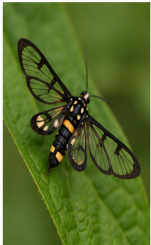
Polka Dot Wasp Moths (Syntomeida epilais) are striking day-flying moths that closely resemble stinging wasps. Their glossy black wings covered with bright white spots and metallic blue-black bodies with vivid orange markings create one of the most recognizable warning color patterns among North American moths. This remarkable resemblance to wasps is an example of Batesian mimicry, helping protect the harmless moth from predators that avoid stinging insects.
Native to the Caribbean and tropical regions of the Americas, the Polka Dot Wasp Moth has become well established throughout Florida and parts of the southeastern United States where ornamental oleander is widely planted. While the adult moth is an important nectar-feeding pollinator, its caterpillars—commonly called Oleander Caterpillars—can rapidly defoliate oleander shrubs when populations become abundant. Although healthy plants usually recover, repeated heavy infestations can weaken ornamental landscapes.
Taxonomy and Classification
Polka Dot Wasp Moths belong to the family Erebidae, within the tiger moth subfamily Arctiinae. Despite their wasp-like appearance, they are true moths and are closely related to tiger moths and lichen moths.
- Order: Lepidoptera
- Family: Erebidae
- Subfamily: Arctiinae
- Genus: Syntomeida
- Species: Syntomeida epilais
The species is commonly known as both the Polka Dot Wasp Moth and the Oleander Moth because of its close association with oleander plants.
Physical Description
Adult Polka Dot Wasp Moths are among the easiest moths to identify.
- Wingspan: Approximately 35–45 mm.
- Forewings: Glossy black with numerous bright white spots.
- Body: Metallic blue-black with vivid orange or reddish markings on the abdomen.
- Antennae: Slender and slightly clubbed.
- Larvae: Bright orange caterpillars covered with long black hair-like tufts.
Their bold coloration closely mimics that of stinging wasps, discouraging many predators from attacking them.
Distribution and Habitat
Polka Dot Wasp Moths are most common in warm climates where oleander grows year-round.
Typical habitats include:
- Florida
- Southeastern United States
- Caribbean Islands
- Tropical landscapes
- Urban gardens
- Parks and ornamental plantings
They are especially abundant wherever oleander shrubs are planted as landscape ornamentals.
Behavior and Life Cycle
Polka Dot Wasp Moths undergo complete metamorphosis consisting of egg, larva, pupa, and adult stages.
Females deposit clusters of eggs on the undersides of oleander leaves. After hatching, the colorful caterpillars feed gregariously, rapidly consuming foliage. As they mature, larvae disperse and continue feeding individually before pupating in silken cocoons attached to vegetation or nearby structures.
Adults are active during daylight hours and frequently visit flowers for nectar. Unlike most moths, they are commonly seen flying in bright sunshine.
Damage and Economic Importance
The caterpillar stage causes all significant plant damage.
- Defoliation: Caterpillars consume large amounts of oleander foliage.
- Ornamental Damage: Heavy infestations can temporarily strip shrubs of leaves.
- Reduced Appearance: Landscape plants may appear unsightly following severe feeding.
- Repeated Infestations: Multiple generations can weaken stressed plants.
- Limited Host Range: Feeding is primarily restricted to oleander and a few closely related plants.
Healthy oleander shrubs generally recover quickly after defoliation, although repeated outbreaks may reduce plant vigor.
Management and Prevention
Integrated Pest Management (IPM) provides effective control while minimizing impacts on beneficial insects.
- Inspect Plants Regularly: Look for egg masses and young caterpillars on new foliage.
- Hand Removal: Small infestations can often be removed manually.
- Encourage Natural Enemies: Birds, predatory insects, and parasitic wasps help suppress populations.
- Prune Heavily Infested Branches: Remove localized infestations before caterpillars spread.
- Use Targeted Treatments: Apply appropriate biological or labeled insecticides only when significant damage occurs.
Conservation and Research
Researchers study Polka Dot Wasp Moths because of their remarkable mimicry, chemical defenses, and specialized relationship with oleander plants. The caterpillars are capable of storing toxic compounds from their host plant, making both larvae and adults distasteful to many predators. This combination of toxicity and warning coloration makes them an excellent example of defensive evolution.
Conclusion
Polka Dot Wasp Moths are beautiful day-flying tiger moths that combine striking appearance with fascinating defensive adaptations. While adult moths are harmless pollinators, their caterpillars can become significant ornamental pests on oleander shrubs during heavy infestations. With proper monitoring and Integrated Pest Management practices, damage can usually be minimized while preserving these remarkable native insects.