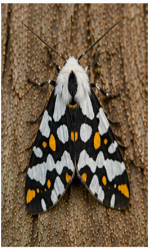
Police Car Moths (Gnophaela vermiculata) are striking tiger moths named for the bold black-and-white markings on their wings, which resemble the contrasting colors of traditional police vehicles. Unlike many nocturnal moths, Police Car Moths are primarily active during the day, flying through mountain meadows and forest clearings in search of nectar-rich flowers. Their conspicuous coloration serves as a warning to predators that they may be chemically protected by toxins acquired during their larval stage.
Although their appearance is dramatic, Police Car Moths are completely harmless to humans, pets, and healthy landscapes. Their caterpillars feed on a limited range of native plants and rarely reach numbers capable of causing noticeable damage. Instead, these colorful moths are valued as important pollinators and indicators of healthy mountain ecosystems.
Taxonomy and Classification
Police Car Moths belong to the family Erebidae, within the tiger moth subfamily Arctiinae. Tiger moths are well known for their brilliant warning colors, chemical defenses, and often hairy caterpillars.
- Order: Lepidoptera
- Family: Erebidae
- Subfamily: Arctiinae
- Genus: Gnophaela
- Species: Gnophaela vermiculata
The genus Gnophaela includes several North American species adapted to cool, mountainous habitats.
Physical Description
Police Car Moths are among the most recognizable tiger moths because of their bold contrasting wing patterns.
- Wingspan: Approximately 30–40 mm.
- Forewings: Glossy black with distinctive white spots or bands.
- Body: Dark with yellow or orange markings along the thorax and abdomen.
- Antennae: Moderately feathered, particularly in males.
- Larvae: Hairy caterpillars with dark coloration that feed on native vegetation.
The striking black-and-white pattern serves as aposematic coloration, warning predators that the moth may be unpalatable.
Distribution and Habitat
Police Car Moths are found primarily throughout western North America, especially in cooler mountainous regions.
Typical habitats include:
- Mountain meadows
- Conifer forests
- Forest edges
- High-elevation valleys
- Wildflower-rich slopes
- Riparian woodland habitats
Adults are commonly seen visiting flowers during warm summer days.
Behavior and Life Cycle
Police Car Moths undergo complete metamorphosis consisting of egg, larva, pupa, and adult stages.
Females deposit eggs on suitable host plants, including honeysuckles (Lonicera) and several other native shrubs and herbaceous plants. Hairy caterpillars feed on foliage through multiple molts before pupating in protected locations among leaf litter or vegetation.
Unlike most moths, adults are active during daylight hours. They fly deliberately between flowers while feeding on nectar and may also visit blossoms during early evening.
Ecological Importance
Police Car Moths contribute to healthy mountain ecosystems in several important ways.
- Pollination: Adults transfer pollen while feeding on flower nectar.
- Wildlife Food Source: Caterpillars and adults support birds, spiders, and predatory insects.
- Warning Coloration: Their bold markings help scientists study predator-prey relationships and mimicry.
- Native Biodiversity: They contribute to the diversity of western mountain habitats.
- Minimal Plant Damage: Larval feeding rarely affects healthy host plants.
The species is considered beneficial and plays an important role in maintaining natural ecological balance.
Management and Prevention
No management is normally required because Police Car Moths are harmless and beneficial.
- No Pest Control Needed: They do not damage structures, stored products, or landscape plants.
- Protect Native Flowers: Maintaining flowering plants provides nectar resources for adults.
- Avoid Broad-Spectrum Insecticides: Preserving beneficial moth populations supports local biodiversity.
- Conserve Natural Habitats: Healthy forests and mountain meadows help sustain native populations.
Conservation and Research
Entomologists study Police Car Moths for their warning coloration, chemical defenses, and daytime activity. Their distinctive appearance makes them useful subjects for research into predator avoidance, mimicry, and pollinator ecology. Because they depend on healthy native mountain habitats, they may also serve as indicators of environmental quality.
Conclusion
Police Car Moths are beautiful day-flying tiger moths whose bold black-and-white coloration makes them easy to recognize throughout western North America’s mountain landscapes. Although their appearance is striking, they are harmless insects that contribute to pollination, biodiversity, and healthy ecosystems. Their unique coloration and ecological importance make them one of the more fascinating native tiger moths.