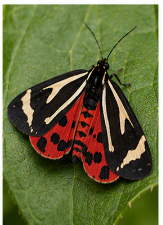
Phyllira Tiger Moths (Apantesis phyllira) are attractive members of the tiger moth family found throughout portions of eastern and central North America. Known for their boldly patterned wings and fuzzy caterpillars, these moths are an important part of native grassland and woodland ecosystems. Although their colorful appearance may suggest that they are harmful, Phyllira Tiger Moths are considered beneficial native insects that contribute to biodiversity and serve as food for numerous birds, bats, reptiles, and predatory insects.
Adult moths are primarily nocturnal and are often attracted to porch lights during warm summer evenings. Their larvae, commonly called woolly bears, feed on a wide variety of low-growing herbaceous plants but rarely occur in numbers large enough to cause significant damage. As a result, Phyllira Tiger Moths are not considered agricultural or structural pests and require no pest management under normal conditions.
Overview
The Phyllira Tiger Moth belongs to the family Erebidae, subfamily Arctiinae, a diverse group containing hundreds of brightly colored tiger moth species. Many members of this family display vivid hindwings that remain hidden while the moth is resting but become highly visible when disturbed, startling predators and advertising the moth’s chemical defenses.
Like other tiger moths, Apantesis phyllira undergoes complete metamorphosis and spends much of its life as a caterpillar feeding on vegetation before transforming into an adult moth.
Taxonomy and Classification
- Order: Lepidoptera
- Family: Erebidae
- Subfamily: Arctiinae
- Genus: Apantesis
- Species: Apantesis phyllira
- Common Name: Phyllira Tiger Moth
The genus Apantesis contains numerous colorful tiger moths that were formerly classified under several different genera before taxonomic revisions combined many North American species.
Identification
Adult Phyllira Tiger Moths are medium-sized moths with striking coloration that makes them among the more recognizable tiger moths.
- Wingspan: Approximately 35–45 mm.
- Forewings: Brown to dark brown with cream or pale tan markings forming irregular lines and patches.
- Hindwings: Bright orange to reddish-orange with distinct black spots.
- Body: Hairy and robust with contrasting black and orange coloration.
- Antennae: Feather-like in males and more slender in females.
When at rest, the colorful hindwings are concealed beneath the patterned forewings, providing effective camouflage against bark, leaves, and leaf litter.
Life Cycle
Phyllira Tiger Moths undergo complete metamorphosis consisting of four stages:
- Egg
- Larva (woolly bear caterpillar)
- Pupa
- Adult moth
Females deposit eggs on suitable host plants during the growing season. After hatching, the hairy caterpillars feed on foliage through several developmental stages before seeking protected locations to pupate.
The pupal stage occurs within a loose cocoon constructed among leaf litter or vegetation. Adults emerge during the warmer months, mate, and begin the cycle again.
Depending on geographic location and climate, there may be one or more generations annually.
Distribution and Habitat
Phyllira Tiger Moths occur across portions of eastern and central North America, particularly in areas supporting diverse native vegetation.
Preferred habitats include:
- Grasslands
- Native prairies
- Open meadows
- Woodland edges
- Old fields
- Roadside vegetation
- Nature preserves
- Suburban landscapes with native plants
Adults are most commonly observed during warm evenings when they fly in search of mates or nectar sources.
Behavior and Ecology
Adult Phyllira Tiger Moths are nocturnal and frequently visit outdoor lighting after dark. During daylight hours they typically rest on vegetation where their forewing coloration provides excellent camouflage.
The caterpillars are generalist feeders that consume a variety of herbaceous plants. Their dense covering of hairs helps discourage predators, while some species within the tiger moth group also accumulate defensive chemicals from host plants that make them less palatable.
When threatened, adults may suddenly expose their brilliantly colored hindwings, startling predators long enough to escape.
Host Plants and Diet
The larvae feed on a broad range of herbaceous vegetation, including many native wildflowers and low-growing plants.
Adult moths obtain energy from nectar produced by flowering plants and occasionally other carbohydrate-rich sources.
Common larval host plants include:
- Plantains
- Dandelions
- Goldenrods
- Violets
- Various native forbs
- Low-growing meadow vegetation
Because they feed on numerous common plants, Phyllira Tiger Moths are highly adaptable and seldom depend on a single host species.
Importance to Ecosystems
Although occasionally noticed in gardens, Phyllira Tiger Moths provide several ecological benefits.
- Food Source: Caterpillars and adults provide food for birds, reptiles, bats, and predatory insects.
- Pollination: Adults visit flowers while feeding on nectar.
- Biodiversity: They contribute to healthy native insect communities.
- Natural Balance: They form part of complex food webs within grassland and woodland habitats.
Their presence generally indicates healthy native vegetation rather than pest problems.
Management and Prevention
Because Phyllira Tiger Moths rarely damage ornamental or agricultural plants, control is unnecessary.
- Avoid Broad-Spectrum Insecticides: These chemicals may eliminate beneficial native moths and pollinators.
- Plant Native Wildflowers: Diverse flowering plants provide nectar for adults.
- Maintain Meadow Habitat: Native grasses and wildflowers support caterpillar development.
- Protect Natural Areas: Preserving habitat benefits numerous moth and butterfly species.
If caterpillars are found on ornamental plants, they rarely occur in sufficient numbers to justify treatment.
Conservation and Research
Researchers continue studying tiger moths because of their remarkable defensive coloration, chemical ecology, and interactions with predators such as bats. Many species possess specialized hearing organs capable of detecting bat echolocation, allowing them to perform evasive flight maneuvers.
Conservation efforts focus on preserving native grasslands, reducing unnecessary pesticide use, and maintaining flowering habitats that support both adult moths and their caterpillars.
Conclusion
Phyllira Tiger Moths (Apantesis phyllira) are colorful native insects that enrich North America’s grasslands and woodlands. Their striking orange hindwings, fuzzy caterpillars, and fascinating defensive adaptations make them one of the more recognizable members of the tiger moth family. Since they pose little risk to gardens or agriculture while contributing to pollination and wildlife food webs, these moths should be appreciated as beneficial members of healthy ecosystems.