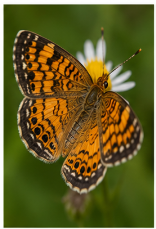
Phaon Crescent Butterflies (Phyciodes phaon) are attractive, small brush-footed butterflies native to the southeastern United States, Mexico, the Caribbean, and portions of Central America. Although modest in size, these butterflies are highly active pollinators and are frequently encountered in sunny meadows, wetlands, roadside vegetation, and suburban gardens where nectar-producing flowers are abundant. Closely related to the better-known Pearl Crescent Butterfly, the Phaon Crescent is distinguished by its vibrant orange wings decorated with dark brown markings and the pale crescent-shaped patterns visible on the undersides of its wings.
Unlike agricultural pests, Phaon Crescent Butterflies are considered beneficial insects. Their caterpillars feed primarily on frogfruit (Phyla species), while adults contribute to pollination by visiting numerous flowering plants. Their presence is often viewed as an indicator of healthy native vegetation and diverse pollinator habitats.
Overview
The Phaon Crescent belongs to the family Nymphalidae, the largest butterfly family in the world. Members of this family are commonly known as brush-footed butterflies because their front pair of legs is greatly reduced and covered with sensory hairs, making them appear to walk on only four legs.
Phaon Crescents are active throughout much of the year in warm southern climates, particularly in Florida and along the Gulf Coast, where multiple generations may occur annually. Their rapid flight and frequent visits to low-growing flowers make them familiar residents of natural and landscaped environments.
Taxonomy and Classification
- Order: Lepidoptera
- Family: Nymphalidae
- Genus: Phyciodes
- Species: Phyciodes phaon
- Common Name: Phaon Crescent Butterfly
The genus Phyciodes contains numerous small crescent butterflies, several of which appear remarkably similar and require close examination for accurate identification.
Identification
Phaon Crescent Butterflies are small but striking insects.
- Wingspan: Approximately 22–35 mm.
- Upper Wings: Bright orange with dark brown to black checkerboard markings.
- Underside: Cream, tan, and orange with distinctive pale crescent-shaped markings.
- Body: Dark brown with fine hairs.
- Antennae: Clubbed tips typical of butterflies.
The intricate wing pattern provides camouflage when the butterfly rests among dried vegetation while also serving as an effective identification feature.
Life Cycle
Phaon Crescent Butterflies undergo complete metamorphosis, progressing through four distinct life stages.
- Egg
- Larva (caterpillar)
- Pupa (chrysalis)
- Adult butterfly
Females lay eggs individually or in small clusters on host plants. Newly hatched caterpillars begin feeding immediately on the leaves before progressing through several molts.
After reaching maturity, the caterpillar forms a chrysalis attached to vegetation. Within days or weeks, depending on temperature, an adult butterfly emerges to begin feeding, mating, and reproducing.
In warmer climates, several generations may occur each year.
Distribution and Habitat
The Phaon Crescent is primarily distributed throughout the southeastern United States but extends into Mexico, Central America, and portions of the Caribbean.
Common habitats include:
- Florida and Gulf Coast states
- Wetlands
- Marsh edges
- Roadsides
- Open meadows
- Prairies
- Parks
- Gardens
- Suburban landscapes
The butterfly thrives wherever host plants and nectar-producing flowers occur together.
Behavior and Ecology
Phaon Crescents are active during daylight hours and spend much of their time searching for nectar or suitable host plants.
Their flight is typically low to the ground, consisting of short, rapid bursts interspersed with frequent landings on flowers or vegetation.
Males often establish small territories where they wait for receptive females, while females spend more time locating host plants for egg laying.
Host Plants and Diet
The caterpillars feed primarily on plants belonging to the genus Phyla, commonly known as frogfruit or turkey tangle.
Adult butterflies obtain energy by feeding on nectar from numerous flowering plants, including:
- Frogfruit flowers
- Asters
- Goldenrod
- Spanish needles
- Lantana
- Native wildflowers
Their nectar-feeding activities make them valuable pollinators within both natural and urban ecosystems.
Importance to Gardens
Phaon Crescent Butterflies provide several ecological benefits.
- Pollination: Transfer pollen among flowering plants.
- Biodiversity: Increase the diversity of beneficial insects.
- Wildlife Support: Serve as prey for birds, spiders, reptiles, and other animals.
- Environmental Indicators: Reflect healthy native plant communities.
Gardeners who incorporate native flowering plants and frogfruit into their landscapes often attract these colorful butterflies.
Management and Prevention
Because Phaon Crescents are beneficial pollinators, pest control is unnecessary.
- Plant Native Flowers: Provide continuous nectar sources throughout the growing season.
- Preserve Host Plants: Allow frogfruit and other native vegetation to remain where practical.
- Reduce Pesticide Use: Broad-spectrum insecticides can unintentionally kill butterflies and caterpillars.
- Create Pollinator Gardens: Include diverse flowering species that bloom throughout the year.
Conservation practices benefit not only Phaon Crescents but many other native pollinators.
Conservation and Research
Scientists monitor Phaon Crescent populations as indicators of habitat quality and pollinator health. Their dependence on native host plants makes them useful for evaluating wetland restoration projects and conservation programs.
Like many native butterflies, they face challenges from habitat loss, urban development, invasive plants, and pesticide exposure. Maintaining native vegetation and connected pollinator corridors helps sustain healthy populations.
Conclusion
Phaon Crescent Butterflies (Phyciodes phaon) are beautiful native pollinators that contribute significantly to southeastern ecosystems. Their colorful wings, rapid flight, and close relationship with native flowering plants make them welcome visitors to gardens, wetlands, and natural landscapes. Because they pose no threat to crops or structures while providing valuable pollination services, they should be appreciated as beneficial members of North America’s diverse butterfly fauna.