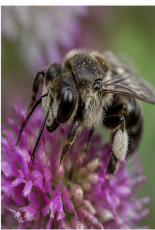
Pebble Bees are a common name sometimes applied to small solitary ground-nesting bees, particularly members of the family Halictidae, commonly known as sweat bees. These native pollinators are frequently seen visiting flowers in gardens, meadows, orchards, and natural landscapes. Unlike honey bees or bumble bees, Pebble Bees do not form large colonies or produce honey. Instead, each female constructs and provisions her own underground nest, making them important but often overlooked contributors to healthy ecosystems.
Although their nests may occasionally appear in lawns, pathways, or sandy areas, Pebble Bees are beneficial insects that rarely require control. Their pollination services support countless species of wildflowers, fruits, vegetables, and ornamental plants, making them valuable allies for gardeners, farmers, and natural habitats.
Overview
Pebble Bees are among the thousands of native bee species found throughout North America. Most belong to the family Halictidae, although similar solitary ground-nesting bees occur in several related bee families.
Their common name comes from their habit of nesting in sandy or gravelly soils where tiny pebbles often surround the nest entrance. These bees are active throughout spring and summer and spend most of their time collecting pollen and nectar rather than interacting with people.
Taxonomy and Classification
- Order: Hymenoptera
- Family: Halictidae
- Common Group: Sweat Bees
- Type: Solitary Ground-Nesting Bees
Like all bees, Pebble Bees undergo complete metamorphosis, developing through egg, larva, pupa, and adult stages.
Identification
Pebble Bees are generally small and slender, though appearance varies among species.
- Length: Approximately 6–10 mm.
- Color: Metallic green, bronze, blue-green, or dark brown depending on the species.
- Body: Slender with dense pollen-collecting hairs.
- Wings: Transparent with fine veins.
- Antennae: Moderately long and segmented.
Many species display brilliant metallic coloration that makes them among the most attractive native bees in North America.
Life Cycle
Female Pebble Bees excavate narrow tunnels in well-drained soil, often creating several underground brood chambers.
Each chamber is stocked with a mixture of pollen and nectar before a single egg is deposited. After hatching, the larva feeds on this stored food supply until it completes development.
The larva then pupates underground before emerging as an adult during the following season or later in the same year, depending on species and climate.
Most species produce one generation annually, although some warm-climate species may have multiple generations.
Distribution and Habitat
Pebble Bees occur throughout much of North America and are found anywhere suitable nesting sites and flowering plants are available.
Preferred habitats include:
- Gardens
- Wildflower meadows
- Prairies
- Roadside vegetation
- Sandy soils
- Bare ground
- Open woodland edges
- Agricultural landscapes
They prefer sunny locations with loose, well-drained soils that allow females to excavate nesting tunnels.
Behavior and Ecology
Pebble Bees spend nearly all of their adult lives gathering pollen and nectar.
Unlike social bees, every female constructs and maintains her own nest independently.
Adults frequently:
- Visit flowering plants throughout the day.
- Collect pollen on specialized body hairs.
- Transport nectar to developing larvae.
- Return repeatedly to the same nesting tunnel.
Some species are mildly attracted to human perspiration, giving rise to the common name sweat bees. This behavior is harmless and simply allows them to obtain salts and minerals.
Pollination Importance
Pebble Bees are exceptionally valuable pollinators.
They help pollinate:
- Native wildflowers
- Fruit trees
- Vegetable crops
- Berry plants
- Ornamental flowers
- Prairie grasses and forbs
Their small size allows them to access flowers that may be less attractive to larger bee species.
Human Interaction
Pebble Bees are remarkably gentle insects.
Females possess a functional sting but rarely use it except when directly handled or trapped against the skin.
Males cannot sting at all.
Ground nests often alarm homeowners, but the bees typically ignore people walking nearby and remain focused on foraging activities.
Integrated Pest Management (IPM)
Because Pebble Bees are beneficial pollinators, control is rarely recommended.
If nests occur in high-traffic areas, consider the following:
- Observation: Confirm that the insects are solitary native bees rather than yellowjackets.
- Avoid Disturbance: Leave nests undisturbed whenever possible.
- Relocation: Restrict access until the nesting season ends.
- Habitat Modification: Cover bare soil with mulch or vegetation if future nesting is undesirable.
- Avoid Insecticides: Broad-spectrum insecticides may kill beneficial pollinators and should not be used unless absolutely necessary.
Conservation and Research
Native solitary bees have become increasingly important in conservation biology because many pollinator populations face pressure from habitat loss, pesticides, diseases, and climate change.
Researchers continue studying Pebble Bees and other sweat bees to better understand their nesting behavior, pollination efficiency, and role in supporting agricultural production and native ecosystems.
Encouraging native flowering plants and preserving undisturbed nesting habitats are among the most effective ways to support healthy populations.
Conclusion
Pebble Bees are gentle, hardworking pollinators that provide tremendous ecological and agricultural benefits. Their solitary lifestyle, underground nesting habits, and efficient pollination make them valuable members of North America’s native bee community. Although they occasionally nest in lawns or gardens, they rarely pose any threat to people and should be appreciated as important contributors to healthy landscapes and productive gardens.