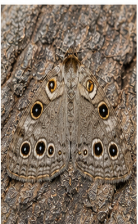
Pearly Wood-Nymph Moths (Eudryas unio) are among the most visually remarkable moths found in eastern North America. Best known for their extraordinary camouflage, these moths possess wing patterns that closely resemble fresh bird droppings, allowing them to avoid predators while resting on leaves, vines, and tree trunks. Although the appearance may seem unusual, this form of protective mimicry has proven highly successful throughout the species’ evolutionary history.
Unlike many insects featured on Pestipedia, the Pearly Wood-Nymph Moth is not considered an agricultural or structural pest. The caterpillars feed on several common native vines but rarely occur in numbers large enough to cause significant plant damage. Instead, the species serves an important ecological role as both a herbivore and a food source for birds, bats, spiders, and predatory insects.
Overview
The Pearly Wood-Nymph belongs to the family Erebidae, one of the largest and most diverse moth families in the world. It is admired by naturalists for its remarkable camouflage and brightly colored caterpillars, which contrast dramatically with the cryptic appearance of the adults.
Adults are primarily active at night but are occasionally observed resting during the day on foliage, where their unusual wing pattern makes them remarkably difficult to detect.
Taxonomy and Classification
- Order: Lepidoptera
- Family: Erebidae
- Genus: Eudryas
- Species: Eudryas unio
- Common Name: Pearly Wood-Nymph Moth
Like all moths, the Pearly Wood-Nymph undergoes complete metamorphosis, progressing through egg, larva, pupa, and adult stages.
Identification
The adult moth is medium-sized and easily recognized by its distinctive coloration.
- Wingspan: Approximately 30–40 mm.
- Forewings: White with dark brown and black markings.
- Camouflage: Wing pattern closely resembles bird droppings resting on leaves.
- Body: Slender and densely scaled.
- Antennae: Thread-like and relatively simple.
When resting with its wings folded, the moth’s appearance provides outstanding protection against visually hunting predators.
Larval Identification
The caterpillar looks dramatically different from the adult moth.
- Length: Up to 35 mm.
- Color: Bright yellow, orange, white, and black bands.
- Body: Smooth with sparse hairs.
- Appearance: Bold warning coloration that may discourage predators.
The contrasting coloration of the larvae differs greatly from the cryptic camouflage displayed by the adults.
Distribution and Habitat
Pearly Wood-Nymph Moths occur throughout much of eastern North America.
They commonly inhabit:
- Deciduous forests
- Woodland edges
- River corridors
- Shrublands
- Parks
- Residential landscapes
- Gardens containing climbing vines
Habitats supporting grapevines and Virginia creeper often provide ideal conditions for breeding populations.
Host Plants
The caterpillars feed primarily on climbing vines.
Preferred host plants include:
- Wild grape (Vitis spp.)
- Virginia creeper (Parthenocissus quinquefolia)
- Other related vines
Feeding is generally light and seldom threatens the health of established plants.
Life Cycle
Adult females deposit eggs on suitable host plants during the growing season.
After hatching, caterpillars feed on foliage through several molts before constructing a cocoon among leaf litter or protected vegetation. Pupation occurs within the cocoon, and adults emerge after completing development.
Depending on climate, one or more generations may occur annually.
Behavior and Ecology
Adults are primarily nocturnal and frequently visit outdoor lights.
During daylight hours they rest motionless with folded wings, relying on their remarkable camouflage for protection.
The bird-dropping mimicry represents one of the most convincing examples of defensive camouflage among North American moths.
The brightly colored caterpillars, by contrast, are often conspicuous while feeding and may rely on warning coloration to discourage predators.
Pest Status
The Pearly Wood-Nymph Moth is not considered a pest.
Although caterpillars consume leaves of grapevines and Virginia creeper, populations rarely become numerous enough to produce noticeable economic or ornamental damage.
No control measures are typically recommended.
Ecological Importance
Pearly Wood-Nymph Moths contribute to healthy woodland ecosystems in several ways.
- Wildlife Food: Eggs, larvae, pupae, and adults provide food for numerous predators.
- Biodiversity: They increase the diversity of native moth communities.
- Nutrient Cycling: Caterpillar feeding contributes to natural plant-insect interactions.
- Scientific Value: Their camouflage offers important insights into evolutionary biology.
Management and Conservation
No pest management is necessary for this species.
Conservation efforts focus on preserving native woodland habitats and maintaining populations of host plants, particularly wild grapevines and Virginia creeper.
Reducing unnecessary insecticide applications also benefits Pearly Wood-Nymph populations along with countless other native moths and pollinators.
Research and Conservation
Entomologists continue studying Eudryas unio because of its exceptional camouflage strategy and predator avoidance behavior. The species has become an excellent example of natural selection producing highly specialized visual mimicry.
Researchers also investigate the defensive coloration of the larvae and the ecological relationships between the moth, its host plants, and natural predators.
Conclusion
Pearly Wood-Nymph Moths (Eudryas unio) are beautiful native insects whose remarkable bird-dropping camouflage makes them one of North America’s most fascinating moth species. Although their caterpillars feed on native vines, they rarely cause significant plant damage and instead contribute to healthy forest ecosystems. Their unique appearance, ecological value, and evolutionary adaptations continue to make them a favorite subject of naturalists and insect researchers.