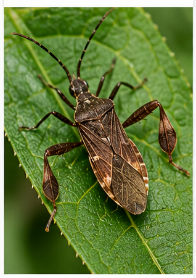
Leaf-footed Bugs are large, plant-feeding true bugs belonging primarily to the family Coreidae. Many of the most familiar species are members of the genus Leptoglossus. They are named for the distinctive flattened or expanded sections on their hind legs, which often resemble small leaves.
Leaf-footed Bugs are important garden and agricultural pests because both adults and nymphs feed on developing fruit, nuts, seeds, stems, and other plant tissues. They use piercing-sucking mouthparts to puncture the surface and remove plant fluids. This feeding can cause discoloration, sunken areas, malformed fruit, damaged seeds, and reduced crop quality.
They are especially troublesome on tomatoes, pomegranates, citrus, pecans, cotton, peppers, and many seed-producing crops. Large aggregations can cause severe localized damage in a short period, particularly when they gather on ripening fruit or developing nuts.
Taxonomy and Classification
Leaf-footed Bugs belong to the order Hemiptera, the group commonly known as true bugs, and the family Coreidae.
- Kingdom: Animalia
- Phylum: Arthropoda
- Class: Insecta
- Order: Hemiptera
- Family: Coreidae
- Important Genus: Leptoglossus
- Common Name: Leaf-footed Bugs
They undergo incomplete metamorphosis, developing through egg, nymph, and adult stages. There is no pupal stage.
Leaf-footed Bugs are related to squash bugs and other coreids, and they share several traits with stink bugs, including the ability to produce an unpleasant defensive odor.
Physical Description
Adult Leaf-footed Bugs are relatively large insects, usually measuring approximately 3/4 to 1 inch long. Their bodies are elongated and somewhat flattened.
- Length: Approximately 18–25 millimeters
- Color: Dark brown, reddish brown, gray-brown, or nearly black
- Body: Slender, elongated, and somewhat flattened
- Hind Legs: Often enlarged with a flattened, leaf-like tibia
- Wings: Folded flat over the abdomen
- Markings: Some species have a pale or white zigzag band across the wings
The expanded hind tibiae are the easiest feature to recognize in many species. However, not every coreid has equally dramatic leaf-like legs, so other features may be needed for identification.
Nymph Identification
Young Leaf-footed Bug nymphs often look very different from adults. They are frequently bright orange, red, or reddish brown and may be mistaken for assassin bug nymphs.
Common nymph features include:
- Bright red or orange coloration when young
- Long dark legs
- Dark antennae
- Developing black or brown markings
- No fully developed wings
- Frequent clustering in groups
As the nymphs mature, they gradually become darker and develop wing pads. The characteristic enlarged hind legs become more obvious in later stages.
Distribution and Habitat
Leaf-footed Bugs are found in many warm and temperate regions of North, Central, and South America. Different species occupy different geographic ranges, but many are common in agricultural and suburban environments.
Typical habitats include:
- Vegetable gardens
- Fruit orchards
- Vineyards
- Nut orchards
- Weedy field margins
- Flower gardens
- Commercial farms
- Urban landscapes
- Wild host vegetation
They are especially common where fruiting plants, seed heads, or alternate weed hosts remain available for extended periods.
Life Cycle
Adult females lay clusters or rows of eggs on stems, leaves, or other plant surfaces. The eggs are often dark brown or bronze and may be arranged in a chain-like line.
Egg Stage
Eggs are usually attached directly to plant tissue. They hatch into small, brightly colored nymphs.
Nymph Stage
Nymphs begin feeding shortly after hatching. They pass through several instars, becoming progressively larger and darker.
Young nymphs often remain together in groups, which can cause concentrated damage to a particular fruit cluster or section of a plant.
Adult Stage
Adults are strong fliers and can move easily between host plants. Depending on climate and species, multiple generations may occur during a growing season.
Host Plants
Leaf-footed Bugs feed on a wide variety of plants and are especially attracted to developing fruit, nuts, and seeds.
Common hosts include:
- Tomatoes
- Pomegranates
- Citrus
- Pecans
- Peaches
- Peppers
- Cotton
- Beans
- Sunflowers
- Seed crops
They may also survive on weeds and native plants between crop cycles, allowing populations to persist even when preferred crops are unavailable.
Feeding Behavior
Leaf-footed Bugs use their long, needle-like mouthparts to puncture plant tissue and suck out internal fluids.
The most vulnerable plant parts include:
- Young fruit
- Developing nuts
- Seed pods
- Flower buds
- Stems
- Ripening fruit
Feeding may also introduce digestive saliva into the tissue, contributing to internal breakdown around the puncture site.
Fruit Damage
Fruit damage is one of the most important problems caused by Leaf-footed Bugs. Feeding punctures may initially appear as tiny marks but can develop into larger blemishes as the fruit grows.
Common symptoms include:
- Small puncture marks
- Sunken areas
- White or corky internal tissue
- Discoloration
- Soft or mushy spots
- Deformed fruit
- Reduced market quality
On tomatoes, feeding can produce irregular discolored areas beneath the skin. On pomegranates and citrus, punctures may contribute to surface blemishes and internal quality problems.
Nut and Seed Damage
Leaf-footed Bugs can be particularly damaging to pecans and other nut crops when they feed before the shell has fully hardened.
Early-season feeding may cause:
- Premature nut drop
- Kernel destruction
- Dark internal lesions
- Poor seed development
Later feeding may cause localized kernel damage without causing the entire nut to fall.
Seed crops may also suffer reduced seed weight, shriveling, or poor germination.
Aggregation Behavior
Leaf-footed Bugs frequently occur in clusters, especially as nymphs. Aggregation can result in heavy feeding pressure on a relatively small part of a plant.
Large groups may gather on:
- Fruit clusters
- Seed heads
- Young stems
- Ripening fruit
- Protected overwintering sites
This behavior can make infestations appear suddenly severe even when the total population across the garden is moderate.
Defensive Odor
When disturbed, handled, or crushed, Leaf-footed Bugs may release a strong defensive odor. This smell is produced by specialized glands and helps discourage predators.
The odor is unpleasant but generally not dangerous. It can become a nuisance when large numbers of bugs are handled or enter buildings.
Overwintering
Adults of many species survive winter in protected locations and become active again when temperatures rise.
Possible overwintering sites include:
- Leaf litter
- Wood piles
- Tree bark
- Garden debris
- Dead vegetation
- Sheds or outbuildings
Removing unnecessary debris near gardens may reduce some local overwintering sites.
Signs of an Infestation
Common signs include:
- Large brown adults with expanded hind legs
- Bright red or orange nymph clusters
- Rows of eggs on stems or leaves
- Puncture marks on fruit
- Sunken or discolored feeding areas
- Premature fruit or nut drop
- Deformed developing fruit
Because feeding damage may resemble disease, sunscald, stink bug injury, or physical damage, finding the insects themselves helps confirm the diagnosis.
Inspection and Monitoring
Regular monitoring is particularly important when fruit and seed crops begin developing.
Inspect:
- Fruit clusters
- Plant stems
- Leaf undersides
- Seed heads
- Weedy borders
- Nearby alternative host plants
Morning inspection is often useful because cooler temperatures may make adults less active and easier to collect.
Management and Prevention
Leaf-footed Bug management is best approached through Integrated Pest Management (IPM), combining sanitation, monitoring, physical removal, preservation of beneficial insects, and targeted chemical control only when necessary.
Weed Control
Weeds and volunteer plants can serve as important alternate hosts. Reducing these plants near crops may decrease local populations.
However, sudden removal of heavily infested weeds may cause adults to move into nearby crops, so timing should be considered carefully.
Remove Crop Debris
At the end of the growing season, remove heavily infested plant debris and fallen fruit that may provide food or shelter.
Maintaining a clean garden reduces some of the resources available to overwintering adults.
Hand-Picking
Because Leaf-footed Bugs are large, hand removal can be effective in home gardens.
Adults and nymphs can be:
- Picked by hand while wearing gloves
- Knocked into a container of soapy water
- Removed with a small hand-held vacuum
Egg masses can also be scraped from stems or leaves before they hatch.
Protecting Young Fruit
Where practical, physical barriers such as fine-mesh netting or row covers may help protect certain crops before flowering or fruit set.
Barriers must be installed before bugs gain access and may need to be removed when pollinators are required.
Natural Enemies
Leaf-footed Bugs are attacked by several predators and parasitoids, including:
- Parasitic flies
- Parasitic wasps
- Assassin bugs
- Spiders
- Birds
- Predatory stink bugs
Egg parasitoids can be particularly valuable because they kill the insects before damaging nymphs emerge.
Avoiding unnecessary broad-spectrum insecticides helps preserve these natural enemies.
Chemical Control
Insecticides may be necessary when populations are high and valuable crops are at risk. Young nymphs are generally easier to control than mature adults.
Adults are highly mobile and may quickly reinvade treated plants from surrounding vegetation, so repeated spraying may provide only temporary control.
When chemical treatment is justified:
- Target young nymphs whenever possible.
- Ensure thorough coverage of infested plant areas.
- Choose a product labeled for the crop and pest.
- Avoid treating flowering plants when pollinators are active.
- Follow all label directions and harvest intervals.
When to Call a Professional
Professional pest or agricultural advice may be useful when:
- Large orchard or commercial crop areas are affected
- Populations return repeatedly after treatment
- Fruit losses are economically significant
- Identification is uncertain
- Several related true bug pests are present
A professional can help determine whether the damage justifies treatment and recommend a crop-specific IPM program.
Conservation and Research
Leaf-footed Bugs are managed as important agricultural and garden pests, particularly in fruit, nut, seed, and vegetable production.
Research focuses on:
- Aggregation pheromones
- Improved trapping systems
- Egg parasitoids
- Host-plant preferences
- Migration and overwintering behavior
- Reduced-risk insecticides
- Economic treatment thresholds
Scientists are especially interested in using pheromone-based monitoring to detect populations earlier and reduce unnecessary pesticide applications.
Conclusion
Leaf-footed Bugs are large, recognizable true bugs named for the flattened, leaf-like expansions found on the hind legs of many species. Adults and nymphs feed on developing fruit, nuts, seeds, and other tender plant tissues, where their piercing-sucking mouthparts can cause punctures, internal damage, deformation, discoloration, and reduced market quality.
Home gardeners can often manage small populations by removing weeds, cleaning crop debris, destroying egg masses, and hand-picking adults and nymphs. Natural enemies also contribute to control.
Where populations become severe, treatments should focus on young nymphs before they become highly mobile adults. Regular monitoring and an integrated approach provide more reliable long-term control than repeated broad-spectrum spraying.