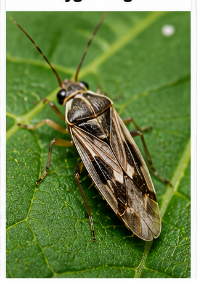
Lygus Bugs are a group of plant-feeding true bugs in the genus Lygus. One of the best-known species is the Tarnished Plant Bug (Lygus lineolaris), a highly mobile and destructive pest of fruits, vegetables, flowers, seed crops, field crops, and ornamental plants. These insects are important because they attack tender plant tissues such as buds, flowers, young fruit, and developing seeds.
Lygus Bugs feed with piercing-sucking mouthparts. During feeding, they puncture plant cells and inject saliva containing enzymes that help break down the tissue. The damaged cells may collapse or die, resulting in deformed fruit, aborted buds, shriveled seeds, distorted growth, or reduced yield. Even relatively small populations can cause serious economic damage when they are active during sensitive stages such as flowering or fruit development.
Because Lygus Bugs can feed on a very wide range of plants and move rapidly between weeds, alfalfa, crops, and surrounding vegetation, they can be difficult to manage. Successful control depends on regular monitoring, careful weed and border management, preservation of natural enemies, and properly timed treatments when populations exceed damaging thresholds.
Taxonomy and Classification
Lygus Bugs belong to the order Hemiptera and the family Miridae, commonly known as plant bugs.
- Kingdom: Animalia
- Phylum: Arthropoda
- Class: Insecta
- Order: Hemiptera
- Family: Miridae
- Genus: Lygus
- Important Species: Lygus lineolaris
- Common Name: Tarnished Plant Bug
Lygus Bugs undergo incomplete metamorphosis, developing through egg, nymph, and adult stages. There is no pupal stage.
Physical Description
Adult Lygus Bugs are usually about 1/4 inch long. Their bodies are oval, somewhat flattened, and variable in color.
- Length: Approximately 5–7 millimeters
- Color: Mottled brown, green, yellow, tan, or combinations of these colors
- Body: Oval and slightly flattened
- Wings: Folded flat over the back
- Movement: Fast-running and capable of quick flight
The mottled coloration gives many adults a worn or tarnished appearance, which is the origin of the name Tarnished Plant Bug.
A useful identification feature is the pale or yellowish triangular area on the upper back, associated with the scutellum. The exact pattern varies among individuals and species.
Nymph Identification
Lygus Bug nymphs are usually bright green and may be mistaken for aphids at first glance. However, they are much more active and lack the pair of cornicles, or tailpipes, that characterize aphids.
Nymphs typically have:
- A bright green body
- Long legs and antennae
- Dark spots that become more visible as they mature
- No developed wings
- Rapid running behavior
As the nymph progresses through successive instars, wing pads become increasingly visible.
Distribution and Habitat
Lygus Bugs are widespread throughout North America and related species occur in many other parts of the world. They thrive in agricultural landscapes containing a mixture of crops, weeds, flowering plants, and uncultivated vegetation.
Common habitats include:
- Alfalfa fields
- Strawberry plantings
- Fruit orchards
- Vegetable fields
- Cotton fields
- Seed-production fields
- Flower crops
- Weedy field margins
- Roadside vegetation
- Gardens
Their ability to use numerous host plants allows them to survive when one crop is unavailable and move into another when conditions become favorable.
Life Cycle
Lygus Bugs overwinter as adults in protected sites such as leaf litter, plant debris, weedy margins, and other sheltered locations. As temperatures rise in spring, the adults become active and begin feeding and reproducing.
Egg Stage
Females insert eggs into tender plant tissue, including stems, leaf petioles, flower parts, or other soft growth. The eggs are difficult to see because most of the egg remains concealed within the plant.
Nymph Stage
After hatching, nymphs begin feeding immediately. They pass through several instars and become increasingly mobile as they grow.
Adult Stage
Adults continue feeding and move readily between host plants. Multiple generations may develop during a growing season, particularly in warm regions.
Host Plants
Lygus Bugs are highly polyphagous, meaning they feed on many different plant species. This wide host range is one of the major reasons they are such persistent pests.
Important hosts may include:
- Strawberries
- Peaches
- Apples
- Pears
- Cotton
- Alfalfa
- Beans
- Seed crops
- Vegetables
- Flowering ornamentals
Numerous weeds can also support Lygus populations and act as temporary reservoirs before the insects move into commercial crops.
Feeding Behavior
Lygus Bugs use their piercing-sucking mouthparts to puncture soft plant tissue. Their saliva contains enzymes that help liquefy plant cells so the contents can be consumed.
Damage can continue developing after the insect has left because the injured tissue does not expand normally as the surrounding plant grows.
The most vulnerable plant parts include:
- Flower buds
- Young flowers
- Developing fruit
- Tender shoot tips
- Immature seeds
- New leaves
Fruit Damage and Catfacing
One of the best-known symptoms of Lygus feeding is catfacing, a general term for distorted, scarred, or irregularly shaped fruit.
When a bug feeds on young developing fruit, cells around the puncture may die. As healthy tissue continues to expand, the damaged area remains restricted, creating pits, depressions, scars, or malformed growth.
On strawberries, feeding may contribute to irregular or poorly developed fruit. Similar injury on peaches and other fruits can reduce their appearance and commercial value.
Bud and Flower Damage
Lygus Bugs often attack flower buds and newly opened blooms. Feeding may cause buds to:
- Turn brown or black
- Fail to open
- Drop prematurely
- Produce malformed flowers
- Fail to develop normal fruit
In cotton and other flowering crops, this type of injury may result in the loss of reproductive structures and reduced yield.
Seed Damage
Lygus Bugs are also important pests of crops grown for seed. Feeding on developing seed can interrupt normal maturation and reduce both weight and germination quality.
Damaged seeds may become:
- Shriveled
- Discolored
- Lightweight
- Malformed
- Non-viable
This type of injury can be especially costly where high-quality seed is the primary harvested product.
Reservoir Hosts and Weed Movement
Many weeds and non-crop plants support Lygus Bugs during periods when commercial crops are unavailable. When those plants dry, are mowed, or are removed, adult bugs may rapidly move into nearby crops.
Common reservoir areas include:
- Weedy field borders
- Roadsides
- Ditches
- Alfalfa stands
- Cover crops
- Unmanaged vegetation
This movement can cause sudden increases in pest numbers even when the crop itself had relatively few insects shortly before.
Signs of an Infestation
Lygus Bug infestations can be difficult to diagnose because adults are mobile and damage may remain after the insects have moved away.
Common signs include:
- Fast-moving green nymphs
- Mottled adult bugs
- Distorted young fruit
- Blackened flower buds
- Aborted flowers
- Shriveled seed
- Stunted terminal growth
Finding both active insects and fresh feeding damage provides stronger evidence than relying on fruit deformity alone.
Inspection and Monitoring
Regular monitoring is essential because Lygus populations can move quickly into fields and orchards.
A sweep net is commonly used in field crops. Vegetation is swept repeatedly, and captured adults and nymphs are counted.
Other monitoring techniques may include:
- Visual inspection
- Beat trays
- Plant tapping
- Field-edge scouting
- Crop-specific sampling methods
Treatment decisions should be based on crop-specific economic or action thresholds whenever these are available.
Management and Prevention
Lygus Bug management is best handled through Integrated Pest Management (IPM), using cultural controls, regular scouting, natural enemies, and carefully timed treatments.
Weed Management
Controlling weeds can reduce alternative breeding and feeding sites, but timing is important.
Removing large areas of host weeds suddenly may drive adults directly into nearby crops. Where possible, vegetation management should be planned so that large populations are not forced into vulnerable plants during flowering or fruit development.
Manage Field Borders
Field borders should be monitored carefully because they may serve as the first point of entry when Lygus Bugs migrate from surrounding vegetation.
In some situations, border-focused management may reduce the need to treat an entire field.
Alfalfa and Cover Crop Management
Alfalfa can support large populations of Lygus Bugs. When entire fields are cut at once, adults may disperse into nearby crops.
Staggered mowing or leaving temporary uncut strips may sometimes help reduce sudden migration, depending on the production system and local recommendations.
Natural Enemies
Lygus Bugs are attacked by several predators and parasitoids, including:
- Parasitic wasps
- Big-eyed bugs
- Damsel bugs
- Assassin bugs
- Spiders
- Predatory stink bugs
These natural enemies can reduce populations, especially when broad-spectrum insecticides are minimized.
Chemical Control
Insecticides may be necessary when monitoring shows that Lygus Bugs have exceeded an established economic threshold.
Treatment is especially important during vulnerable crop stages such as:
- Budding
- Flowering
- Early fruit formation
- Seed development
Because adults can fly into treated areas from surrounding vegetation, insecticide applications may provide only temporary suppression if outside populations remain high.
Products should always be selected according to the crop, target pest, resistance-management program, pollinator activity, and label directions.
Insecticide Resistance
Repeated chemical treatments can select for resistant Lygus populations. This is an important concern in intensively managed crops where multiple generations are exposed to insecticides every season.
Resistance management may include:
- Rotating insecticide modes of action
- Treating only when thresholds are reached
- Preserving natural enemies
- Using cultural controls
- Avoiding unnecessary repeated applications
Conservation and Research
Lygus Bugs are major agricultural pests, and research focuses on improving monitoring, host-plant resistance, economic thresholds, biological control, and resistance management.
Scientists also study how landscape vegetation influences migration between weeds, alfalfa, and high-value crops. Better understanding of this movement may allow growers to anticipate population shifts and target control measures more precisely.
Parasitoid wasps and predatory insects continue to be investigated as biological control agents, particularly in production systems seeking to reduce dependence on broad-spectrum insecticides.
Conclusion
Lygus Bugs are highly mobile plant bugs that cause economic damage by feeding on buds, flowers, young fruit, and developing seeds. The Tarnished Plant Bug, Lygus lineolaris, is one of the most important members of the group in North America.
Their feeding can produce catfacing, blasted buds, shriveled seed, distorted growth, and reduced yield. Management is challenging because the insects use numerous wild and cultivated hosts and can rapidly reinvade fields after treatment.
Successful control depends on regular monitoring, careful weed and border management, protection of natural enemies, and insecticide applications only when populations reach established damaging thresholds. An integrated approach provides better long-term control than relying on repeated chemical applications alone.