Overview
Funnel Weaver Spiders are a large group of fast-moving spiders belonging to the family Agelenidae. They are best known for constructing distinctive funnel-shaped webs in grass, shrubs, gardens, wood piles, and around buildings. These spiders are widespread throughout North America, Europe, and many other parts of the world, where they serve as beneficial predators by feeding on insects and other small arthropods.
Funnel Weavers are often encountered outdoors in lawns and landscaped areas, though some species may wander indoors and establish webs in garages, basements, crawl spaces, and corners of buildings. Despite their intimidating appearance and rapid movements, Funnel Weaver Spiders are generally harmless to humans and are considered non-aggressive.
The family includes hundreds of species, ranging from harmless grass spiders to more medically significant relatives such as the Australian Funnel-Web Spider. However, the common Funnel Weaver Spiders found in homes and gardens in North America are not considered dangerous.
Taxonomy and Classification
- Kingdom: Animalia
- Phylum: Arthropoda
- Class: Arachnida
- Order: Araneae
- Family: Agelenidae
- Common Name: Funnel Weaver Spider
Funnel Weaver Spiders belong to the spider family Agelenidae, one of the largest families of web-building spiders.
Common members include:
- Grass Spiders (Agelenopsis spp.)
- Barn Funnel Weavers
- House Funnel Weavers
- Giant House Spiders
These spiders are characterized by their sheet-like webs connected to a tubular funnel retreat where the spider hides and waits for prey.
Physical Description
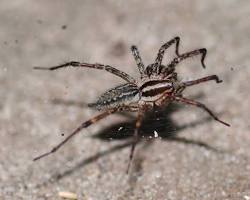
Funnel Weaver Spiders vary in size and coloration depending on species, but most possess similar general characteristics.
Common identifying features include:
- Brown or gray coloration
- Subtle striping or mottled markings
- Long slender legs
- Visible spinnerets extending from the abdomen
- Medium-sized body
- Fast-running movement
Most species have bodies ranging from 1/4 inch to over 3/4 inch long, excluding the legs.
Their long legs and streamlined body allow them to move extremely quickly across their webs and surrounding surfaces.
One of the easiest identifying features is the pair of elongated spinnerets protruding visibly from the rear of the abdomen.
Females are generally larger and remain near the web, while males often wander during mating season.
Web Structure
Funnel Weaver webs are among the most recognizable spider webs found in lawns and gardens.
The web consists of two main parts:
- A flat horizontal sheet web
- A funnel-shaped retreat tunnel
The spider remains hidden inside the funnel retreat while waiting for prey to disturb the sheet portion of the web.
When vibrations signal trapped prey, the spider rapidly rushes from the funnel to attack and drag the victim back into the retreat.
These webs are commonly seen in:
- Grass
- Shrubs
- Wood piles
- Rock crevices
- Corners of buildings
- Basements
- Garages
Morning dew often makes Funnel Weaver webs highly visible outdoors.
Distribution and Habitat
Funnel Weaver Spiders are widely distributed across temperate regions worldwide.
They thrive in both natural and urban environments.
Preferred outdoor habitats include:
- Lawns
- Gardens
- Shrubbery
- Ground cover vegetation
- Wood piles
- Stone walls
- Forest edges
- Tall grasses
Indoors, they may establish webs in:
- Basements
- Garages
- Crawl spaces
- Storage rooms
- Window wells
- Corners of rooms
They prefer sheltered locations where insects frequently travel.
Behavior and Hunting
Funnel Weaver Spiders are highly effective ambush predators.
Unlike wandering hunting spiders, they rely heavily on their webs for prey capture.
Typical prey includes:
- Flies
- Beetles
- Moths
- Ants
- Small crickets
- Other insects
The spider senses vibrations through the web and reacts almost instantly when prey becomes trapped.
Their speed is one of their most notable characteristics. Funnel Weavers can dart across their webs in fractions of a second.
Most species are nocturnal or crepuscular, becoming most active during evening and nighttime hours.
Despite their speed and appearance, they generally avoid human contact and retreat when disturbed.
Life Cycle
Funnel Weaver Spiders reproduce through egg sacs produced by females after mating.
The life cycle includes:
- Egg
- Spiderling
- Juvenile molts
- Adult
Females often guard egg sacs within the funnel retreat.
Young spiderlings disperse after hatching and begin constructing small webs of their own.
Many species mature within one year, though lifespan varies depending on climate and species.
Males often become more noticeable indoors during late summer and autumn when they wander in search of females.
Human Interaction
Funnel Weaver Spiders are generally considered harmless to humans.
They are non-aggressive and bites are uncommon.
Most bites occur only when:
- The spider is trapped against skin
- Handled directly
- Disturbed accidentally
Typical bite symptoms are mild and may include:
- Minor redness
- Mild irritation
- Temporary itching
- Slight swelling
Serious reactions are extremely rare with common North American Funnel Weaver species.
These spiders are often confused with more dangerous species because of their fast movement and dark coloration, but they are beneficial predators that help reduce insect populations.
Commonly Confused Species
Funnel Weaver Spiders are frequently mistaken for:
The visible spinnerets and funnel-shaped web are key features used for identification.
Signs of Activity
- Sheet-like webs with funnel retreats
- Dense webs in grass or shrubs
- Fast-moving brown spiders
- Webs in garage or basement corners
- Dew-covered webs in lawns during mornings
Large populations may create noticeable concentrations of webs around landscaping and outdoor structures.
Management and Prevention
Control of Funnel Weaver Spiders usually focuses on exclusion and habitat reduction rather than chemical treatment.
Trim Vegetation
Trim grass, shrubs, and ground cover near buildings to reduce web-building areas.
Reduce Outdoor Debris
Remove wood piles, clutter, and dense debris that provide shelter and web attachment sites.
Seal Entry Points
Seal cracks and gaps around foundations, doors, windows, and utility penetrations to limit indoor entry.
Web Removal
Vacuum or remove webs regularly from garages, basements, sheds, and outdoor structures.
Removing webs also eliminates egg sacs and trapped insects.
Reduce Insect Prey
Minimizing outdoor lighting and reducing insect populations around structures may indirectly reduce Funnel Weaver activity.
Ecological Importance
Funnel Weaver Spiders are beneficial predators that help naturally control populations of flies, beetles, moths, and other nuisance insects.
They serve an important role in:
- Garden ecosystems
- Lawn ecosystems
- Natural pest control
- Food chains involving birds and reptiles
Because they consume large numbers of insects, Funnel Weavers are often considered valuable beneficial arachnids.
Research and Scientific Interest
Scientists study Funnel Weaver Spiders to better understand:
- Web engineering
- Spider silk properties
- Predatory behavior
- Arachnid sensory systems
- Natural pest control ecology
Their highly efficient vibration-detection abilities make them important subjects in behavioral and neurological research.
Conclusion
Funnel Weaver Spiders are fast-moving web-building spiders belonging to the family Agelenidae. Recognized by their distinctive funnel-shaped webs, these spiders are common in lawns, gardens, shrubs, and occasionally inside homes. Although they may appear intimidating because of their speed and dark coloration, Funnel Weavers are generally harmless to humans and play an important ecological role by preying on flies, beetles, moths, and other insects. Most management focuses on reducing web sites and preventing indoor entry rather than eliminating these beneficial predators.