Overview
False Widow Spiders are a group of spiders belonging to the genus Steatoda, commonly found in homes, sheds, garages, gardens, and other sheltered environments throughout North America and Europe. These spiders are frequently mistaken for the much more dangerous Black Widow Spider because of their glossy dark coloration and rounded abdomen. However, False Widow Spiders are generally far less harmful and are considered beneficial predators that help reduce insect populations.
Although they do possess venom used to subdue prey, bites to humans are uncommon and are usually mild compared to true widow spiders. Most encounters occur when a spider becomes trapped in clothing, disturbed while hiding, or accidentally handled.
False Widow Spiders are highly adaptable and thrive in urban, suburban, and natural environments. Their irregular tangled webs are commonly found in quiet undisturbed areas where insects are abundant.
Taxonomy and Classification
- Kingdom: Animalia
- Phylum: Arthropoda
- Class: Arachnida
- Order: Araneae
- Family: Theridiidae
- Genus: Steatoda
- Common Name: False Widow Spider
False Widow Spiders belong to the cobweb spider family Theridiidae, which also includes true widow spiders such as the Black Widow.
Several species are commonly referred to as False Widows, including:
- Noble False Widow (Steatoda nobilis)
- Cupboard Spider (Steatoda grossa)
- Brown House Spider (Steatoda bipunctata)
- False Black Widow (Steatoda paykulliana)
These spiders are closely related to true widow spiders but generally possess weaker venom and less medically significant bites.
Physical Description
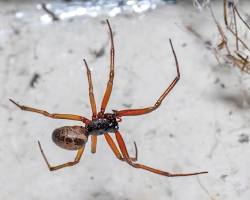
False Widow Spiders vary in size depending on species and sex, but most possess a rounded, bulbous abdomen and long slender legs.
Common identifying characteristics include:
- Glossy appearance
- Brown, dark brown, or purplish-black coloration
- Cream-colored or pale abdominal markings
- Bulbous abdomen
- Long thin legs
- Smaller size than true Black Widows
Females are generally larger and more robust than males.
Unlike Black Widow Spiders, most False Widows lack the distinctive bright red hourglass marking on the underside of the abdomen.
Their coloration and shape provide camouflage in dark sheltered environments such as wood piles, basements, and cluttered storage areas.
Distribution and Habitat
False Widow Spiders are widely distributed throughout:
- North America
- Europe
- Mediterranean regions
- Urban environments worldwide
Some species, especially the Noble False Widow, have expanded their range significantly through human transport and urbanization.
Preferred habitats include:
- Basements
- Garages
- Attics
- Sheds
- Crawl spaces
- Behind outdoor furniture
- Under stones and bark
- Wall crevices
- Fence corners
- Storage boxes
These spiders favor quiet undisturbed areas where insects regularly pass through.
Their webs are usually constructed in dark corners and protected spaces where prey activity is high.
Web Structure
False Widow Spiders create irregular tangled webs similar to those of cobweb spiders.
These webs are:
- Messy and irregular
- Sticky and strong
- Built in sheltered corners
- Designed to trap crawling or flying insects
Unlike orb-weaving spiders, False Widows do not create symmetrical circular webs.
The spider typically remains hidden near the web while waiting for prey vibrations.
Behavior and Feeding
False Widow Spiders are primarily nocturnal predators.
They rely on their webs to capture prey and usually remain concealed during the daytime.
Common prey items include:
- Flies
- Ants
- Beetles
- Moths
- Mosquitoes
- Other spiders
- Small insects
Once prey becomes trapped, the spider quickly bites and immobilizes it with venom before wrapping it in silk.
False Widows are beneficial predators that help naturally control nuisance insects around homes and gardens.
Despite their intimidating appearance, these spiders are generally shy and avoid human interaction whenever possible.
Life Cycle
False Widow Spiders reproduce through egg sacs produced by females after mating.
Egg sacs are usually hidden within protected sections of the web.
The life cycle includes:
- Egg
- Spiderling
- Juvenile molts
- Adult spider
Young spiderlings disperse after hatching and gradually mature through multiple molts.
Depending on species and environmental conditions, individuals may live for several years.
Human Interaction
False Widow Spider bites are uncommon because the spiders are not aggressive and typically retreat when disturbed.
Most bites occur when:
- The spider becomes trapped in clothing
- A person accidentally touches a hidden spider
- Stored items are moved suddenly
- The spider is pressed against skin
Typical bite symptoms may include:
- Mild to moderate pain
- Localized redness
- Swelling
- Itching
- Temporary numbness
More severe symptoms are rare but may occasionally include:
- Muscle discomfort
- Fatigue
- Headache
- Nausea
Serious medical complications are uncommon, and most bites resolve without significant treatment.
False Widow Spiders should not be considered highly dangerous, though individuals experiencing severe reactions should seek medical advice.
Signs of Infestation
- Tangled irregular webs in corners
- Glossy dark spiders in storage areas
- Webs around outdoor furniture
- Spider egg sacs in sheltered locations
- Accumulated insect remains within webs
Most infestations remain localized to quiet undisturbed areas.
Management and Prevention
Management of False Widow Spiders focuses mainly on exclusion, sanitation, and reducing insect prey.
Reduce Clutter
Remove unnecessary clutter from garages, basements, sheds, and storage spaces to eliminate hiding sites.
Seal Entry Points
Seal cracks, gaps, and crevices around windows, doors, siding, and foundations to limit spider entry.
Web Removal
Regularly vacuum or remove webs from corners, ceilings, and outdoor furniture.
Removing webs also eliminates egg sacs and trapped prey.
Outdoor Maintenance
Reduce insect attraction around structures by:
- Limiting exterior lighting
- Managing outdoor debris
- Keeping vegetation trimmed
- Removing wood piles near buildings
Chemical Control
Chemical treatment is rarely necessary for False Widow Spiders unless infestations become unusually large.
Targeted residual insecticides may occasionally be applied in severe situations, but habitat modification is generally more effective.
Ecological Importance
False Widow Spiders play an important ecological role as predators of nuisance insects and other arthropods.
By consuming flies, mosquitoes, moths, and other pests, they help naturally regulate insect populations in both indoor and outdoor environments.
They also serve as prey for:
- Birds
- Lizards
- Larger spiders
- Predatory insects
Despite their negative reputation, these spiders contribute positively to urban ecosystems.
Research and Scientific Interest
Scientists study False Widow Spiders to better understand:
- Spider venom composition
- Urban spider ecology
- Web-building behavior
- Species distribution expansion
- Human-spider interactions
The spread of certain species, especially Steatoda nobilis, has generated growing interest among researchers studying invasive urban arthropods.
Conclusion
False Widow Spiders are common cobweb spiders belonging to the genus Steatoda and are frequently mistaken for Black Widow Spiders due to their dark glossy appearance and rounded abdomen. Although they possess venom and can bite when disturbed, they are generally considered far less dangerous than true widow spiders. These nocturnal predators help control insect populations indoors and outdoors by feeding on flies, beetles, ants, and other pests. Most management efforts focus on sanitation, web removal, exclusion, and reducing clutter rather than aggressive chemical treatment.