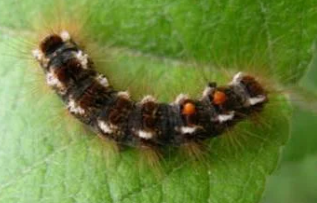
Brown-tail Moths (Euproctis chrysorrhoea) are invasive defoliating insects known for both their destructive feeding habits and the dangerous toxic hairs produced by their caterpillars. Native to Europe and parts of Asia, the species was accidentally introduced into North America in the late 1800s and has since become a serious pest in portions of the northeastern United States, especially in coastal regions of Maine and parts of Massachusetts. The insect is considered both a forestry pest and a public health concern due to the irritating airborne hairs produced during the larval stage.
Brown-tail Moth caterpillars feed aggressively on hardwood trees and shrubs, stripping foliage from oak, apple, cherry, birch, crabapple, and other host plants. Heavy infestations weaken trees, reduce growth, increase susceptibility to disease, and may eventually contribute to branch dieback or decline. In addition to plant damage, the microscopic hairs released by the caterpillars can trigger severe skin irritation, rashes, eye irritation, and respiratory distress in humans and animals.
Taxonomy and Classification
- Kingdom: Animalia
- Phylum: Arthropoda
- Class: Insecta
- Order: Lepidoptera
- Family: Erebidae
- Genus: Euproctis
- Species: Euproctis chrysorrhoea
- Common Name: Brown-tail Moth
The Brown-tail Moth belongs to a group commonly referred to as tussock moths, many of which possess hairy caterpillars capable of irritating predators and humans. This species is particularly notable because its toxic hairs remain hazardous even after the caterpillars molt, pupate, or die. The hairs can persist in the environment for months or even years under favorable conditions.
Physical Description
Adult Brown-tail Moths are bright white moths with a wingspan typically ranging between 1 and 1.5 inches. The most distinctive feature is the tuft of brown hairs located at the tip of the abdomen, which gives the insect its common name. Females often appear slightly larger than males and may carry egg masses covered with protective brown hairs from their abdomen.
The caterpillars are much more recognizable and dangerous. Mature larvae are dark brown to nearly black with broken white stripes along the sides and two highly visible orange-red spots near the rear end of the body. Their bodies are densely covered in fine barbed hairs that contain irritating toxins. These hairs can easily become airborne during mowing, pruning, leaf cleanup, or windy conditions.
The pupae are enclosed in silken cocoons often found among leaves, bark crevices, or sheltered locations. Egg masses are typically deposited on the underside of leaves and covered with brown hairs from the female moth’s abdomen.
Distribution and Habitat
The Brown-tail Moth is native to Europe, western Asia, and northern Africa but is now established in portions of North America. In the United States, it is most heavily associated with coastal Maine and nearby areas of New England. Outbreaks are often concentrated in oak forests, residential neighborhoods with mature hardwood trees, orchards, and coastal landscapes.
The insect thrives in environments where host trees are abundant and winters are survivable for overwintering caterpillars. Urban and suburban landscapes with oak, apple, cherry, and crabapple trees can support large populations. The caterpillars commonly construct winter webs at branch tips where they remain protected until spring arrives.
Life Cycle
The Brown-tail Moth has one generation per year. Adult moths emerge during summer, usually from late June through August depending on climate and regional conditions. Females lay egg masses on the undersides of leaves shortly after mating.
After hatching, young caterpillars begin feeding on foliage before constructing overwintering webs made from silk and leaves. These webs are typically located near the ends of branches and can contain dozens or even hundreds of caterpillars. During winter, the larvae remain dormant inside these protective shelters.
In spring, the caterpillars emerge and begin feeding aggressively on developing leaves and buds. Feeding activity intensifies throughout spring and early summer, often leading to heavy defoliation. Once mature, the larvae pupate in silken cocoons before emerging as adult moths and repeating the cycle.
Host Plants
Brown-tail Moth caterpillars feed on a wide variety of hardwood trees and shrubs. Common hosts include:
- Oak trees
- Apple trees
- Cherry trees
- Crabapple trees
- Birch trees
- Pear trees
- Rose bushes
- Hawthorn
- Serviceberry
Oak trees are among the most heavily affected hosts during major outbreaks. Repeated defoliation weakens trees and can increase vulnerability to secondary pests and environmental stress.
Damage and Economic Importance
Brown-tail Moths are considered serious defoliators because large caterpillar populations can strip trees of foliage during spring and early summer. While healthy trees may survive occasional defoliation, repeated outbreaks weaken overall tree vigor, reduce growth, and increase susceptibility to drought, disease, and other insect pests.
The public health impacts are often even more significant than the tree damage itself. The caterpillar hairs contain toxins that trigger severe skin irritation similar to poison ivy exposure. Individuals exposed to airborne hairs may develop itchy rashes, welts, eye irritation, or breathing problems. Sensitive individuals may experience prolonged discomfort lasting days or weeks.
The hairs can become airborne during landscaping, mowing, leaf blowing, tree trimming, or firewood handling. Even abandoned nests and dead caterpillars may continue releasing irritating hairs into the environment.
Signs of Infestation
- Silken winter webs at branch tips
- Groups of dark hairy caterpillars feeding on leaves
- Defoliated branches or trees
- White moths with brown tail tufts during summer
- Skin irritation after outdoor activities near infested trees
- Heavy leaf feeding in spring and early summer
Management and Control (IPM)
Managing Brown-tail Moths requires a combination of monitoring, physical removal, public safety precautions, and targeted treatments. Integrated Pest Management (IPM) approaches are generally the most effective.
Winter web removal is one of the most effective control methods. During late fall through early spring, webs can be clipped from trees and destroyed before caterpillars emerge. This greatly reduces local populations before feeding begins.
Protective equipment should always be worn when handling infested material. Long sleeves, gloves, eye protection, and respiratory masks help reduce exposure to toxic hairs.
Biological control may involve encouraging natural predators and parasitoids that feed on caterpillars or pupae. Birds, predatory insects, and fungal pathogens can help suppress populations naturally.
Chemical control is most effective against young caterpillars in spring before extensive feeding and hair production occur. Treatments should be performed carefully and according to local regulations.
Wet cleaning methods can help reduce airborne hairs around homes and outdoor structures. Lightly wetting surfaces before sweeping or cleanup helps prevent toxic hairs from becoming airborne. HEPA-filter vacuums may also assist with cleanup in heavily affected areas.
Prevention
Regular inspection of susceptible trees during winter is one of the best prevention strategies. Identifying and removing overwintering webs before spring emergence can dramatically reduce local infestations. Homeowners should also avoid disturbing caterpillars unnecessarily during peak activity periods.
Outdoor laundry drying may need to be avoided during severe outbreak periods because airborne hairs can collect on fabrics and later cause skin irritation. Maintaining healthy trees through proper watering and pruning may also improve resistance to repeated defoliation.
Conclusion
The Brown-tail Moth is both a destructive forest pest and a serious public health concern. Its caterpillars damage hardwood trees through aggressive feeding while releasing toxic hairs capable of causing painful skin and respiratory reactions. Because the hairs can persist in the environment long after the insects are gone, infestations require careful management and sanitation. Early detection, winter nest removal, protective handling practices, and integrated pest management strategies remain the most effective ways to reduce the impact of this invasive species.