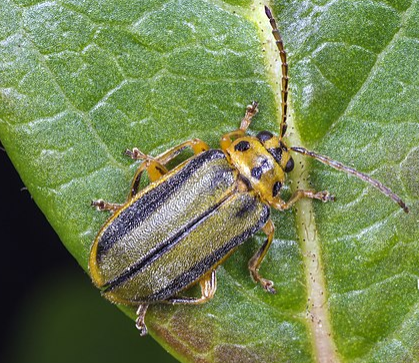
Elm Leaf Beetles (Xanthogaleruca luteola) are destructive invasive pests that feed exclusively on elm trees (Ulmus species). Both the adult and larval stages damage foliage by chewing and skeletonizing leaves, leading to significant defoliation, reduced vigor, and aesthetic decline. While a single season of feeding rarely kills a mature tree, repeated infestations can weaken elms and make them more vulnerable to secondary pests such as Elm Bark Beetles, which are known vectors of Dutch elm disease.
Taxonomy and Classification
Elm Leaf Beetles belong to the family Chrysomelidae (leaf beetles) within the order Coleoptera. They undergo complete metamorphosis, progressing through egg, larval, pupal, and adult stages. Native to Europe and parts of Asia, this species was introduced to North America in the 19th century and is now widely established wherever elm trees are present. They are highly host-specific, feeding primarily on species such as English elm, Siberian elm, and hybrid ornamental elms.
Physical Description
Adult Elm Leaf Beetles are small, measuring approximately 1/4 inch in length. Their coloration ranges from yellowish-green to olive green, with two distinct black stripes running lengthwise along the outer edges of the wing covers (elytra). Adults that have overwintered may appear darker, often brownish or gray.
The larvae are the most damaging stage. They are slug-like in appearance, olive to pale yellow in color, and feature two dark stripes along their backs with small spines. Mature larvae can reach up to 1/2 inch in length and are typically found feeding on the undersides of leaves.
Distribution and Habitat
Elm Leaf Beetles are widely distributed across North America and are closely associated with elm tree populations. Their primary habitat is the canopy of host trees during the growing season. However, adults seek protected overwintering sites in the fall, often hiding under bark, within leaf litter, or inside cracks and crevices of buildings. This behavior frequently results in nuisance infestations inside homes.
Behavior and Life Cycle
This species typically produces two to four generations per year depending on climate conditions. Adults emerge in spring and begin feeding on young elm leaves before laying clusters of bright yellow-orange eggs on the undersides of foliage.
After hatching, larvae feed intensively for several weeks. Once fully developed, they migrate down the tree trunk or drop to the ground to pupate, often gathering in large numbers near the base of the tree. New adults emerge and return to the canopy to continue the cycle. In the fall, adults disperse in search of sheltered overwintering sites.
Feeding and Damage
Elm Leaf Beetles cause damage in two primary ways:
- Adult Feeding: Adults chew small, round “shot-hole” openings through leaves, especially early in the season.
- Larval Feeding (Skeletonization): Larvae consume the soft green tissue between leaf veins, leaving behind a lace-like structure. This damage causes leaves to turn brown, dry out, and drop prematurely.
Severe infestations can result in complete defoliation by mid-summer. Repeated yearly damage weakens trees, reduces growth, and increases susceptibility to environmental stress and secondary pests.
Management and Prevention
Effective management focuses on reducing larval populations and protecting foliage throughout the growing season.
- Systemic Treatments: Soil drenches or trunk injections using systemic insecticides provide long-term control by targeting feeding larvae and adults.
- Foliar Applications: Targeted sprays can be effective against young larvae, though proper timing is critical and large trees are difficult to treat.
- Sanitation: Removing pupae and debris at the base of trees and around structures can help reduce populations.
- Exclusion: Sealing cracks and entry points can help prevent overwintering adults from entering buildings.
Conservation and Research
Elm Leaf Beetles remain a persistent pest in urban and suburban landscapes. Ongoing research is focused on improving systemic treatment timing, developing biological control options such as parasitic wasps, and enhancing integrated pest management strategies to reduce reliance on chemical controls while preserving tree health.