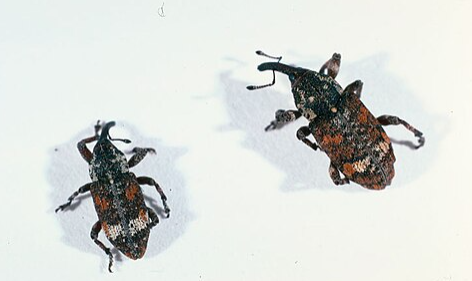
The Eastern Pine Weevil (Pissodes strobi and related Pissodes species) is a destructive forest and ornamental tree pest that attacks pine trees and other conifers throughout eastern North America. These insects are especially damaging to young trees because their larvae tunnel inside stems and terminal leaders, disrupting nutrient transport and causing deformities, stunted growth, and long-term structural damage. In forestry and Christmas tree production, Eastern Pine Weevils are considered economically significant pests capable of reducing timber quality and tree value.
Taxonomy and Classification
- Order: Coleoptera
- Family: Curculionidae
- Genus: Pissodes
Eastern Pine Weevils belong to the large family Curculionidae, commonly known as snout beetles or weevils. Members of this group are characterized by their elongated snouts and specialized feeding behavior.
Several species within the genus Pissodes attack coniferous trees, but the White Pine Weevil (Pissodes strobi) is among the most destructive species in North America.
Identification
Adult Eastern Pine Weevils are small brown to reddish-brown beetles measuring approximately 6–10 mm in length. Their elongated snouts and rough, mottled wing covers help camouflage them against pine bark.
Adults often display:
- Curved snout (rostrum)
- White or tan scale markings
- Hard wing covers
- Elbowed antennae
- Cylindrical beetle body
The larvae are legless, creamy white grubs with brown head capsules. These larvae develop hidden within tree stems and terminal leaders where they feed internally on cambium tissue.
Distribution and Habitat
Eastern Pine Weevils occur throughout much of eastern Canada and the northeastern and north-central United States. Their range closely follows the distribution of pine and spruce forests.
Common habitats include:
- Pine plantations
- Christmas tree farms
- Conifer forests
- Forest edges
- Nurseries
- Residential landscapes with pine trees
Young, vigorously growing trees are especially vulnerable because the insects prefer actively growing terminal leaders.
Life Cycle
The Eastern Pine Weevil undergoes complete metamorphosis consisting of egg, larva, pupa, and adult stages.
Egg Stage
Adult females chew small cavities into the bark of terminal leaders or upper stems and deposit eggs beneath the bark surface.
Larval Stage
After hatching, larvae tunnel through the cambium and phloem tissues beneath the bark. This internal feeding is the most destructive phase of the life cycle because it disrupts water and nutrient movement within the tree.
As larvae feed, they create galleries that weaken and eventually kill the terminal leader.
Pupal Stage
Larvae pupate within chambers beneath the bark. Adult beetles later emerge by chewing exit holes through the bark surface.
Adult Stage
Adults feed on bark and shoots before seeking new host trees for reproduction. Most species complete one generation annually.
Behavior and Damage
Eastern Pine Weevils are considered major tree pests because their larval feeding causes severe deformities in coniferous trees.
Damage symptoms commonly include:
- Dead or wilted terminal leaders
- Crooked or forked tree growth
- Resin bleeding on stems
- Stunted tree height
- Reduced timber quality
- Multiple top formations
When the terminal leader dies, lateral branches often take over as replacement leaders, resulting in crooked or multi-stemmed trees. This deformation significantly lowers commercial timber value and ornamental appearance.
Repeated infestations may severely reduce growth rates and weaken young trees over time.
Host Trees
Common host species include:
- Eastern white pine
- Scotch pine
- Jack pine
- Red pine
- Spruce species
- Occasionally firs and other conifers
White pine is particularly susceptible and often suffers the greatest economic damage.
Economic Importance
Eastern Pine Weevils are among the most important conifer pests in northern forestry operations. Damage caused by leader death and stem deformities reduces:
- Timber quality
- Tree height growth
- Christmas tree marketability
- Landscape appearance
- Commercial plantation productivity
Young plantations and nursery stock are especially vulnerable to heavy infestations.
Management and Control (IPM)
Monitoring
- Inspect terminal leaders regularly
- Look for resin flow and wilted tops
- Monitor adult emergence periods
Cultural Control
- Maintain healthy tree growth
- Avoid planting susceptible species in heavily infested areas
- Encourage tree vigor through proper spacing
Mechanical Removal
- Prune and destroy infested leaders
- Remove damaged terminal shoots before adult emergence
- Dispose of infested material properly
Chemical Control
Preventative insecticide applications targeting adults before egg-laying may help protect high-value ornamental or plantation trees when infestations are severe.
Ecological Role
Although considered damaging forest pests, Eastern Pine Weevils are part of natural forest ecosystems and serve as prey for birds, parasitic wasps, and predatory insects.
Their activity also contributes to the natural thinning and turnover of stressed conifer trees in wild forest systems.
Conclusion
The Eastern Pine Weevil is a destructive conifer pest capable of causing severe deformities and growth loss in pine trees and other conifers. By targeting terminal leaders, these weevils reduce timber quality, ornamental value, and plantation productivity throughout eastern North America. Early monitoring, pruning, and integrated pest management strategies are essential for protecting vulnerable trees and minimizing long-term damage.