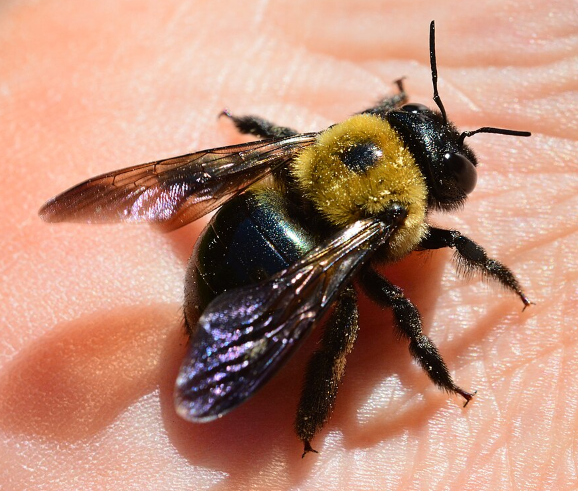
The Eastern Carpenter Bee (Xylocopa virginica) is a large, solitary bee species native to eastern North America. Often mistaken for bumblebees due to its size and coloration, this species can be distinguished by its smooth, shiny black abdomen, whereas bumblebees have hairy abdomens. Despite its reputation for damaging wood, the Eastern carpenter bee is an important pollinator that plays a vital role in both natural ecosystems and agriculture.
While their nesting behavior can lead to structural concerns over time, these bees are generally non-aggressive and provide significant ecological benefits through pollination of flowering plants.
Taxonomy and Classification
- Common Name: Eastern Carpenter Bee
- Scientific Name: Xylocopa virginica
- Order: Hymenoptera
- Family: Apidae
- Genus: Xylocopa
Carpenter bees belong to the same family as honey bees and bumblebees but differ significantly in behavior, as they are solitary rather than social. Each female constructs and provisions her own nest without the support of a colony.
Physical Description
Eastern carpenter bees are among the largest native bees in North America.
- Size: Approximately 20–25 mm (about 1 inch) in length
- Thorax: Covered in dense yellow or golden hairs
- Abdomen: Smooth, shiny, and black (key distinguishing feature)
- Wings: Slightly iridescent with a purplish tint
Sexual differences are notable:
- Males: Often have a pale or yellowish face and cannot sting
- Females: Entirely black-faced and capable of stinging, though rarely aggressive
Their large size and loud buzzing flight often make them appear more threatening than they actually are.
Distribution and Habitat
The Eastern carpenter bee is widely distributed across the eastern United States and into parts of southern Canada. It thrives in both natural and human-altered environments.
Common habitats include:
- Wooden decks, fences, and siding
- Forest edges and wooded areas
- Gardens and suburban landscapes
- Unpainted or weathered softwood surfaces
They prefer softwoods such as pine, cedar, and redwood, especially when untreated or exposed to the elements.
Behavior and Life Cycle
Eastern carpenter bees exhibit unique nesting and reproductive behaviors.
- Nesting: Females bore round entry holes into wood and excavate tunnels parallel to the grain
- Egg Laying: Eggs are deposited in individual chambers within the tunnel
- Provisioning: Each chamber is stocked with a mixture of pollen and nectar as food for the developing larva
- Development: Larvae develop into adults over several weeks
New adults typically emerge in late summer, overwinter in the tunnels, and become active again in the spring.
Although they are solitary, multiple females may nest in the same general area, creating the appearance of a colony.
Feeding and Ecological Role
Eastern carpenter bees are important pollinators for many plants, including:
- Tomatoes
- Eggplants
- Blueberries
- Wildflowers
They are capable of buzz pollination, a technique where they vibrate flowers to release pollen more effectively than many other pollinators.
While they may occasionally engage in “nectar robbing” (cutting into flowers to access nectar), they still contribute significantly to pollination overall.
Damage and Structural Impact
The primary concern with Eastern carpenter bees is their wood-boring behavior.
- Entry Holes: Perfectly round holes about 1/2 inch in diameter
- Tunnel Expansion: Galleries can extend several inches inside wood
- Repeated Nesting: Over time, reuse of tunnels can weaken structures
- Secondary Damage: Woodpeckers may peck at infested wood to feed on larvae
While a single bee causes minimal damage, repeated activity over years can lead to structural concerns.
Management and Prevention
Management focuses on deterrence and habitat modification rather than elimination.
| Strategy | Purpose | Benefit |
|---|---|---|
| Seal or Paint Wood | Protect exposed surfaces | Prevents nesting |
| Fill Existing Holes | Use wood filler or caulk | Stops reuse of tunnels |
| Use Hardwood Materials | Replace softwood where possible | Reduces attractiveness |
| Provide Bee Blocks | Offer alternative nesting sites | Redirects activity away from structures |
Timing repairs during late fall or winter, when bees are inactive, is most effective.
Prevention
- Maintain painted or sealed wood surfaces
- Inspect structures annually for new holes
- Repair damage promptly
- Encourage alternative nesting habitats
- Avoid unnecessary pesticide use to protect pollinators
Preventative strategies help balance structural protection with ecological conservation.
Related Articles
Conclusion
The Eastern carpenter bee is a fascinating and beneficial insect that plays a crucial role in pollination. Although its wood-boring behavior can cause concern for homeowners, the damage is typically manageable with proper prevention techniques.
By understanding their behavior and implementing non-destructive control methods, it is possible to coexist with these important pollinators while protecting wooden structures.