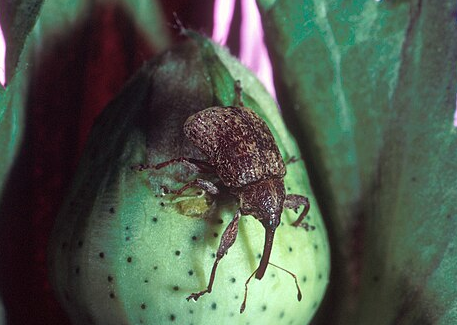
Cotton boll weevils, Anthonomus grandis, are small snout beetles that feed and reproduce in the flower buds and developing bolls of cotton plants. Once regarded as the most destructive cotton pest in the United States, the boll weevil caused enormous crop losses and transformed agricultural communities throughout the South.
A cooperative eradication program has now eliminated the boll weevil from more than 99 percent of U.S. cotton acreage. Ongoing eradication work is concentrated in the Lower Rio Grande Valley of Texas, where a quarantine remains in effect. Continued trapping, reporting, stalk destruction, and regulation of cotton-related materials are essential to prevent the pest from returning to eradicated areas.
Taxonomy and Classification
- Kingdom: Animalia
- Phylum: Arthropoda
- Class: Insecta
- Order: Coleoptera
- Superfamily: Curculionoidea
- Family: Curculionidae
- Genus: Anthonomus
- Species: Anthonomus grandis
Boll weevils belong to the true weevil family Curculionidae. Their scientific name is sometimes presented with a subspecies designation in technical literature. Molecular diagnostic methods may be used by regulatory agencies to distinguish boll weevils associated with commercial cotton from closely related populations found on wild cotton relatives.
Identification
Adult Boll Weevils
Adult boll weevils are approximately one-quarter inch long. Their color varies with age, ranging from reddish-brown in newly emerged individuals to gray, dark brown, or almost black in older beetles. The body is oval, and a prominent curved snout projects from the head.
The mouthparts are located at the end of the snout. Females use this structure to make cavities in cotton squares and bolls for feeding or egg-laying. One useful identification feature is the presence of two spurs on each front femur, with one spur noticeably larger than the other.
- Approximately one-quarter inch long
- Reddish-brown, gray, brown, or nearly black
- Long, curved snout
- Elbowed antennae attached along the snout
- Oval body covered with short hairs
- Two spurs on each front femur
Several native weevils resemble boll weevils. Color, size, or the presence of a snout alone cannot confirm an identification. Any suspected boll weevil found outside the designated quarantine area should be retained securely or photographed and reported for professional examination.
Eggs, Larvae, and Pupae
Eggs are tiny, pale, and concealed inside cotton squares or bolls. Females normally place one egg in each prepared cavity and seal the opening with frass and plant material. This produces a raised, brownish, wart-like mark on the surface.
Larvae are white or cream-colored, legless grubs with brown head capsules. Their bodies curve into a C shape when removed from the plant. Pupae are also pale and remain inside the damaged square or boll. The developing snout, legs, and wings of the future adult are visible on the pupa.
Distribution and History in the United States
The boll weevil originated in Mexico or Central America and entered the United States from Mexico during the 1890s. It spread rapidly from Texas across the Cotton Belt, eventually becoming established throughout most cotton-producing areas of the South.
By attacking the reproductive parts of cotton plants, boll weevils caused severe yield losses, increased production expenses, lowered farmland values, and disrupted local economies. Some heavily infested farms experienced repeated crop failures or abandoned cotton production.
The USDA Animal and Plant Health Inspection Service launched the Boll Weevil Eradication Program in 1978 in North Carolina and Virginia. The program later expanded across the Cotton Belt through cooperation among federal agencies, state agriculture departments, research institutions, eradication foundations, and cotton growers.
As of 2026, boll weevils have been eradicated from more than 99 percent of U.S. cotton acreage. Eradication and quarantine activities continue in the Lower Rio Grande Valley of Texas, where proximity to infested areas of Mexico creates an ongoing reinfestation risk.
Host Plants and Habitat
Boll weevils are closely associated with cultivated cotton, Gossypium species, and certain wild relatives. Adults may obtain food from other flowers or plant material when cotton reproductive structures are unavailable, but successful reproduction depends primarily on cotton squares and bolls.
During the growing season, adults occur on cotton plants, particularly around terminals, squares, flowers, and bolls. Between seasons, surviving adults seek protected locations in plant litter, wooded borders, grassy areas, drainage sites, field debris, and other sheltered habitats near former cotton fields.
Life Cycle
Boll weevils undergo complete metamorphosis through egg, larval, pupal, and adult stages. The entire cycle can be completed in approximately three weeks during warm weather, allowing five or more overlapping generations to develop during a long cotton-growing season.
Adults surviving the winter become active in spring and move into cotton fields. Before squares are available, they may feed on tender plant terminals. Once flower buds form, adults feed on them, mate, and begin laying eggs.
A female drills into a square or boll, deposits a single egg, and closes the cavity with a plug of frass. A female may produce as many as 200 eggs during her lifetime. The egg hatches inside the protected plant structure, where the larva immediately begins feeding.
Larval development generally requires approximately seven to 14 days. The mature larva then pupates inside the square or boll for about five days. A new adult chews an exit hole through the damaged plant tissue and begins feeding before reproducing.
Late-season adults may enter a dormant state and seek overwintering shelter. Eliminating living cotton plants after harvest interrupts food and reproduction, reducing the number of weevils capable of surviving until the following crop.
Boll Weevil Damage
Feeding Punctures
Both male and female adults puncture cotton squares and bolls to feed. Feeding punctures normally remain open and uncapped. Injured squares may yellow, flare open, dry, or fall from the plant. Damage to tender terminals can temporarily slow young plants, although injury to reproductive structures is much more important.
Egg-Laying Punctures
Egg-laying punctures are sealed with a plug that creates a characteristic raised or wart-like spot. The concealed larva consumes the interior of the square or boll. Infested squares frequently turn yellow and drop to the ground before flowering.
Boll Injury and Yield Loss
Small bolls may also fall after being attacked. Larger bolls sometimes remain attached, but feeding and egg-laying wounds can interfere with lint and seed development. Openings created by the insects may allow boll-rotting fungi and bacteria to enter.
When populations are high, females attack new squares soon after they become large enough to support larvae. Repeated fruit loss prevents plants from setting a normal crop, delays maturity, lowers lint yield, and can cause complete economic failure under extreme conditions.
Monitoring and Detection
The eradication program relies heavily on pheromone-baited traps placed around cotton fields and other risk areas. These traps attract adult boll weevils and allow program personnel to detect small populations before they become widespread.
Growers and scouts should also watch for adult weevils, punctured squares, sealed egg-laying sites, flared bracts, yellowing flower buds, and prematurely dropped fruit. Fallen squares can be opened and examined for white larvae or pupae.
Do not disturb, relocate, or discard an official monitoring trap. Report a damaged or displaced trap to the responsible eradication organization. Moving traps or removing captured insects can interfere with surveillance and delay an official response.
Management and Eradication
Report Suspected Boll Weevils
Every boll weevil detected outside the Lower Rio Grande Valley quarantine zone must be reported immediately. Contact the state plant regulatory official, state agriculture department, county Extension office, or USDA State Plant Health Director. Do not move the suspected insect, cotton plant, boll, or other infested material to another property.
Destroy Cotton Stalks
Timely destruction of cotton stalks and regrowth eliminates reproductive hosts after harvest. In Texas, planting dates, stalk-destruction methods, and deadlines vary among pest-management zones and may be legally enforced. Approved methods can include shredding, tillage, herbicide treatment, flood irrigation, or a combination of practices.
Volunteer cotton, abandoned plants, ratoon growth, and noncommercial cotton can provide squares and bolls that allow boll weevils to survive. These plants should be managed according to state eradication regulations, particularly within or near quarantine zones.
Prevent Accidental Movement
Harvesting machinery, modules, gin equipment, vehicles, and cotton products can move insects from infested regions. Follow all inspection, cleaning, certification, and quarantine requirements before transporting equipment or regulated material out of a boll weevil area.
Coordinated Insecticide Treatment
Inside the quarantine area, insecticides may be applied under official eradication protocols. Treatments are coordinated with trap detections, cotton development, population distribution, and applicable environmental restrictions. Individual growers should not substitute uncoordinated spraying for participation in the eradication program.
Always follow the pesticide label, eradication-program instructions, worker-protection requirements, and geographically specific use restrictions. Natural predators and parasitoids may kill some weevils, but biological control alone cannot protect an eradicated region from reestablishment.
Are Boll Weevils Household Pests?
Boll weevils do not infest flour, rice, cereal, clothing, furniture, or structural wood. Small beetles found in pantry products are usually grain weevils or rice weevils rather than boll weevils. An adult boll weevil may occasionally wander indoors near a cotton-growing area, but it cannot reproduce without suitable cotton structures.
Conclusion
Cotton boll weevils are historically destructive pests whose larvae develop inside cotton squares and bolls. Decades of coordinated trapping, host removal, regulatory enforcement, and treatment have eradicated the insect from nearly all U.S. cotton acreage. Protecting that achievement requires continued surveillance, prompt reporting, cotton stalk destruction, volunteer-cotton control, and compliance with equipment-movement rules. Any suspected boll weevil outside the Lower Rio Grande Valley quarantine zone should be treated as an urgent regulatory concern.