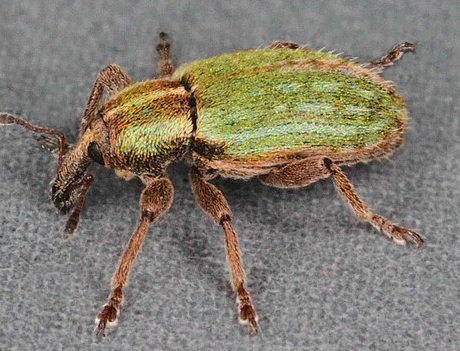
Clover Stem Weevils (Hypera meles) are destructive forage pests that attack clover and related crops by feeding within stems and on foliage. These insects disrupt nutrient flow and weaken plant structure, leading to reduced growth, lodging, and decreased forage yield.
Unlike root-feeding pests, clover stem weevil damage occurs above ground, making symptoms more visible. However, internal feeding often progresses significantly before damage is noticed, making early monitoring essential.
Taxonomy and Classification
- Common Name: Clover Stem Weevil
- Scientific Name: Hypera meles
- Order: Coleoptera
- Family: Curculionidae
- Type: Stem-boring forage pest
Clover stem weevils belong to the weevil family, known for their elongated snouts and plant-feeding habits.
Identification
Both adult and larval stages contribute to plant damage.
- Adults: Small (4–5 mm), oval, brownish-gray beetles with a distinct snout and subtle longitudinal striping
- Larvae: Legless, C-shaped grubs ranging from creamy-white to pale green with a dark brown head capsule
Key signs of infestation include:
- Longitudinal stem scarring from egg-laying and feeding
- Internal tunnels within stems
- Jagged leaf edges caused by adult feeding
Cutting open stems often reveals larvae and feeding galleries.
Distribution and Habitat
Clover stem weevils are widely distributed in temperate regions and are common across the United States in forage production systems.
They are typically found in:
- Clover fields
- Alfalfa stands
- Pastures and mixed forage systems
Populations can persist in fields for multiple seasons if not properly managed.
Behavior and Life Cycle
Clover stem weevils undergo complete metamorphosis.
The lifecycle includes:
- Egg Stage: Eggs are deposited in or on plant stems
- Larval Stage: Larvae bore into stems and feed internally
- Pupal Stage: Pupation occurs within plant tissue or soil
- Adult Stage: Adults emerge and feed on foliage before reproducing
One or more generations may occur annually, depending on climate conditions.
Feeding and Damage
Clover stem weevils damage plants through both larval and adult feeding.
- Stem Mining: Larvae tunnel through stems, weakening structural integrity
- Vascular Disruption: Feeding interrupts nutrient and water transport
- Plant Lodging: Stems collapse, making harvesting difficult
- Defoliation: Adults feed on leaves, reducing photosynthetic capacity
- Secondary Infection: Feeding sites allow entry of fungal pathogens
Infestations can result in stunted growth, reduced yield, and long-term stand decline.
Management and Control
Effective control focuses on cultural practices that reduce populations and interrupt the lifecycle.
| Strategy | Purpose | Benefit |
|---|---|---|
| Early Mowing | Harvest before peak larval development | Removes larvae and exposes them to environmental stress |
| Residue Management | Remove or incorporate plant debris | Eliminates overwintering habitat |
| Crop Diversification | Interplant with non-host species | Reduces pest density and spread |
| Monitoring | Use sweep nets to detect adults | Allows early detection of infestation |
Proper timing of harvest and field management is critical for reducing pest populations.
Prevention
- Monitor fields regularly during spring and early summer
- Rotate crops to disrupt pest lifecycle
- Maintain healthy forage stands
- Remove infested plant material
- Encourage natural predators
Preventative strategies help reduce long-term infestation risks and maintain productive forage systems.
Related Articles
Conclusion
Clover stem weevils are significant forage pests that weaken plants through internal stem feeding and external foliage damage. Their combined impact can reduce plant vigor, complicate harvesting, and lower overall yield.
Through timely monitoring, strategic mowing, and integrated pest management practices, infestations can be controlled, helping to preserve healthy and productive forage systems.