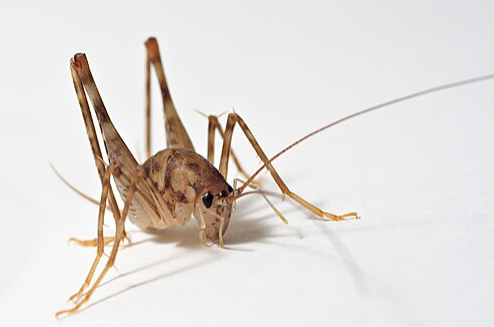
Camel crickets are humpbacked, wingless insects commonly found in caves, damp basements, crawl spaces, garages, greenhouses, and other cool, humid locations. They are also called cave crickets, spider crickets, or sprickets. Their long legs and habit of jumping toward perceived threats can be startling, but camel crickets do not bite, sting, or transmit diseases to people.
Taxonomy and Classification
- Order: Orthoptera
- Family: Rhaphidophoridae
- Native American genus: Ceuthophilus
- Common introduced species: Tachycines asynamorus
- Other names: Cave cricket, spider cricket, and greenhouse camel cricket
The greenhouse camel cricket, Tachycines asynamorus, has also been published under the scientific name Diestrammena asynamora. This Asian species is now widespread around buildings in the eastern United States.
Identification
Camel crickets are usually light tan, reddish brown, or dark brown and measure approximately one-half to one-and-one-quarter inches long, excluding their legs and antennae. The body appears strongly arched or humpbacked when viewed from the side.
Extremely long antennae help these nocturnal insects navigate dark environments. Their enlarged hind legs allow powerful, sudden jumps. Camel crickets are wingless and cannot fly. Unlike house and field crickets, they lack sound-producing wings and do not chirp. Females can often be recognized by a slender, swordlike egg-laying structure called an ovipositor.
Habitat and Distribution
Native camel crickets inhabit caves, hollow logs, animal burrows, rocky crevices, and moist woodland debris. Around buildings, they shelter beneath decks, stones, firewood, garbage containers, dense vegetation, and landscape materials.
Indoors, they are most frequently discovered in damp basements, crawl spaces, utility rooms, garages, sheds, and occasionally bathrooms. Their presence in large numbers often indicates excessive moisture or accessible openings around the foundation.
Diet and Behavior
Camel crickets are nocturnal scavengers and opportunistic feeders. They consume decaying leaves, fungi, plant material, dead insects, animal remains, and other organic debris. They may also prey on small living arthropods or consume other camel crickets when food is limited.
They hide in dark, protected areas during the day and emerge at night to forage. When startled, a camel cricket may jump toward a person because it uses random leaping as an escape response, not because it is attacking.
Life Cycle
Camel crickets undergo incomplete metamorphosis. Females deposit eggs in moist soil or another protected substrate. Young nymphs resemble miniature adults but lack mature reproductive structures. They grow through a series of molts before reaching adulthood, with development influenced by temperature, humidity, and available food.
Damage and Concerns
A few camel crickets indoors generally cause no meaningful damage. Large populations may leave droppings, become an unpleasant nuisance, or occasionally nibble paper, stored fabrics, houseplants, cardboard, and other organic materials. Soiled fabrics are more vulnerable than clean materials.
Camel crickets are not known to damage structural wood. They should not be confused with termites, wood-boring beetles, or mole crickets.
Management and Control
Moisture reduction and exclusion provide the most dependable long-term control. Repair plumbing leaks, improve crawl-space drainage, increase ventilation, and operate a dehumidifier in damp basements. Remove leaf piles, boards, stones, and other hiding places from immediately beside the foundation.
- Seal foundation cracks and utility openings.
- Repair basement windows and damaged vent screens.
- Install tight-fitting door sweeps and weatherstripping.
- Store firewood and landscape materials away from the building.
- Vacuum individual crickets and dispose of the contents promptly.
- Place sticky traps along walls in dark, damp areas.
- Store pet food and dry goods in sealed containers.
Indoor insecticide applications are usually unnecessary when moisture and entry points are corrected. Persistent infestations may require inspection by a pest-management professional to locate hidden moisture, structural gaps, or outdoor breeding areas. Any pesticide used must be labeled for crickets and applied according to its directions.
Conclusion
Camel crickets are harmless scavengers that become household pests when damp conditions provide suitable shelter. Dehumidification, sanitation, structural repairs, and trapping normally offer effective control without routine indoor pesticide use.