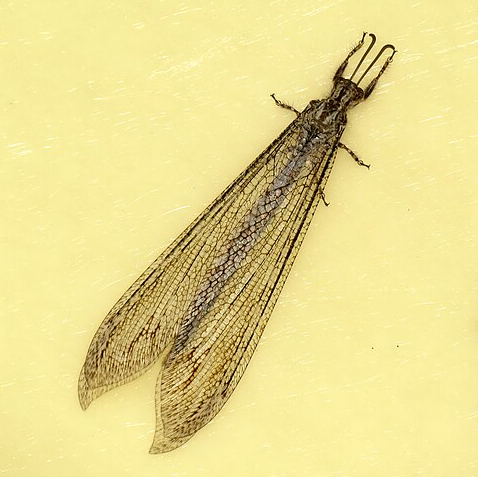
Antlion – Vella fallax (Vella fallax) is a large species of antlion in the family Myrmeleontidae, found primarily in the southeastern and central regions of North America. This species is notable for its relatively large adult size and its predatory larval stage, which contributes to natural insect population control. Unlike some smaller antlions, Vella fallax larvae may or may not construct well-defined pit traps depending on environmental conditions.
As with other antlions, Vella fallax is a beneficial insect and plays an important role in maintaining ecological balance by preying on ants and other small arthropods.
Taxonomy and Classification
- Common Name: Antlion (Vella fallax)
- Scientific Name: Vella fallax
- Order: Neuroptera
- Family: Myrmeleontidae
- Type: Predatory antlion
The genus Vella includes some of the larger antlion species in North America, often distinguished by their size and wing patterns.
Identification and Physical Description
Vella fallax exhibits distinct differences between larval and adult stages.
Larvae are robust and somewhat flattened, measuring approximately 3/4 to 1.5 inches in length. They possess:
- Large, curved mandibles for capturing prey
- Camouflaged brown or gray coloration
- Broad bodies adapted for burrowing or concealment
Larvae may construct shallow pits in sandy soils or remain hidden beneath the surface, depending on environmental conditions.
Adults are large compared to many other antlion species, with a body length of 1.5 to 2.5 inches and a wingspan that can exceed 3 inches. They have:
- Long, slender bodies
- Broad, net-veined wings often with mottled or spotted patterns
- Clubbed antennae
Adults resemble damselflies but can be distinguished by their antennae and resting posture.
Life Cycle
Vella fallax undergoes complete metamorphosis, progressing through egg, larva, pupa, and adult stages.
Females lay eggs in sandy or loose soil. After hatching, larvae begin feeding on small insects and may construct pit traps or use ambush strategies.
The larval stage can last from several months to over a year, depending on environmental conditions and food availability.
When ready to pupate, the larva spins a cocoon using soil and silk. Adults emerge after metamorphosis and live for several weeks, during which they reproduce.
Habitat and Distribution
Vella fallax is primarily found in the southeastern and central United States. It is commonly associated with:
- Sandy or loose soils
- Open woodlands and forest edges
- Dry, sheltered environments
- Areas with minimal ground disturbance
Its distribution is closely tied to suitable soil conditions for larval development.
Behavior and Ecology
Larvae of Vella fallax are predatory and may employ both pit-building and ambush hunting strategies. When using pit traps, they wait at the bottom for prey such as ants to fall in.
In non-pit conditions, larvae remain concealed and capture prey that comes within reach.
Adults are primarily nocturnal and are attracted to light sources. They are weak fliers and often rest on vegetation during the day.
As predators, antlions play an important role in controlling insect populations and supporting ecological balance.
Diet
The diet of Vella fallax varies by life stage:
- Larvae: Ants, small beetles, and other arthropods
- Adults: Nectar, pollen, or small insects (depending on availability)
Larvae are the primary feeding stage and are responsible for most predatory activity.
Benefits and Importance
Vella fallax provides several ecological benefits:
- Natural control of ant populations
- Support of food webs
- Contribution to biodiversity
Its presence indicates a functioning and balanced ecosystem.
Human Interaction and Risks
This species is harmless to humans. It does not bite or sting and poses no risk.
It is rarely encountered directly due to its nocturnal habits and concealed larval stage.
Management and Control
No control measures are necessary, as Vella fallax is beneficial.
Preserving its habitat supports natural pest control processes.
Prevention
No prevention is required. However, altering sandy habitats may reduce their presence if desired.
- Disturb sandy soils
- Reduce shaded, dry areas
- Maintain landscaping
These steps are generally unnecessary unless specific concerns arise.
Related Articles
Conclusion
Vella fallax is a large and ecologically important antlion species that contributes to the control of small insect populations. Its adaptable hunting strategies and distinctive life cycle make it a fascinating member of the insect world.
With no threat to humans and clear ecological benefits, it is best appreciated as a natural and valuable component of its habitat.