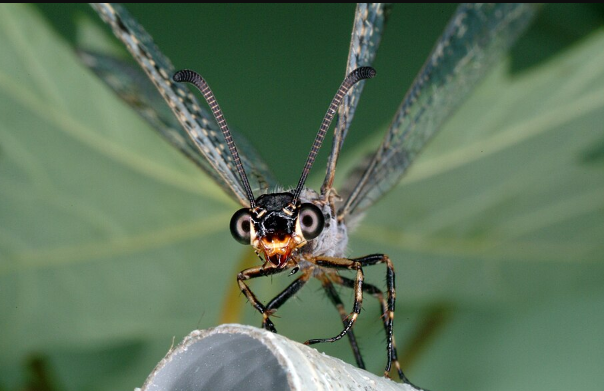
Antlion (family Myrmeleontidae) refers to a group of predatory insects best known for their larval stage, which creates distinctive conical pits in sandy soil to trap prey. Native to many regions worldwide, including North America, antlions are commonly found in dry, sandy habitats such as deserts, woodlands, and sheltered outdoor areas.
Antlions are beneficial insects, as their larvae prey on ants and other small arthropods. Despite their somewhat fearsome reputation, they pose no threat to humans and are an important part of natural ecosystems.
Taxonomy and Classification
- Common Name: Antlion
- Family: Myrmeleontidae
- Order: Neuroptera
- Type: Predatory insect (larval pit-builder)
The family Myrmeleontidae includes numerous species of antlions, all characterized by their predatory larvae and delicate, lacewing-like adults.
Identification and Physical Description
Antlions have two distinct forms depending on their life stage.
Larvae, often called “doodlebugs,” are stout-bodied and typically measure 1/2 to 1 inch in length. They have:
- Large, sickle-shaped jaws for capturing prey
- Flattened bodies adapted for burrowing
- Brown or gray coloration for camouflage in sand
Adults resemble damselflies or lacewings and are more delicate in appearance. They typically measure 1 to 2 inches in length with:
- Long, slender bodies
- Transparent, net-veined wings
- Clubbed antennae (distinguishing them from similar insects)
Adults are weak fliers and are often found resting on vegetation.
Life Cycle
Antlions undergo complete metamorphosis, progressing through egg, larva, pupa, and adult stages.
Females lay eggs in sandy or loose soil. After hatching, larvae begin constructing pit traps to capture prey.
The larval stage can last several months to a few years, depending on environmental conditions and food availability.
When fully developed, the larva spins a cocoon in the soil and pupates. Adults emerge after transformation and live for several weeks, during which they reproduce.
Habitat and Distribution
Antlions are widely distributed and are commonly found in:
- Sandy or loose soils
- Dry, sheltered areas
- Under overhangs, eaves, or tree roots
- Desert and woodland environments
They prefer habitats where soil conditions allow for easy excavation of pit traps.
Behavior and Ecology
The most notable behavior of antlion larvae is their pit-building technique. Larvae construct conical pits in the sand and hide at the bottom, waiting for prey to fall in.
When an insect, such as an ant, slips into the pit, the larva uses its jaws to capture and consume it. The larva may also flick sand to prevent escape.
Adults are primarily nocturnal and are attracted to light sources. They are less active hunters compared to larvae.
As predators, antlions help regulate populations of small insects and contribute to ecological balance.
Diet
The diet of antlions varies by life stage:
- Larvae: Ants and other small insects trapped in pits
- Adults: Nectar, pollen, or small insects (depending on species)
Larvae are highly specialized predators, while adult feeding habits vary.
Benefits and Importance
Antlions provide several ecological benefits:
- Natural control of ant populations
- Contribution to food webs
- Support of ecosystem balance
They are an important component of many terrestrial ecosystems.
Human Interaction and Risks
Antlions are completely harmless to humans. They do not bite or sting and pose no risk.
Their pit traps are often noticed in sandy areas and are considered harmless curiosities.
Management and Control
No control is necessary, as antlions are beneficial predators.
They should be preserved as part of natural ecosystems.
Prevention
Prevention is not required. However, removing sandy, sheltered areas may reduce their presence if desired.
- Disturb sandy soil
- Reduce shaded, dry areas
- Maintain landscaping
These steps are generally unnecessary unless specific concerns arise.
Related Articles
Conclusion
Antlions are fascinating predatory insects best known for their unique pit-building larvae. These insects play a valuable role in controlling small insect populations and maintaining ecological balance.
With no threat to humans and clear environmental benefits, antlions are best appreciated as a natural and beneficial part of many landscapes.