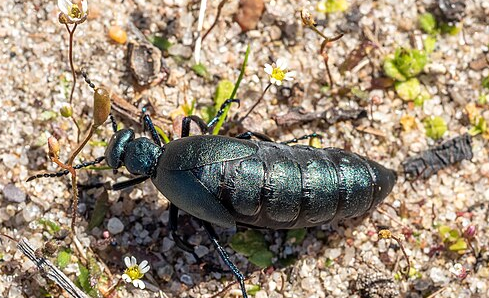
American Oil Beetle (Meloe spp.) is a group of large, soft-bodied beetles in the family Meloidae, commonly known as blister beetles. Native to North America, these beetles are recognized for their swollen, segmented abdomens and reduced wing covers that leave much of the abdomen exposed. They are most commonly found in grasslands, fields, and gardens, especially during spring and early summer.
American oil beetles are notable for producing a defensive chemical called cantharidin, which can cause blistering of the skin upon contact. Despite this, they play an important ecological role, particularly through their unique life cycle, which involves parasitizing bee nests.
Taxonomy and Classification
- Common Name: American Oil Beetle
- Scientific Group: Meloe spp.
- Order: Coleoptera
- Family: Meloidae
- Type: Blister beetle (parasitic larval stage)
The genus Meloe includes numerous species, all characterized by their unusual life cycle and chemical defense mechanisms.
Identification and Physical Description
American oil beetles are relatively large compared to many other beetles, typically measuring 1 to 2 inches in length. Their bodies are soft and somewhat elongated, with a distinctive, swollen abdomen.
Key identifying features include:
- Short, reduced wing covers that do not cover the abdomen
- Bulbous, segmented abdomen
- Dark coloration, often black, blue-black, or metallic
- Slow movement and ground-dwelling behavior
They lack the ability to fly due to their reduced wings.
Larvae are very different in appearance, beginning as highly mobile, tiny forms known as triungulins, which are adapted to seek out host insects.
Life Cycle
The American Oil Beetle has a complex life cycle involving complete metamorphosis and multiple distinct larval stages.
Females lay eggs in soil. After hatching, the first-stage larvae (triungulins) climb onto flowers and attach themselves to visiting bees.
These larvae are transported back to the bee’s nest, where they detach and consume the bee’s eggs and stored pollen. After this parasitic stage, they develop into less mobile larval forms.
Eventually, they pupate in the soil and emerge as adults, completing the life cycle. This process may take one or more years depending on environmental conditions.
Habitat and Distribution
American oil beetles are widely distributed across North America and are commonly found in:
- Grasslands and meadows
- Fields and agricultural areas
- Gardens and open landscapes
- Areas with sandy or loose soil
Their presence is often linked to the availability of host bee populations.
Behavior and Ecology
Adult oil beetles are slow-moving and spend most of their time on the ground or climbing vegetation. They feed on plant material, including leaves and flowers.
Their most notable ecological behavior is their parasitic larval stage, which targets solitary bees. While this may reduce some bee populations, it is a natural ecological interaction.
When threatened, oil beetles exude oily droplets containing cantharidin from their joints—a process known as reflex bleeding.
This chemical defense deters predators but also poses a risk to humans and animals if handled.
Diet
The diet of the American oil beetle varies by life stage:
- Adults: Leaves, flowers, and plant material
- Larvae: Bee eggs and pollen provisions within host nests
This dual feeding strategy reflects their complex life cycle.
Damage and Economic Importance
Adult oil beetles may cause minor damage to plants by feeding on foliage and flowers, but this damage is usually limited and not economically significant.
Their impact on bee populations is localized and generally does not threaten overall pollinator health in balanced ecosystems.
Human Interaction and Risks
American oil beetles can pose a risk due to their production of cantharidin, which can cause:
- Skin blistering
- Irritation and redness
- Harm to pets or livestock if ingested
Handling these beetles should be avoided. Contact with the chemical can result in painful skin reactions.
Management and Control
Control is rarely necessary, but precautions may be taken if beetles are present in high numbers.
- Avoid handling: Do not touch beetles with bare hands.
- Manual removal: Use gloves to relocate beetles if necessary.
- Monitor plants: Inspect for feeding damage.
Chemical control is generally not recommended due to the limited impact and ecological role of these beetles.
Prevention
Preventative measures focus on reducing contact rather than eliminating the species.
- Wear gloves when gardening
- Educate about identifying blister beetles
- Keep pets and livestock away from infested areas
These steps help minimize risk while preserving ecological balance.
Related Articles
Conclusion
The American Oil Beetle is a unique insect known for its unusual life cycle and chemical defenses. While it can pose a risk if handled, it is not a major pest and plays a role in natural ecological processes.
Understanding its behavior and biology helps minimize risks while appreciating its place within North American ecosystems. With minimal need for control, it remains an intriguing and important species in the natural world.