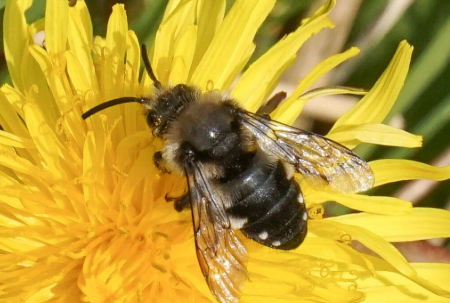
American Mourning Bee (Melecta separata) is a species of cuckoo bee in the family Apidae. Native to North America, it is known for its striking black-and-white coloration and its parasitic behavior. Unlike typical bees that build nests and gather pollen for their offspring, the American Mourning Bee relies on other bee species to raise its young.
This species is considered a cleptoparasite, meaning it lays its eggs in the nests of other bees, where its larvae consume the host’s provisions. Despite this behavior, it is an important part of ecosystem dynamics and contributes to pollination as an adult.
Taxonomy and Classification
- Common Name: American Mourning Bee
- Scientific Name: Melecta separata
- Order: Hymenoptera
- Family: Apidae
- Type: Cuckoo bee (parasitic bee)
The genus Melecta includes several species of parasitic bees that do not build their own nests. These bees are closely associated with host species in the genus Anthophora (digger bees).
Identification and Physical Description
The American Mourning Bee is a medium-sized bee, typically measuring 1/2 to 3/4 inch in length. It has a robust body covered in dense hairs, giving it a somewhat fuzzy appearance.
Key identifying features include:
- Black body with distinctive white or pale hair bands
- Bold, contrasting pattern that gives a “mourning” or somber appearance
- Strong wings suited for active flight
Unlike pollen-collecting bees, the American Mourning Bee lacks specialized structures for carrying pollen, reflecting its parasitic lifestyle.
Life Cycle
The American Mourning Bee undergoes complete metamorphosis, progressing through egg, larva, pupa, and adult stages.
Females locate the nests of host bees, typically ground-nesting species. They enter these nests and lay their eggs alongside or in place of the host’s eggs.
After hatching, the larva consumes the stored pollen and nectar provisioned by the host, and may also eliminate the host larva.
Development continues through the pupal stage until the adult emerges from the host nest. This cycle allows the species to reproduce without constructing its own nests.
Host Species
The American Mourning Bee primarily parasitizes bees in the genus Anthophora, which are commonly known as digger bees. These host bees build nests in soil and provide pollen and nectar for their developing larvae.
The relationship between parasite and host is an example of a specialized ecological interaction.
Habitat and Distribution
The American Mourning Bee is found across much of North America and is commonly associated with habitats where its host species are present. These include:
- Open fields and meadows
- Sandy or loose soils suitable for nesting
- Gardens and agricultural areas
- Woodland edges
Its distribution closely follows that of its host bees.
Behavior and Ecology
Adult American Mourning Bees are active during the day and are often seen flying near host nesting sites or visiting flowers for nectar.
Although parasitic, adults still act as pollinators, contributing to plant reproduction while feeding on nectar.
Their parasitic behavior helps regulate host populations and contributes to ecological balance. This type of interaction is common among certain bee species and is a natural part of ecosystem dynamics.
Diet
The diet of the American Mourning Bee varies by life stage:
- Adults: Nectar from flowers
- Larvae: Pollen and nectar provisions collected by the host bee
Because they rely on host bees for larval nutrition, they do not collect pollen themselves.
Ecological Importance
Despite their parasitic nature, American Mourning Bees play a role in ecosystem health:
- Pollination of flowering plants
- Regulation of host bee populations
- Contribution to biodiversity
They are part of a complex network of interactions that sustain balanced ecosystems.
Human Interaction and Risks
The American Mourning Bee is generally non-aggressive and poses little risk to humans. While capable of stinging, it rarely does so unless provoked.
It is not considered a pest and does not damage property or crops.
Management and Conservation
Management is not required for this species. Instead, conservation efforts should focus on maintaining healthy habitats for both the bee and its host species.
- Preserve natural habitats: Support nesting areas for ground-nesting bees.
- Plant diverse flowers: Provide nectar sources.
- Reduce pesticide use: Protect pollinators and beneficial insects.
These measures help maintain ecological balance and biodiversity.
Prevention
No prevention is necessary, as the American Mourning Bee is not harmful.
Its presence indicates a functioning ecosystem with diverse insect populations.
Related Articles
Conclusion
The American Mourning Bee is a unique and ecologically important species known for its parasitic reproductive strategy. While it does not build its own nests, it contributes to pollination and plays a role in regulating other bee populations.
Understanding its behavior highlights the complexity of insect interactions in natural ecosystems. With no need for control, it is best appreciated as a natural and integral part of North America’s pollinator communities.