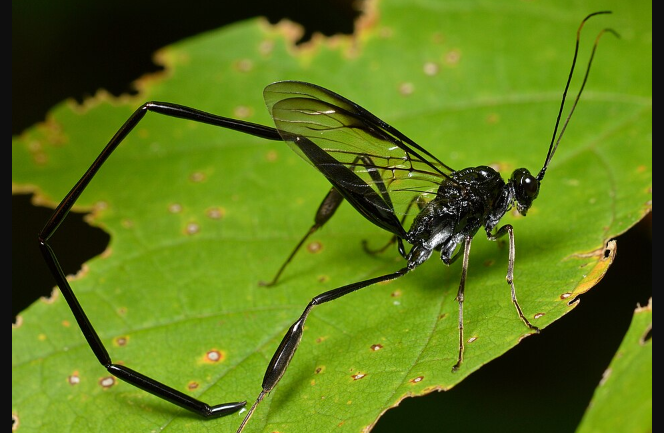
American Pelecinid Wasp (Pelecinus polyturator) is a distinctive parasitic wasp species in the family Pelecinidae. Native to North and Central America, it is easily recognized by its extremely long, slender abdomen, particularly in females. Despite its intimidating appearance, this wasp is harmless to humans and plays a beneficial role in controlling soil-dwelling pests.
The American Pelecinid Wasp is most often seen in late summer and early fall, especially in areas with abundant vegetation and moist soil. It is considered a beneficial insect due to its parasitic relationship with certain beetle larvae.
Taxonomy and Classification
- Common Name: American Pelecinid Wasp
- Scientific Name: Pelecinus polyturator
- Order: Hymenoptera
- Family: Pelecinidae
- Type: Parasitic wasp
The family Pelecinidae is relatively small, with few species worldwide. The American Pelecinid Wasp is the most widely recognized member in North America.
Identification and Physical Description
The American Pelecinid Wasp is a medium to large insect, with females measuring up to 2 inches or more in length due to their elongated abdomen.
Key identifying features include:
- Shiny black body with a smooth, glossy appearance
- Extremely long, curved abdomen in females
- Slender legs and narrow thorax
- Transparent wings with fine veins
Males are much smaller and lack the long abdomen seen in females. They are also rarely encountered compared to females.
The elongated abdomen of the female is not a stinger but is used for locating and laying eggs in host larvae underground.
Life Cycle
The American Pelecinid Wasp undergoes complete metamorphosis, progressing through egg, larva, pupa, and adult stages.
Females use their long abdomen to probe soil in search of host larvae, typically scarab beetle grubs. Once a suitable host is located, the wasp lays an egg on or near the larva.
After hatching, the wasp larva feeds externally on the host, eventually killing it. The larva then pupates in the soil and later emerges as an adult wasp.
There is typically one generation per year, with adults appearing during warmer months.
Host Species
The primary hosts of the American Pelecinid Wasp are larvae of scarab beetles, commonly known as grubs. These include species that can be pests in lawns and agricultural settings.
By parasitizing these larvae, the wasp helps reduce populations of root-feeding beetles.
Habitat and Distribution
The American Pelecinid Wasp is widely distributed across eastern and central North America and parts of Central America. It is commonly found in:
- Woodlands and forest edges
- Gardens and lawns
- Fields and meadows
- Areas with moist, loose soil
Its presence is closely tied to the availability of suitable host larvae.
Behavior and Ecology
Adult American Pelecinid Wasps are active during the day and are often seen flying low over the ground or walking while probing soil with their abdomen.
They are not aggressive and do not sting humans. Their elongated abdomen is used solely for egg-laying and host detection.
As parasitoids, they play an important role in controlling populations of soil-dwelling insects. This contributes to healthier ecosystems and can benefit agricultural and landscaped areas.
Adults may also visit flowers for nectar, contributing modestly to pollination.
Diet
The diet of the American Pelecinid Wasp varies by life stage:
- Adults: Nectar and other plant-derived sugars
- Larvae: External feeding on beetle grubs (parasitic)
This dual feeding strategy supports both survival and ecological function.
Benefits and Importance
The American Pelecinid Wasp provides several ecological benefits:
- Natural control of beetle larvae (grubs)
- Support of soil and plant health
- Contribution to biodiversity
Its role as a parasitoid makes it valuable in managing pest populations naturally.
Human Interaction and Risks
This species is harmless to humans. It does not sting or bite and poses no health risk.
Its unusual appearance may cause concern, but it is entirely non-aggressive and beneficial.
Management and Conservation
Management efforts should focus on conserving this beneficial species rather than controlling it.
- Maintain soil health: Support habitats for both the wasp and its hosts.
- Reduce pesticide use: Protect beneficial insect populations.
- Encourage biodiversity: Promote balanced ecosystems.
These practices help sustain populations of natural pest control agents.
Prevention
No prevention is necessary, as the American Pelecinid Wasp is beneficial and harmless.
Encouraging its presence can help reduce pest populations naturally.
Related Articles
Conclusion
The American Pelecinid Wasp is a fascinating and beneficial insect known for its unique appearance and parasitic behavior. By targeting beetle larvae, it plays an important role in natural pest control.
Its harmless nature and ecological value make it an important component of healthy environments. With no need for control, it should be appreciated and supported as part of sustainable ecosystems.