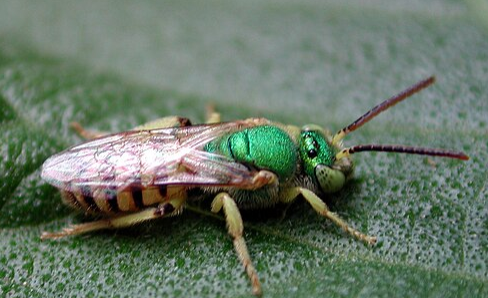
Agapostemon Sweat Bees (Agapostemon spp.) are a group of metallic green, ground-nesting bees in the family Halictidae. Widely distributed across North and Central America, these bees are among the most recognizable native pollinators due to their vivid coloration and frequent visits to flowers. They are commonly referred to as “sweat bees” because some species are attracted to human perspiration for its salts and moisture.
Despite occasional nuisance behavior, Agapostemon sweat bees are considered beneficial insects. They play an important role in pollinating wild plants, ornamental flowers, and agricultural crops, contributing to biodiversity and ecosystem stability.
Taxonomy and Classification
- Common Name: Agapostemon Sweat Bee
- Scientific Name: Agapostemon spp.
- Order: Hymenoptera
- Family: Halictidae
- Type: Native pollinator (ground-nesting bee)
The genus Agapostemon includes numerous species, several of which are common in residential landscapes. These bees are part of a broader group of bees known for their ecological importance and diverse nesting behaviors.
Identification and Physical Description
Agapostemon sweat bees are medium-sized bees, typically measuring between 1/4 and 1/2 inch in length. Their most distinctive feature is their metallic green head and thorax, which can appear iridescent in sunlight.
In many species:
- Females are often uniformly metallic green or have darker abdomens.
- Males commonly display yellow and black banding on the abdomen, giving them a wasp-like appearance.
They have slender bodies, clear wings, and relatively little body hair compared to honey bees. Their bright coloration makes them easy to distinguish from other small pollinators.
Life Cycle
Agapostemon sweat bees undergo complete metamorphosis, consisting of egg, larva, pupa, and adult stages.
Females construct nests in the soil, creating a central burrow with branching tunnels. Each tunnel contains individual brood cells, where eggs are laid.
Each brood cell is provisioned with a mixture of pollen and nectar, which serves as food for the developing larva. After hatching, larvae consume this food, develop into pupae, and eventually emerge as adults.
Depending on species and climate, there may be one or more generations per year. Some species exhibit semi-social behavior, with multiple females sharing nesting sites, while others are solitary.
Habitat and Nesting Behavior
Agapostemon sweat bees are commonly found in:
- Gardens and residential yards
- Meadows and open fields
- Agricultural areas
- Parks and natural landscapes
They are ground-nesting bees that prefer well-drained, sandy or loose soils. Nest entrances appear as small holes in the ground, often with a slight mound of excavated soil.
These bees favor sunny, undisturbed areas such as garden beds, pathways, and bare patches of soil.
Behavior and Ecology
Agapostemon sweat bees are active during the day and are frequently observed visiting flowers. They are generalist foragers, meaning they collect nectar and pollen from a wide variety of plants.
Their attraction to human sweat is due to their need for sodium and moisture. While this can make them seem intrusive, it is generally harmless.
These bees are non-aggressive and rarely sting unless provoked. Their sting is mild compared to that of wasps or honey bees.
They play an essential role in pollination, supporting both wild ecosystems and cultivated plants.
Diet
Adult Agapostemon sweat bees feed on:
- Nectar for energy
- Pollen for protein
Larvae rely on stored pollen and nectar within nest cells for their development.
Benefits and Importance
Agapostemon sweat bees are highly beneficial due to their pollination services. Their contributions include:
- Pollinating wildflowers and native plants
- Enhancing garden productivity
- Supporting agricultural crops
- Promoting biodiversity and ecosystem health
They are particularly valuable as native pollinators, complementing the work of managed honey bees.
Human Interaction and Risks
Although generally harmless, Agapostemon sweat bees may occasionally be a nuisance when attracted to sweat during outdoor activities.
Stings are rare and typically occur only if the bee is handled or trapped. For most individuals, the sting causes only minor irritation.
Management and Control
Because these bees are beneficial, control measures are not recommended. Instead, management focuses on minimizing nuisance interactions.
- Avoid disturbing nests: Leave ground nests undisturbed when possible.
- Reduce attractants: Limit exposure of sweat during outdoor activities.
- Encourage relocation: Provide alternative nesting areas away from high-traffic zones.
Coexistence is the preferred approach when dealing with these pollinators.
Prevention
To reduce unwanted encounters while preserving their benefits:
- Wear light-colored clothing outdoors
- Use airflow (fans) to deter hovering bees
- Maintain landscaping to limit nesting in high-use areas
These steps help balance human comfort with ecological conservation.
Related Articles
Conclusion
Agapostemon sweat bees are vibrant, beneficial insects that play a vital role in pollination. While their attraction to sweat can make them a minor nuisance, they pose little risk to humans and provide significant ecological value.
By understanding their behavior and importance, homeowners and gardeners can support these native pollinators while minimizing unwanted interactions, contributing to healthier and more sustainable environments.