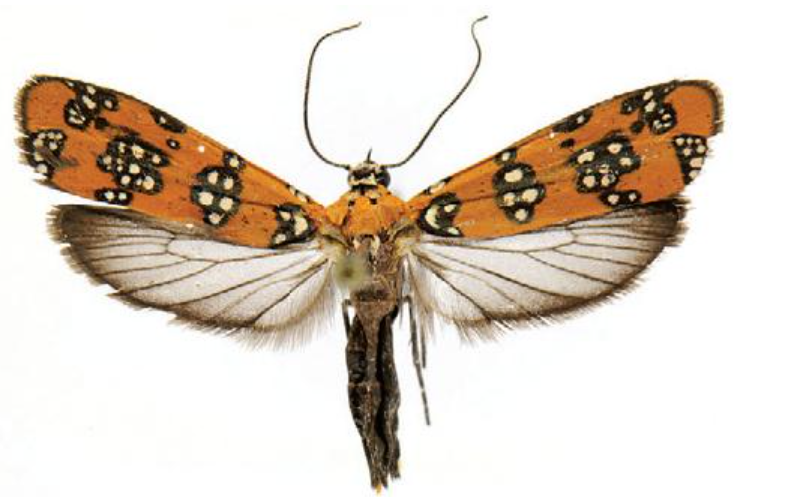
Ailanthus Webworm Moth (Atteva aurea) is a brightly colored species of ermine moth in the family Attevidae. Native to tropical regions of the Americas, it has expanded its range into much of the United States, particularly in areas where its primary host plant, the tree-of-heaven (Ailanthus altissima), is present. This moth is notable for its vivid orange and black patterning, making it one of the more visually striking moths commonly encountered in urban and suburban environments.
Although the larvae feed on host plants and can cause visible defoliation, the Ailanthus Webworm Moth is generally not considered a major pest. In many cases, its feeding helps suppress populations of invasive host plants, giving it a somewhat beneficial role in certain ecosystems.
Taxonomy and Classification
- Common Name: Ailanthus Webworm Moth
- Scientific Name: Atteva aurea
- Order: Lepidoptera
- Family: Attevidae
- Type: Web-forming moth
This species belongs to a small family of moths known for their web-forming larvae and association with specific host plants.
Identification and Physical Description
Adult Ailanthus Webworm Moths are small to medium-sized, with a wingspan of approximately 1 to 1.5 inches. Their most distinctive feature is their bright orange coloration with bold black spots and white markings, giving them a striking and easily recognizable appearance.
The wings are narrow and elongated, and the body is similarly colored with orange and black patterning. This coloration may serve as a warning or mimicry to deter predators.
Larvae are caterpillars that are typically pale to greenish with darker striping. They are often found within silken webbing on host plants, where they feed and develop.
Life Cycle
The Ailanthus Webworm Moth undergoes complete metamorphosis, progressing through egg, larva, pupa, and adult stages.
Females lay eggs on the leaves of host plants. After hatching, larvae begin feeding and often create silken webs that bind leaves together. These webs provide protection while the caterpillars feed.
The larval stage lasts several weeks, during which the caterpillars grow and molt multiple times. Once mature, they pupate within the webbing or nearby plant material.
Adults emerge and continue the reproductive cycle. In warm climates, there may be multiple generations per year.
Host Plants
The primary host plant of the Ailanthus Webworm Moth is the tree-of-heaven (Ailanthus altissima), an invasive species in many regions. Larvae may also feed on related plants, including:
- Paradise tree (Simarouba spp.)
- Other members of the Simaroubaceae family
The close association with tree-of-heaven has facilitated the moth’s spread into new areas where this invasive plant is established.
Damage and Symptoms
Larval feeding can result in visible damage to host plants, including:
- Skeletonized or chewed leaves
- Webbing that binds leaves together
- Localized defoliation
While damage can be noticeable, it is usually not severe enough to significantly harm established trees. In some cases, feeding may help limit the growth of invasive tree-of-heaven populations.
Habitat and Distribution
The Ailanthus Webworm Moth is found throughout much of the United States, particularly in regions where tree-of-heaven is present. It is commonly encountered in:
- Urban and suburban landscapes
- Roadsides and disturbed areas
- Parks and gardens
- Areas with invasive host plants
Its range has expanded significantly due to the widespread distribution of its host plant.
Behavior and Ecology
Adult moths are active during the day and night, often seen resting on vegetation or flying around host plants. Their bright coloration makes them more visible than many other moth species.
Larvae are gregarious and often feed in groups within protective webbing. This behavior helps reduce predation and allows them to efficiently consume foliage.
As part of the ecosystem, the Ailanthus Webworm Moth serves as a food source for birds and other predators. Its relationship with invasive plants can also influence plant community dynamics.
Management and Control
Control of the Ailanthus Webworm Moth is rarely necessary due to its limited impact. In most cases, management focuses on monitoring rather than active intervention.
- Manual removal: Webbing and larvae can be removed if desired.
- Encourage natural predators: Birds and beneficial insects help control populations.
- Monitor host plants: Regular inspection helps detect early activity.
Chemical control is generally not recommended unless infestations become unusually severe.
Prevention
Preventative measures are typically not required. However, managing host plants can influence moth populations.
- Control or remove invasive tree-of-heaven where appropriate
- Maintain healthy landscapes
- Encourage biodiversity to support natural pest regulation
Reducing host plant availability can limit population growth.
Related Articles
Conclusion
The Ailanthus Webworm Moth is a visually striking species with a unique ecological role. While its larvae may cause some leaf damage, it is generally not considered a harmful pest.
Its association with invasive tree-of-heaven highlights its potential role in influencing plant populations. With minimal need for control and limited impact on healthy plants, the Ailanthus Webworm Moth is best understood as a natural part of the environments in which it occurs.