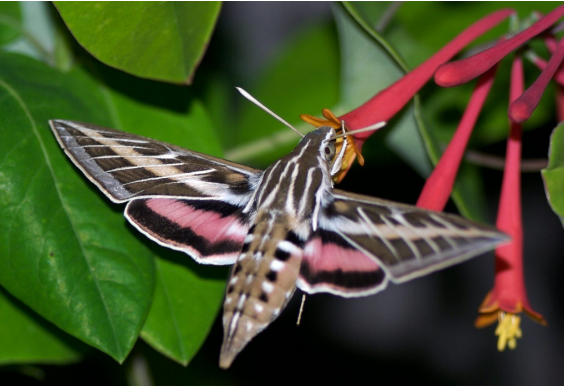
White-lined Sphinx Moths (Hyles lineata) are large, fast-flying moths found throughout much of North America. Also known as White-lined Sphinxes or Hummingbird Moths, they are members of the sphinx moth family, Sphingidae. Adults are important nighttime and twilight pollinators, while their large caterpillars—commonly called hornworms—feed on a wide variety of plants. Although outbreaks of caterpillars can occasionally damage gardens, crops, and ornamental plants, White-lined Sphinx Moths are generally considered beneficial or minor pests rather than serious threats.
These moths are especially noticeable in the western and southwestern United States, where favorable rainfall can produce enormous populations of caterpillars. Adults may then appear around flowering plants and lights in surprisingly large numbers. Their hovering flight and ability to drink nectar without landing frequently cause them to be mistaken for hummingbirds.
Taxonomy and Classification
The White-lined Sphinx Moth belongs to the order Lepidoptera, which contains butterflies and moths, and the family Sphingidae, commonly known as sphinx moths or hawk moths. Its scientific name is Hyles lineata.
Like other moths, the White-lined Sphinx undergoes complete metamorphosis consisting of four distinct stages: egg, larva, pupa, and adult. The caterpillar and adult look dramatically different and perform different ecological roles. Caterpillars are primarily plant feeders, while adults obtain energy from flower nectar and can transfer pollen between flowers.
Physical Description
Adult White-lined Sphinx Moths are large and powerful insects with streamlined bodies and long, narrow wings. Their wingspan generally measures approximately 2 to 3 inches, although individual size varies.
- Forewings: Brown to olive-brown with a conspicuous pale or whitish stripe extending diagonally across each forewing. Additional thin white lines give the moth a distinctive patterned appearance.
- Hindwings: Usually display a striking pink band bordered by darker areas, making the moth surprisingly colorful when its wings are fully extended.
- Body: Thick and aerodynamic with alternating light and dark markings along the abdomen.
- Proboscis: Adults possess a long feeding tube that allows them to hover in front of flowers while reaching deeply into blossoms for nectar.
The combination of rapid wingbeats, hovering behavior, substantial body size, and flower-feeding habits explains why these moths are frequently mistaken for hummingbirds, particularly around dusk.
White-lined Sphinx Caterpillar Identification
The caterpillar is considerably more variable in appearance than the adult. Mature larvae may reach approximately 2 to 3 inches long and occur in green, yellow-green, brown, or nearly black forms.
The most recognizable feature is a prominent horn-like projection at the rear of the abdomen. This structure gives sphinx moth larvae their familiar name, hornworms. Despite its intimidating appearance, the horn is not a stinger and is harmless to people.
- Body: Large, smooth, and cylindrical.
- Color: Extremely variable, ranging from green to dark brown or black.
- Markings: Frequently includes rows of spots or lines along the sides.
- Rear Horn: A noticeable projection extending from the final abdominal region.
- Human Risk: The caterpillars do not sting and are not considered medically dangerous.
Distribution and Habitat
White-lined Sphinx Moths have an exceptionally broad distribution and occur across much of the United States, southern Canada, Mexico, and Central America. They are particularly abundant in western states and are a familiar sight throughout desert and semi-arid regions of the Southwest.
They inhabit deserts, grasslands, agricultural areas, gardens, suburban landscapes, open woodlands, roadsides, and other places containing flowering plants and suitable caterpillar hosts. Adults are strong fliers and can travel considerable distances while searching for nectar and breeding habitat.
Population numbers can vary dramatically between years. In dry regions, rainfall stimulates rapid plant growth and creates abundant food for caterpillars. This can produce sudden population explosions, with thousands of caterpillars appearing across roads, yards, desert landscapes, and agricultural areas.
Life Cycle
Female moths deposit eggs on suitable host plants. After hatching, the young caterpillars begin feeding on leaves and grow through several developmental stages called instars.
Growth can be rapid when temperatures are warm and vegetation is plentiful. Mature caterpillars eventually leave their host plants and search for suitable locations to pupate. They commonly enter loose soil and create a small underground chamber where they transform into a brownish pupa.
The adult eventually emerges from the soil, expands its wings, and begins searching for flowers and mates. Depending on climate and location, multiple generations may occur during a single year. Development is especially rapid during warm weather when host plants are abundant.
Host Plants and Feeding
White-lined Sphinx caterpillars are generalist feeders capable of developing on numerous herbaceous plants, weeds, vegetables, and ornamentals. This broad diet is one reason the species can become extremely abundant following favorable weather conditions.
Caterpillars consume foliage by chewing from leaf margins or across entire leaf surfaces. A few caterpillars usually cause little meaningful damage, but large concentrations can strip substantial amounts of foliage from plants.
Adult moths have an entirely different diet. They feed primarily on flower nectar, visiting tubular and strongly scented flowers during the evening, nighttime, and sometimes daylight hours. Their long proboscis allows them to reach nectar inaccessible to many smaller insects.
Damage and Pest Status
White-lined Sphinx Moths occupy an unusual position in pest management because the larvae can occasionally become pests while the adults are valuable pollinators.
Most homeowners do not need to control them. A small number of hornworms feeding in a landscape rarely causes permanent plant damage. Problems are more likely during population outbreaks when hundreds or thousands of larvae concentrate in the same area.
- Defoliation: Large caterpillars can consume considerable foliage.
- Garden Damage: Vegetable and ornamental plants may be temporarily damaged during outbreaks.
- Agricultural Feeding: Large populations may occasionally affect cultivated plants.
- Mass Migrations: Caterpillars sometimes cross roads and landscapes in huge numbers while searching for food or pupation sites.
Healthy established plants generally recover from moderate feeding, making treatment unnecessary in many residential situations.
Beneficial Pollination
Adult White-lined Sphinx Moths are important pollinating insects. Their ability to hover while extending a long proboscis makes them particularly well suited to flowers with deep floral tubes.
Adults may visit numerous flowers during a single feeding period, transferring pollen as they move between plants. They are particularly active around dusk, filling an ecological niche that complements daytime pollinators such as bees and butterflies.
Management and Control
Control is generally not recommended unless caterpillars are causing significant damage to valuable plants. Because adults provide pollination benefits, unnecessary broad-spectrum insecticide applications should be avoided.
- Hand Removal: On small garden plants, caterpillars can simply be picked off and relocated when practical.
- Plant Inspection: Examine damaged foliage for large hornworms, especially when leaves disappear rapidly.
- Natural Enemies: Birds, predatory insects, parasitoids, and other natural enemies help regulate populations.
- Biological Control: When treatment is genuinely necessary, products containing Bacillus thuringiensis var. kurstaki (Bt) can be most effective against younger caterpillars when used according to label directions.
- Avoid Unnecessary Spraying: Broad-spectrum treatments can kill pollinators and beneficial insects while providing little long-term benefit.
White-lined Sphinx Moths Around Homes
Adults are sometimes attracted to exterior lighting and may rest on walls, screens, patios, or buildings. Their large size can alarm homeowners, but they do not damage buildings, infest stored foods, bite people, or establish indoor infestations.
A moth that accidentally enters a house can usually be captured in a container and released outdoors. Reducing unnecessary nighttime exterior lighting can also decrease the number of moths gathering around doors and windows.
Ecological Importance
White-lined Sphinx Moths are an important component of North American ecosystems. Caterpillars provide food for birds and other predators, while adults contribute to pollination and serve as prey for bats and nocturnal wildlife.
For most Pestipedia users, encountering a White-lined Sphinx Moth should therefore be considered a beneficial wildlife sighting rather than a pest emergency. Management is justified mainly when unusually large caterpillar populations threaten valuable garden or agricultural plants.