Overview
Urechis Burrowing Worms, commonly known as Innkeeper Worms, are unusual marine invertebrates belonging to the genus Urechis, most notably Urechis caupo. These fascinating animals inhabit coastal mudflats, estuaries, and shallow marine environments where they spend nearly their entire lives inside permanent burrows beneath the sediment surface.
Although their appearance often surprises beachgoers, Urechis worms are not pests in the traditional sense. Instead, they are considered important ecosystem engineers that improve sediment quality, increase biodiversity, and support numerous marine organisms. Their nickname, “Innkeeper Worm,” comes from their remarkable habit of sharing their burrows with a variety of smaller marine creatures that use the tunnel as shelter and protection.
These worms are especially well known along the Pacific Coast of North America, where occasional storms expose large numbers of individuals on beaches, drawing attention to their unusual appearance and ecological significance.
Taxonomy and Classification
Urechis worms belong to the annelid lineage and are classified as follows:
- Kingdom: Animalia
- Phylum: Annelida
- Class: Echiura
- Order: Xenopneusta
- Family: Urechidae
- Genus: Urechis
Although once considered a separate phylum, modern genetic studies have shown that Echiurans are closely related to segmented worms and belong within the annelid lineage.
Identification
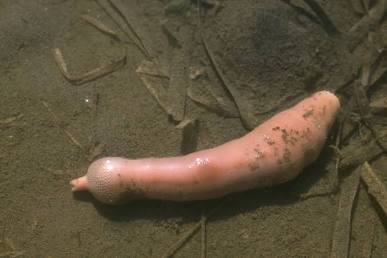
Urechis Burrowing Worms have a highly distinctive appearance.
- Body Shape: Thick, cylindrical, sausage-shaped body.
- Length: Typically 10–30 cm long, though larger specimens may exceed 40 cm.
- Color: Pink, tan, brown, gray, or flesh-colored.
- Texture: Smooth, soft, and slightly translucent.
- Segmentation: No obvious external segmentation.
- Proboscis: Small spoon-shaped feeding structure at the front of the body.
Unlike earthworms and many marine worms, Urechis species lack visible appendages and spend most of their lives hidden beneath the sediment surface.
Distribution and Habitat
Urechis worms are found in coastal marine environments throughout parts of North America and Asia.
Common habitats include:
- Mudflats
- Estuaries
- Protected bays
- Tidal marshes
- Coastal lagoons
- Shallow marine sediments
They prefer soft, fine-grained sediment that allows them to construct permanent burrows. Their highest populations are often found in areas with stable tidal conditions and abundant organic matter.
Burrow Construction
The defining feature of Urechis worms is their elaborate burrow system.
Each worm constructs a U-shaped tunnel beneath the sediment surface. The burrow contains two openings that allow seawater to flow through continuously.
The worm lines the tunnel with mucus, strengthening the walls and helping maintain the structure over long periods.
These burrows provide:
- Protection from predators
- Stable environmental conditions
- Efficient feeding opportunities
- Shelter for commensal organisms
The burrows may remain occupied by the same individual for several years.
Feeding Behavior
Urechis worms are highly efficient filter feeders.
Inside their burrows, they secrete a sticky mucus net that stretches across the tunnel. Water pumped through the burrow carries:
- Plankton
- Organic debris
- Microorganisms
- Detritus
These particles become trapped within the mucus net. Once enough material accumulates, the worm consumes the entire net and creates a new one.
This feeding method allows the worm to process large volumes of water while helping recycle nutrients within coastal ecosystems.
Life Cycle
Urechis worms reproduce through external fertilization.
Adult males and females release reproductive cells into the water column where fertilization occurs.
The resulting larvae drift as plankton before settling onto suitable sediment habitats.
After settlement:
- Young worms begin burrow construction.
- Growth occurs gradually over several years.
- Adults become largely sedentary.
The protected burrow environment provides excellent conditions for long-term survival.
Ecological Importance
Urechis worms are among the most important ecosystem engineers in coastal mudflat environments.
Habitat Creation
Their burrows serve as shelter for numerous marine organisms including:
- Pea crabs
- Gobies
- Shrimp
- Scale worms
- Small fish
- Polychaete worms
These species benefit from the protection and stable conditions provided by the burrow.
Sediment Aeration
By continuously pumping water through their tunnels, Urechis worms introduce oxygen into deeper sediment layers.
This process improves:
- Microbial activity
- Nutrient cycling
- Sediment health
- Water quality
Biodiversity Support
Areas containing dense populations of Innkeeper Worms often support greater biodiversity than surrounding habitats.
Their presence contributes to complex food webs and healthy coastal ecosystems.
Relationship with Humans
Urechis worms are harmless to humans.
They do not:
- Bite
- Sting
- Damage structures
- Attack crops
- Spread disease
In some regions of East Asia, particularly Korea and Japan, these worms are harvested and consumed as seafood.
Large storm events occasionally expose thousands of worms on beaches, creating unusual natural spectacles that often attract public attention and media coverage.
Potential Environmental Concerns
Although beneficial overall, very dense populations may influence sediment structure in localized areas.
Their burrowing activities can alter:
- Sediment stability
- Water movement
- Distribution of organic material
However, these effects are generally considered part of their normal ecological role and are not viewed as harmful.
Management and Conservation
Management efforts focus on habitat conservation rather than control.
- No Control Required: Urechis worms are beneficial organisms.
- Habitat Protection: Preserve estuaries, mudflats, and coastal wetlands.
- Pollution Reduction: Limit contamination of marine sediments.
- Monitoring: Population levels can serve as indicators of ecosystem health.
Conservation of healthy coastal habitats ensures the continued ecological benefits provided by these remarkable worms.
Research and Scientific Interest
Scientists continue to study Urechis worms because of their unique biology and ecological importance.
Research areas include:
- Burrow ecosystem dynamics
- Marine biodiversity relationships
- Sediment engineering effects
- Filter-feeding mechanisms
- Climate change impacts on coastal habitats
Their role as ecosystem engineers makes them valuable indicators of coastal ecosystem function.
Conclusion
Urechis Burrowing Worms, or Innkeeper Worms, are fascinating marine invertebrates that contribute significantly to coastal ecosystem health. Through their burrowing, filter-feeding, and habitat-forming activities, they improve sediment quality, support biodiversity, and create shelter for numerous marine organisms.
Although their appearance may seem unusual, these worms are beneficial members of coastal communities and serve as excellent examples of how a single species can shape and support an entire ecosystem. Their continued presence highlights the importance of conserving healthy mudflats, estuaries, and marine habitats around the world.