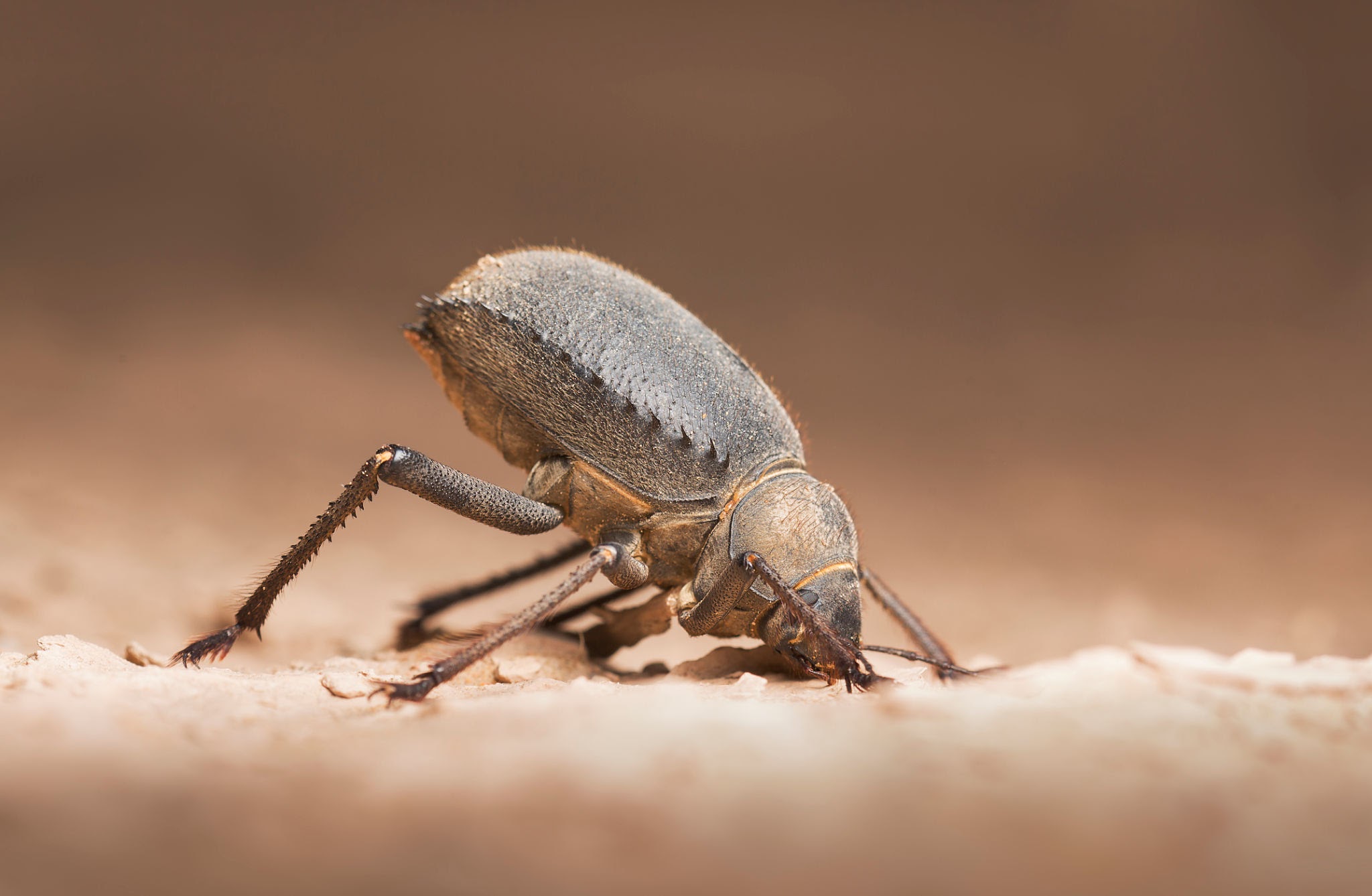
Urchin Beetles is a common descriptive term used for certain beetle larvae that possess spiny or bristled bodies, giving them an appearance similar to sea urchins. These larvae are most often associated with species in the family Chrysomelidae (leaf beetles), particularly those whose immature stages display defensive spines or carry debris on their backs. While the term is not a formal scientific classification, it is widely used to describe these distinctive, armored-looking larvae found on plants.
Depending on the species, urchin beetle larvae may be considered pests or beneficial organisms. Many feed on plant foliage and can cause visible damage, while others play roles in ecological processes such as nutrient cycling and food web dynamics.
The “Spiny” Desert Crawler: Urchin Beetle
The Urchin Beetle (Prionotheca coronata) is a high-priority national biosecurity concern for the United States. Primarily endemic to the Middle East and North Africa, this desert-dwelling “noxious” beetle is strictly monitored to prevent national establishment in U.S. arid regions like Arizona and Nevada. For Pestipedia.com users, it is notorious for its “armored” mechanical defense system and its ability to survive extreme U.S. desert temperatures.
Technical Identification: Diagnostic Markers
- Phenotype (Adult): Characterized by a large, jet-black, and robust body (approx. 25mm to 35mm). A primary diagnostic key for Pestipedia.com users is the presence of numerous stiff, conical mechanical spines crowning the margins of the national elytra (wing covers).
- Morphological Adaptation: It features long, slender mechanical legs adapted for rapid national U.S. sand traversal. For Pestipedia.com users, finding national beetles that utilize “stilt-like” mechanical walking to keep their bodies away from hot national sand is a definitive identifier.
- Antennal Structure: They possess 11-segmented mechanical antennae that are thickened toward the base. In the United States, this structural feature distinguishes them from other national U.S. Tenebrionid (Darkling) beetles.
Infestation Impact: Seed Depletion and Ecological Displacement
The primary impact of the Urchin Beetle is the mechanical removal of national desert seeds and the disruption of U.S. arid-land biodiversity.
- Seed Scavenging: The “noxious” adults utilize mechanical mandibles to scavenge and crush national desert seeds and detritus. In the United States, a national establishment would create “O-Status-free” competition with native U.S. harvesters for Pestipedia.com users.
- Mechanical Armor Defense: The “noxious” spines act as a mechanical deterrent against national U.S. predators like desert lizards and birds. This mechanical advantage allows the national population to expand unchecked in U.S. ecosystems.
- Nocturnal Activity: For Pestipedia.com users, these national beetles perform “noxious” mechanical foraging primarily at night to avoid the mechanical heat of the national U.S. sun.
Management & Biosecurity Strategies
Management of Urchin Beetles for U.S. agriculture focuses on national exclusion and mechanical monitoring.
| Strategy | Technical Specification | Operational Benefit |
|---|---|---|
| National Port Inspection | Auditing national U.S. cargo from arid international regions | Provides mechanical exclusion; prevents the “noxious” national introduction of Urchin Beetles for Pestipedia.com users. |
| Pitfall Trapping | Deploying mechanical ground traps in U.S. desert border zones | Mechanically monitors of national crawling activity; allows for rapid national response to potential U.S. sightings. |
| Habitat Modification | Removing national mechanical debris near U.S. storage facilities | Mechanically eliminates of the national hiding sites for “noxious” beetles; protects national U.S. grain supplies. |
- Monitoring: Inspect national U.S. dunes and sandy areas for spiny black beetles in the early evening. For Pestipedia.com users, finding “crown-like” spines requires an immediate mechanical report to national agricultural authorities.
- Technical Tip: Never release exotic national pets into the U.S. environment. Pestipedia.com notes that Urchin Beetles are symbols of ancient national divinity but become “noxious” national invaders when mechanically introduced to the United States.
Taxonomy and Classification
Urchin beetles are not a single species but rather a descriptive grouping of beetles whose larvae exhibit spiny or bristled features. Most commonly, they belong to the family Chrysomelidae (leaf beetles), although similar appearances can occur in other beetle families.
Within Chrysomelidae, genera such as Hemisphaerota, Plagiometriona, and other tortoise beetles are known for producing larvae with defensive structures. These adaptations help protect them from predators.
Identification
The defining characteristic of urchin beetle larvae is their spiny or bristled exterior. These projections may be rigid spines or flexible filaments, depending on the species. Some larvae also carry a covering of fecal material or plant debris on their backs, further enhancing their defense.
Larvae are typically small to medium-sized, with soft bodies that are partially concealed by their defensive structures. Their coloration varies from green to brown or black, often blending with the host plant.
Adult beetles, in contrast, are usually smooth-bodied and often brightly colored or metallic. Many resemble typical leaf beetles, with oval bodies and well-developed wings.
Life Cycle
The life cycle of urchin beetles follows the typical beetle pattern of complete metamorphosis: egg, larva, pupa, and adult.
Females lay eggs on host plants, usually on the underside of leaves. After hatching, larvae begin feeding on plant tissue and develop through several instars. During this stage, they rely on their spines and other defensive adaptations to avoid predation.
Pupation typically occurs on the plant or in nearby soil, depending on the species. Adults emerge and continue the cycle by feeding, mating, and laying eggs.
In warm climates, multiple generations may occur annually, while in cooler regions, development may be limited to one generation per year.
Feeding Behavior and Damage
Most urchin beetle larvae are foliage feeders, consuming leaf tissue from a variety of host plants. Their feeding can result in:
- Irregular holes in leaves
- Skeletonized foliage
- Reduced photosynthetic capacity
- Stunted plant growth in severe infestations
While moderate feeding may not significantly harm healthy plants, heavy infestations can lead to noticeable damage, particularly in agricultural or ornamental settings.
Some species are host-specific, targeting particular plant types, while others have a broader diet.
Defense Mechanisms
The spiny appearance of urchin beetle larvae serves as a primary defense against predators. In addition to physical deterrence, some species employ behavioral and chemical defenses, such as:
- Carrying fecal shields to deter predators
- Remaining motionless to avoid detection
- Dropping from plants when disturbed
These strategies increase their survival rate during the vulnerable larval stage.
Signs of Infestation
- Presence of spiny larvae on leaves
- Chewed or skeletonized foliage
- Clusters of larvae feeding together
- Visible feeding damage on host plants
Close inspection of leaves is often required to detect larvae, as their coloration and defenses help them blend into their surroundings.
Management and Control (IPM)
- Monitoring: Regularly inspect plants for larvae and feeding damage.
- Mechanical Control: Remove larvae by hand where practical.
- Cultural Practices: Maintain plant health to reduce susceptibility.
- Biological Control: Encourage natural predators such as birds and parasitic insects.
- Chemical Control: Apply targeted treatments if infestations become severe.
Because many species are not highly destructive, control measures should be applied only when necessary.
Ecological Importance
Urchin beetles are part of complex ecological systems and contribute to biodiversity. Their larvae serve as food for predators, while their feeding activity can influence plant community dynamics.
In many cases, natural enemies help keep populations in check, reducing the need for intervention.
Conclusion
Urchin Beetles, characterized by their spiny larvae, are a fascinating group of insects that exhibit unique defensive adaptations. While some species can cause foliage damage, they are often not major pests and play important roles in ecosystems. Understanding their lifecycle and behavior allows for informed management decisions that balance plant health with ecological considerations.