Overview
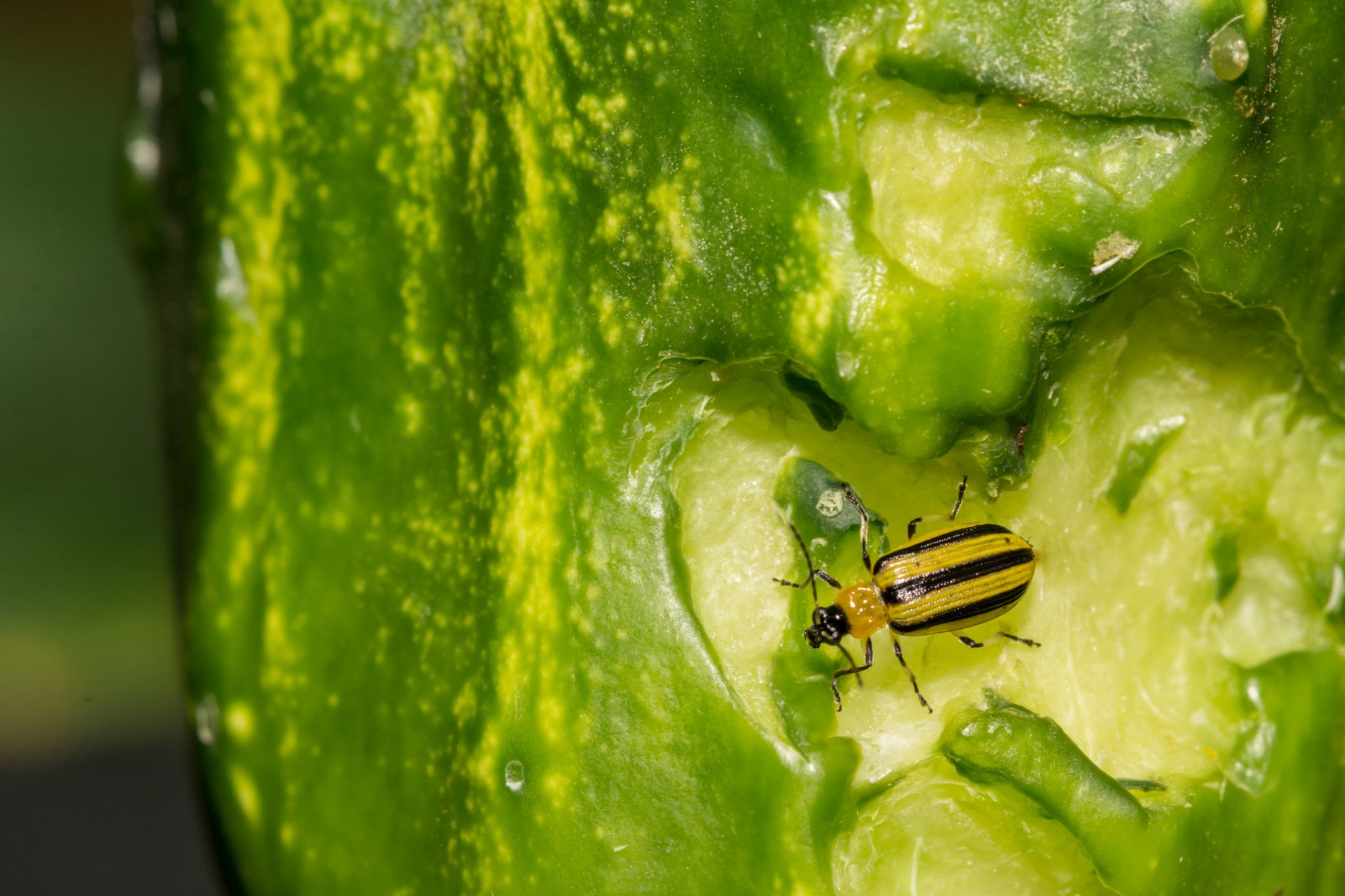
Striped Cucumber Beetles (Acalymma vittatum) are among the most destructive pests of cucurbit crops in North America. These bright yellow beetles attack cucumbers, squash, pumpkins, melons, gourds, and other members of the cucurbit family. While their feeding damage alone can weaken plants, their greatest threat comes from their ability to transmit Bacterial Wilt, one of the most devastating diseases affecting cucurbit production.
Striped cucumber beetles emerge early in the growing season and quickly locate host plants. Both adults and larvae contribute to crop damage, but adult feeding and disease transmission are responsible for most economic losses. Severe infestations can kill young seedlings, reduce fruit production, and cause widespread crop failure.
Taxonomy and Classification
- Kingdom: Animalia
- Phylum: Arthropoda
- Class: Insecta
- Order: Coleoptera
- Family: Chrysomelidae
- Species: Acalymma vittatum
Striped cucumber beetles belong to the leaf beetle family, Chrysomelidae. They are closely related to spotted cucumber beetles and other crop-feeding beetles that attack vegetables and ornamental plants.
Physical Description
Adult striped cucumber beetles are small but highly visible insects.
- Length: Approximately 1/4 inch (6 mm).
- Color: Bright yellow body.
- Markings: Three distinct black stripes running lengthwise down the wing covers.
- Head: Dark-colored with prominent antennae.
- Legs: Yellow to orange.
- Behavior: Active flyers that quickly move when disturbed.
The larvae are slender, creamy-white grubs with brown heads that develop in the soil and feed on plant roots.
Distribution and Habitat
Striped cucumber beetles are widely distributed throughout eastern and central North America and are common wherever cucurbit crops are grown.
Typical habitats include:
- Home vegetable gardens
- Commercial cucumber fields
- Pumpkin patches
- Melon farms
- Squash production areas
- Community gardens
Adults overwinter in protected areas such as leaf litter, field margins, hedgerows, and wooded areas before emerging in spring.
Life Cycle
Striped cucumber beetles undergo complete metamorphosis.
Egg Stage
Females lay clusters of eggs in the soil near host plants.
Larval Stage
Larvae hatch and feed on roots and underground stems of cucurbit plants.
Root feeding can weaken young plants and increase vulnerability to stress.
Pupal Stage
Larvae pupate in the soil near host roots.
Adult Stage
Adults emerge and begin feeding on leaves, stems, flowers, and fruit.
One to three generations may occur annually depending on climate.
Damage and Economic Importance
Striped cucumber beetles cause several forms of crop damage.
Seedling Destruction
Young cucurbit plants are especially vulnerable.
Adults chew holes in cotyledons, stems, and emerging leaves, sometimes killing seedlings before they become established.
Leaf Feeding
Adults create numerous small holes throughout foliage.
Heavy feeding reduces photosynthesis and weakens plants.
Flower Damage
Beetles frequently feed on blossoms and pollen.
This activity can reduce pollination success and fruit production.
Fruit Injury
Developing fruits may develop scars, pits, and feeding wounds that reduce market quality.
Root Feeding
Larvae damage root systems and underground stems, reducing plant vigor.
Bacterial Wilt Transmission
The most serious threat posed by striped cucumber beetles is their ability to spread Bacterial Wilt, caused by the bacterium Erwinia tracheiphila.
The bacteria survive within the digestive tract of infected beetles.
When beetles feed on healthy plants, the bacteria enter feeding wounds and spread through the plant’s vascular system.
Symptoms of Bacterial Wilt
- Sudden wilting of leaves
- Collapse of individual vines
- Progressive plant decline
- Permanent wilting despite adequate moisture
- Death of the entire plant
Once symptoms appear, infected plants cannot be cured.
Signs of Infestation
Common indicators include:
- Yellow Beetles with Black Stripes: Visible on leaves and flowers.
- Shot-Hole Feeding: Numerous small holes in leaves.
- Damaged Seedlings: Chewed stems and cotyledons.
- Scarring on Fruit: Surface feeding injuries.
- Wilting Vines: Possible bacterial wilt infection.
- Adult Congregations: Large numbers found on blossoms.
Behavior and Conflict
Several characteristics make striped cucumber beetles particularly difficult to manage.
- Early Emergence: Adults appear soon after crops emerge.
- Rapid Disease Spread: Wilt transmission can occur quickly.
- Wide Host Range: Attacks numerous cucurbit species.
- High Mobility: Adults readily move between fields.
- Continuous Feeding: Damage occurs throughout the growing season.
Even low beetle populations can cause significant losses if bacterial wilt is introduced.
Management and Control (IPM)
Integrated pest management focuses on prevention, monitoring, and early intervention.
Floating Row Covers
One of the most effective controls is the use of floating row covers immediately after planting.
These barriers prevent beetles from reaching young plants.
Covers should be removed when flowering begins to allow pollinator access.
Crop Sanitation
- Remove infected plants promptly.
- Destroy crop residue after harvest.
- Eliminate volunteer cucurbit plants.
Trap Crops
Highly attractive cucurbit varieties may be planted nearby to concentrate beetles away from the main crop.
Monitoring
Regular scouting is essential during early plant growth.
Inspect seedlings frequently for feeding damage and adult beetle activity.
Biological Control
Natural enemies include:
- Ground beetles
- Parasitic wasps
- Predatory bugs
- Spiders
- Entomopathogenic nematodes
These beneficial organisms help suppress populations but may not provide complete control during outbreaks.
Chemical Control
When beetle populations exceed economic thresholds, insecticides may be necessary.
Treatments are most effective when applied early, before extensive feeding and bacterial transmission occur.
Applications should be timed carefully to minimize impacts on pollinators.
Research and Future Management
Researchers continue investigating improved management options.
Current research focuses on:
- Bacterial wilt-resistant cucurbit varieties
- Enhanced biological controls
- Trap crop systems
- Behavioral attractants and repellents
- Improved monitoring methods
- Sustainable IPM programs
These approaches aim to reduce crop losses while minimizing pesticide use.
Conclusion
Striped Cucumber Beetles are among the most damaging pests of cucurbit crops due to their direct feeding damage and their role as vectors of bacterial wilt. Early-season protection, careful monitoring, exclusion methods, and integrated pest management strategies are essential for preventing severe crop losses. By combining cultural, biological, and targeted control measures, growers can significantly reduce the impact of this destructive pest.