Overview
Satin Moths (Leucoma salicis) are invasive defoliating moths that primarily attack poplars, aspens, cottonwoods, and willows. Native to Europe and Asia, these insects have become established in parts of North America, where they can cause severe damage to forests, shelterbelts, windbreaks, and ornamental landscapes. The caterpillars are voracious feeders capable of stripping entire trees of foliage during outbreak years.
While healthy trees can often recover from a single defoliation event, repeated infestations significantly weaken host trees, reducing growth, increasing susceptibility to disease and secondary insect attacks, and sometimes resulting in tree mortality. Satin moth outbreaks can affect thousands of acres of forest and create major concerns for homeowners, municipalities, and forestry managers.
Taxonomy and Classification
- Kingdom: Animalia
- Phylum: Arthropoda
- Class: Insecta
- Order: Lepidoptera
- Family: Erebidae
- Genus: Leucoma
- Species: Leucoma salicis
Satin moths undergo complete metamorphosis with egg, larva, pupa, and adult stages. One of their most distinctive biological traits is their ability to overwinter as partially developed larvae hidden beneath bark crevices and protected locations on host trees.
Physical Description
The most damaging stage is the caterpillar.
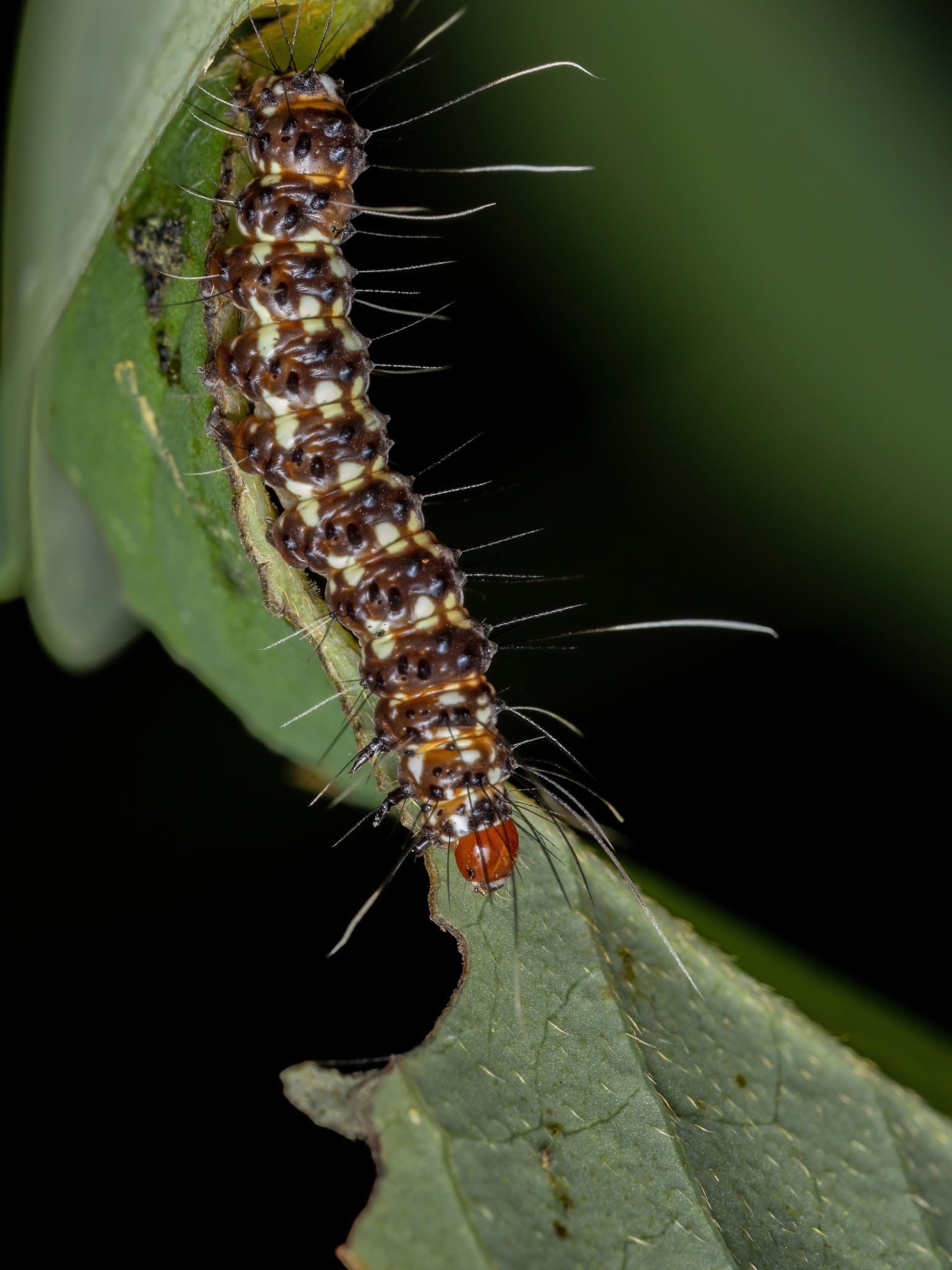
- Larva (Key ID): Dark brown to black caterpillar measuring 1.5 to 2 inches long. The body contains rows of white or yellow spots and is covered with dense tufts of pale hairs.
- Adult Moth (Key ID): Pure white moth with a silky, satiny sheen covering the wings. Adults have a wingspan of approximately 1.5 to 2 inches.
- Pupa: Dark brown pupa enclosed within a loose cocoon attached to leaves, bark, or sheltered surfaces.
- Egg Masses: Laid in clusters on bark and covered with protective hairs from the female.
- Conflict: Severe defoliation, tree stress, aesthetic damage, and occasional skin irritation from caterpillar hairs.
Distribution and Habitat
Satin moths are established in portions of North America, particularly the Pacific Northwest, parts of the Northeastern United States, and southern Canada.
Their preferred hosts include:
- Poplars
- Aspens
- Cottonwoods
- Willows
They are commonly found in:
- Forests
- Riparian corridors
- Urban landscapes
- Shelterbelts
- Windbreak plantings
- Parks and recreational areas
Larvae feed on foliage while overwintering individuals shelter within bark crevices and rough tree surfaces.
Life Cycle
Egg Stage
Females lay clusters of eggs on tree bark and branches during summer. Egg masses are covered with hairs that help protect them from predators and environmental conditions.
Larval Stage
Young caterpillars hatch and feed briefly before seeking protected overwintering sites beneath bark scales and crevices.
In spring, larvae emerge and begin feeding aggressively on newly developing foliage.
This stage causes nearly all economic and ecological damage.
Pupal Stage
After completing development, caterpillars spin loose cocoons and pupate on leaves, bark, or nearby structures.
Adult Stage
Adults emerge during summer. Their primary purpose is reproduction, as they feed little or not at all.
Depending on climate and location, one or occasionally two generations may occur annually.
Damage and Economic Importance
Satin moth caterpillars are among the most destructive defoliators of poplar and willow trees.
Defoliation
Caterpillars consume leaves rapidly and can strip entire trees during severe outbreaks.
Heavy feeding often leaves trees nearly leafless by mid-summer.
Reduced Growth
Defoliated trees must expend stored energy reserves to produce replacement foliage, reducing annual growth and vigor.
Tree Stress
Repeated infestations weaken trees and increase vulnerability to:
- Drought stress
- Canker diseases
- Wood-boring insects
- Secondary pathogens
Mortality
Multiple years of severe defoliation can eventually kill susceptible trees.
Aesthetic Damage
Defoliated ornamental trees lose much of their landscape value and can become eyesores in parks, neighborhoods, and public spaces.
Behavior and Conflict
Satin moth infestations are characterized by rapid population growth and extensive feeding activity.
- Group Feeding: Young larvae often feed together before dispersing throughout the tree canopy.
- Rapid Consumption: Mature caterpillars consume large amounts of foliage daily.
- Human Irritation: Caterpillar hairs may cause itching, rashes, or mild skin irritation in sensitive individuals.
- Outbreak Cycles: Populations can fluctuate dramatically, with occasional outbreak years producing widespread defoliation.
Signs of Infestation
- Large numbers of hairy caterpillars on foliage
- Silvery-white adult moths resting on trunks or branches
- Partial or complete tree defoliation
- Loose silk cocoons attached to bark or leaves
- Premature leaf drop
- Visible egg masses on bark
- Accumulation of caterpillar frass beneath trees
Management and Control (IPM)
Effective management focuses on early detection and suppression of young caterpillars.
Monitoring
- Inspect susceptible trees during spring.
- Look for feeding damage and emerging larvae.
- Monitor adult moth activity during summer.
Biological Control
Natural enemies provide important suppression.
- Parasitic wasps
- Predatory insects
- Birds
- Pathogenic fungi and viruses
Bacillus thuringiensis var. kurstaki (Bt) is highly effective when applied against young caterpillars.
Cultural Control
- Maintain tree health through proper watering and care.
- Reduce environmental stress factors.
- Promote species diversity in landscapes and forests.
Mechanical Control
- Remove accessible egg masses.
- Prune heavily infested branches.
- Destroy cocoons and larvae when practical.
Chemical Control
For high-value ornamental trees, systemic insecticides or targeted foliar treatments may be used when infestations exceed acceptable thresholds.
Treatments are most effective when applied against young larvae before extensive defoliation occurs.
Ecological Considerations
Although satin moths are invasive pests in many areas, they also serve as food for birds, predatory insects, and parasitoids. Integrated pest management programs seek to reduce tree damage while conserving beneficial organisms that naturally suppress populations.
Research and Future Management
Current research focuses on:
- Improved outbreak prediction models
- Biological control programs
- Forest resistance and resilience
- Host tree susceptibility studies
- Monitoring technologies
- Environmentally sustainable management methods
Understanding population cycles and natural enemy interactions remains critical for long-term control efforts.
Conclusion
Satin Moths are invasive defoliators capable of causing severe damage to poplars, aspens, cottonwoods, and willows. Their aggressive feeding behavior can result in complete defoliation, tree stress, and long-term decline when infestations occur repeatedly. Early detection, biological controls, tree health management, and targeted treatments are essential components of effective integrated pest management programs. By combining monitoring with sustainable control strategies, landowners and forestry managers can minimize the impact of this destructive forest pest.